
Vietnam pepper prices November 2026: Export Trends and Buyer Guide
Vietnam pepper prices November 2026 show differing domestic price reports and solid year-to-date exports. This buyer-focused guide explains black and white pepper grades, quality checks, export quotation terms and the documents international importers should request before placing an order.
By Dang Duc Dung·Published
In this article
Vietnam pepper prices November 2026: What do buyers need to know?
Published reports for November 17, 2026, showed different domestic pepper price ranges. The Vietnam Pepper and Spice Association (VPSA), citing VietnamBiz, reported VND 134,000–135,000/kg. The Industry and Trade Newspaper reported VND 134,500–136,000/kg. These figures represent domestic market observations, not confirmed export quotations. Buyers should always verify the reporting date, pepper specification, and commercial terms before using market prices in purchasing decisions.
Domestic pepper price references — November 17, 2026
| Reporting source | Reference price | Interpretation |
|---|---|---|
| VPSA / VietnamBiz | VND 134,000–135,000/kg | Domestic market reference |
| Industry and Trade Newspaper | VND 134,500–136,000/kg | Domestic regional price reference |
| Export supplier quotation | Varies by order | Requires direct confirmation |
Sources: VPSA and Industry and Trade Newspaper, November 17, 2026.
The difference between these reports reflects their respective observations and reporting methods. Neither range should be treated as one official national transaction price.
For international buyers, domestic purchasing prices are only a starting point. Export prices depend on processing, grading, quality requirements, packaging, order volume, logistics, and the agreed Incoterm.
Buyer takeaway: Request a current, written quotation for the exact product grade and shipment period instead of using domestic market reports as a substitute for supplier pricing.
How are Vietnam's pepper exports performing in 2026?
Vietnam's pepper exports recorded year-on-year growth during the first ten months of 2026. According to preliminary figures from VPSA reported in November, the country exported 237,706 metric tonnes worth approximately US$1.5373 billion. Export volume increased by 15.2%, while export value rose by 10.3% compared with the same period in 2025. These figures describe completed trade activity rather than current supplier inventory.
Vietnam pepper export performance — January to October 2026
| Indicator | Reported result |
|---|---|
| Export volume | 237,706 metric tonnes |
| Export value | US$1.5373 billion |
| Volume growth year-on-year | +15.2% |
| Value growth year-on-year | +10.3% |
| October export volume | 21,973 metric tonnes |
| October export value | US$143.7 million |
Source: VPSA statistics reported by the Industry and Trade Newspaper, November 17, 2026.
Which international markets are buying Vietnamese pepper?
Asia remained Vietnam's largest regional export destination during the first ten months of 2026, purchasing nearly 112,700 tonnes. The United States was the largest individual market, importing more than 56,200 tonnes, while China's purchases exceeded 28,300 tonnes.
According to Nhan Dan's November 12 report, exports to China increased by approximately 71% year-on-year. Shipments to the United States increased by about 27.1% over the same period.
These developments demonstrate the scale of Vietnam's international pepper trade. However, national export growth does not guarantee that an individual supplier can meet a particular buyer's specification, delivery schedule, or import compliance requirements.
Buyer takeaway: Use export statistics to understand market activity, then evaluate suppliers using confirmed stock availability, processing capabilities, product samples, and supporting documentation.
What factors could influence Vietnamese pepper prices?
Vietnamese pepper prices may respond to changes in harvest conditions, international demand, inventory availability, and purchasing activity. Weather-related risks in producing countries can also affect supply expectations. However, such risks do not establish the direction or timing of future prices. Importers should distinguish verified market developments from forecasts and avoid making purchasing commitments based on a single daily price movement.
The International Pepper Community's 2026 global production estimate, cited in November market reporting, was approximately 530,000 tonnes, compared with 552,635 tonnes for the previous year. These estimates may be revised.
Key factors for buyers to monitor include:
- Harvest conditions: Unfavorable weather can affect production and crop quality.
- Supplier inventory: Available stock influences shipment readiness and lead times.
- Export demand: Purchasing activity across major importing markets may affect quotation availability.
- Processing requirements: Cleaning, grading, and microbial reduction treatments can change final costs.
- Logistics and currencies: Freight charges, shipment timing, and exchange-rate movements influence landed costs.
For recurring purchases, comparing immediate-delivery and forward-delivery quotations may help buyers evaluate different supply arrangements.
Which Vietnamese pepper grades should international buyers choose?
International buyers should select pepper grades according to their intended application, not simply the highest bulk-density designation. Vietnamese black pepper is commonly offered in categories such as 500, 550, 570, and 580 grams per litre (g/L). Bulk density is useful for comparing commercial grades, but it does not independently confirm food safety, cleanliness, moisture, or suitability for a particular manufacturing process.
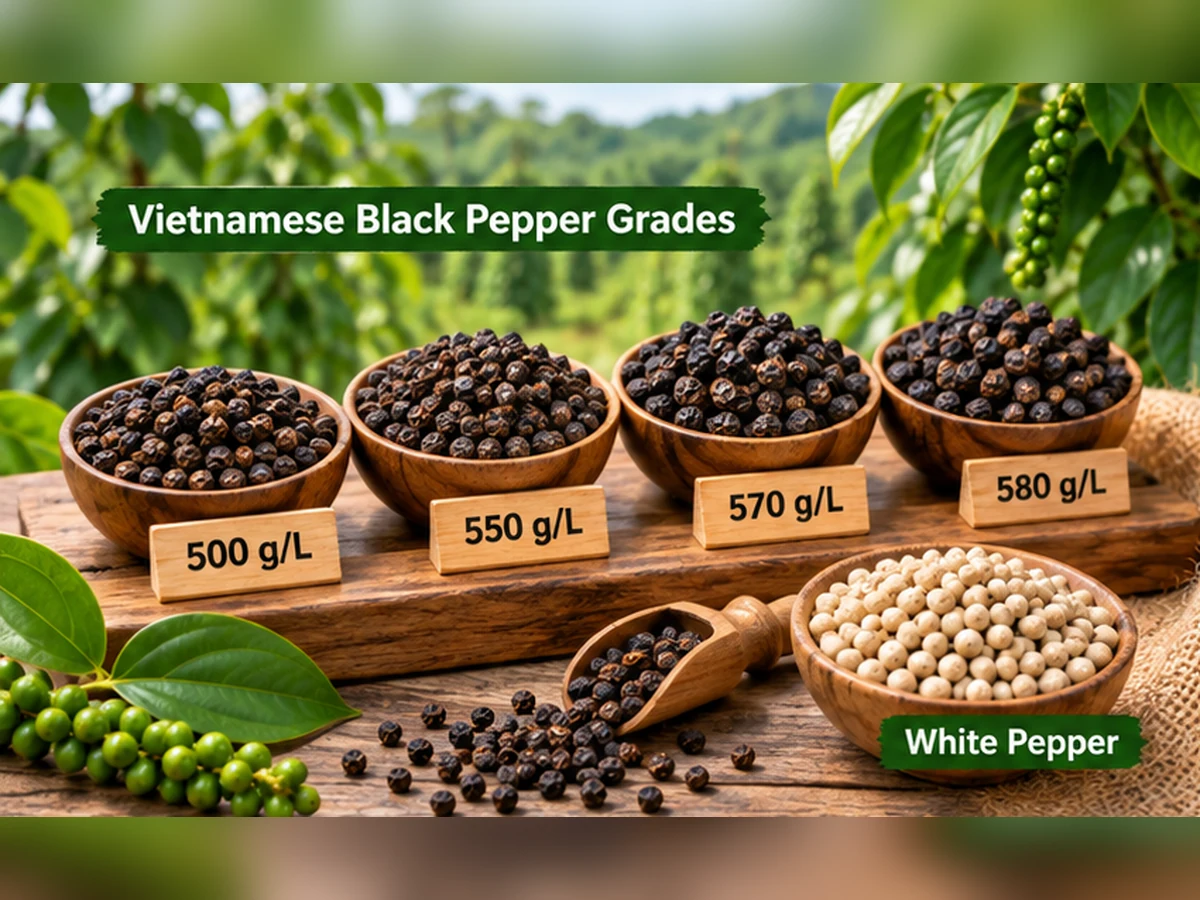
Comparing Vietnamese pepper products
| Product | Main characteristics | What buyers should confirm |
|---|---|---|
| Black pepper 500 g/L | Whole black pepper marketed under a 500 g/L density designation | Actual density, moisture, cleanliness |
| Black pepper 550 g/L | Whole black pepper marketed under a 550 g/L density designation | Physical specification and batch consistency |
| Black pepper 570–580 g/L | Higher-density commercial black pepper grades | Agreed density range, defect tolerance, testing |
| White pepper | Pepper processed to remove the outer fruit layer | Processing method, appearance, sensory quality |
| Ground pepper | Pepper supplied in powdered or milled form | Particle size, microbial controls, packaging |
| Steam-treated pepper | Pepper subjected to a microbial reduction process | Treatment details and batch-specific test results |
These are commercial product categories, not guarantees of conformity to a specific international standard.
Buyers can review the grades listed in the Vexim Trade pepper supplier directory.
What international standards apply to black and white pepper?
The International Organization for Standardization published updated specifications in May 2026:
- ISO 959-1:2026: Pepper, whole or ground — Specification — Part 1: Black pepper.
- ISO 959-2:2026: Pepper, whole or ground — Specification — Part 2: White pepper.
These standards provide technical references for product specifications. Buyers should identify the applicable requirements in their contracts and request evidence supporting compliance.
A supplier mentioning an ISO standard does not automatically mean that every offered batch has been independently tested or certified against it.
What should a buyer check before ordering pepper from Vietnam?
Before placing an order, buyers should establish a written product specification and request supporting evidence for the proposed shipment. The most important checks include pepper type, bulk density, moisture, cleanliness, food safety, traceability, packaging, and delivery conditions. A clear request for quotation (RFQ) helps suppliers offer comparable products and reduces the risk of misunderstandings after the order is confirmed.
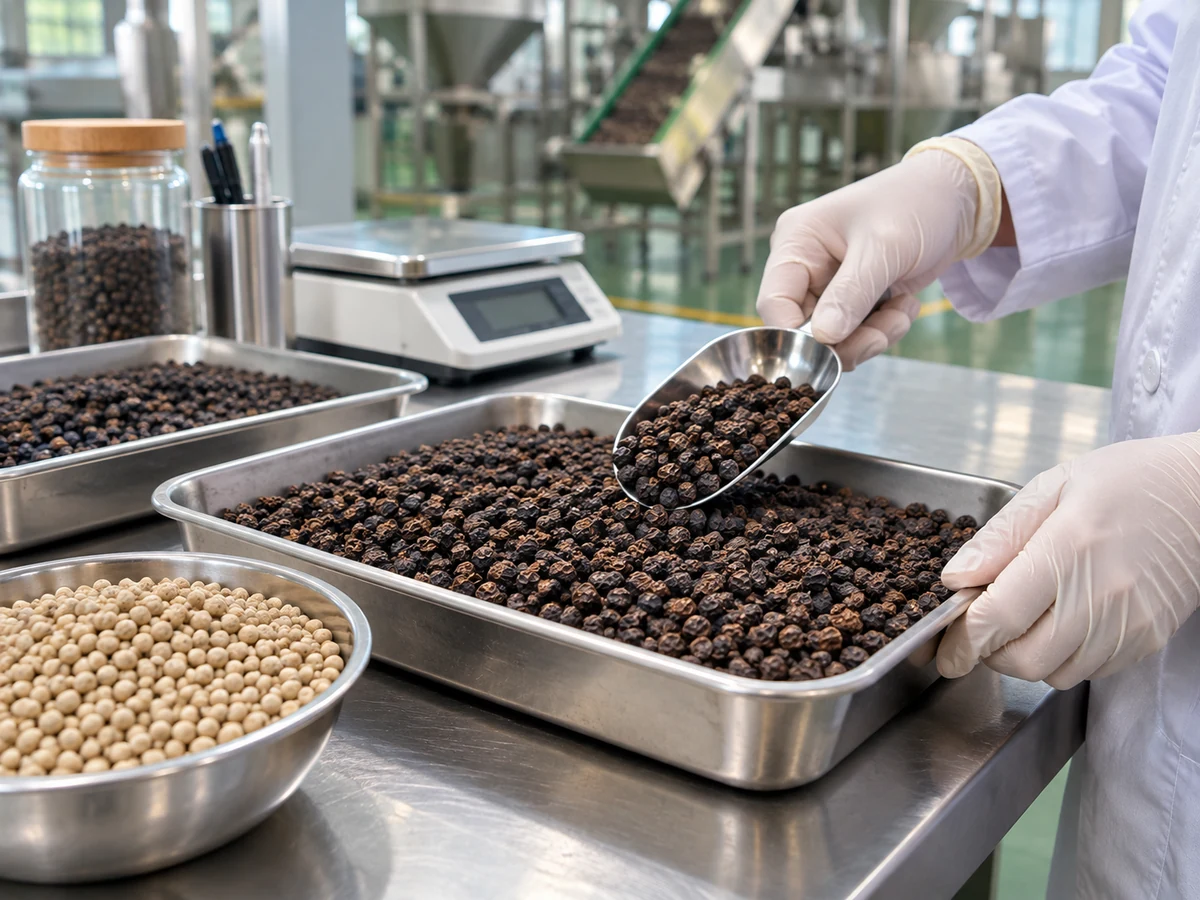
Pepper importer's quality and sourcing checklist
| Inspection area | What to request | Why it matters |
|---|---|---|
| Product identification | Black or white pepper; whole or ground | Confirms the correct product |
| Commercial grade | Target bulk density and physical specifications | Enables like-for-like comparison |
| Moisture and defects | Agreed moisture, foreign matter, and defect limits | Supports product quality evaluation |
| Food safety | Relevant pesticide, contaminant, and microbiological test reports | Supports destination-market compliance |
| Processing | Cleaning, sorting, and treatment details | Clarifies how the product was prepared |
| Traceability | Batch number, origin, and facility information | Connects documents to the supplied goods |
| Packaging | Net weight, bag type, inner liner, labeling | Protects goods and clarifies handling |
| Shipment | Quantity, Incoterm, port, and lead time | Supports logistics and cost planning |
| Documentation | Commercial documents and applicable regulatory certificates | Supports customs and import procedures |
For shipments to the European Union, buyers can use the European Commission's EU Pesticides Database to research maximum residue levels (MRLs).
The database is an information resource; binding requirements should be verified against the applicable EU legislation and destination-specific import rules.
Buyers should also determine whether phytosanitary documentation, additional food safety controls, or specific labeling requirements apply to their shipment.
Buyer takeaway: Approve the product specification and required test evidence before confirming the purchase, rather than relying solely on product descriptions or supplier claims.
How should international buyers compare Vietnamese pepper export quotations?
International buyers should compare pepper quotations using the same product grade, order quantity, packaging specification, shipment period, and delivery terms. An apparently cheaper offer may exclude processing, testing, freight, or other services included by another supplier. Before choosing an exporter, buyers should identify what each price covers and whether the quoted goods can meet their destination market's requirements.
Understanding FOB and CIF prices
| Trade term | General meaning | Buyer consideration |
|---|---|---|
| FOB — Free on Board | Seller delivers the goods on board the vessel at the named port under the agreed Incoterms rules | Buyer generally arranges the main ocean transport and insurance |
| CIF — Cost, Insurance and Freight | Seller arranges and pays for freight and the required insurance cover to the named destination port | Buyer must understand insurance coverage, risk transfer, and destination charges |
The precise responsibilities depend on the agreed contract and applicable Incoterms version.
An effective pepper RFQ should specify:
- Product type and required grade.
- Purchase quantity in metric tonnes.
- Quality and laboratory testing requirements.
- Packaging and labeling specifications.
- Delivery destination and preferred Incoterm.
- Required shipment period.
- Payment terms and quotation validity.
- Inspection, documentation, and non-conformity procedures.
Buyer takeaway: Compare the total commercial offer, not only the advertised price per metric tonne.
Where can international buyers find Vietnamese pepper suppliers?
International buyers can begin their search on Vexim Trade's pepper category page, which provides product listings, commercial grade information, supplier profiles, and quotation options. The platform offers a starting point for comparing available suppliers, but buyers should confirm specifications, current prices, and shipment readiness directly. Supplier verification information helps identify what has been reviewed without replacing independent product testing or contractual due diligence.
Explore the available listings:
Browse Vietnamese Black and White Pepper Suppliers — Vexim Trade
Vexim Trade distinguishes among business registration checks, production-source reviews, and export-history evidence. Each check has a defined scope, and approval in one category does not imply approval in every category.
Read more about how Vexim Trade verifies suppliers.
For a broader explanation of supplier evaluation, see the existing article:
Verified Vietnamese Food Suppliers in 2026: A Buyer's Guide
Vexim Trade supports supplier discovery and quotation requests. Product availability, pricing, delivery, and payment conditions must still be confirmed by the parties involved.
Frequently asked questions about Vietnam pepper sourcing
International pepper buyers frequently ask whether domestic prices reflect export costs, how to compare black pepper grades, and what verification information proves about a supplier. These questions are important because market statistics, product specifications, and company-level documentation describe different aspects of purchasing risk. The following answers clarify common misunderstandings before buyers request samples, quotations, or shipment commitments.
Is the VND 134,000–135,000/kg figure an export price?
No. The VND 134,000–135,000/kg range was a domestic market reference published for November 17, 2026, rather than a confirmed FOB or CIF export offer. Export prices depend on the pepper grade, processing requirements, order volume, shipment schedule, and agreed delivery terms. Buyers should request a dated quotation covering their exact requirements before making a purchasing decision.
Is 580 g/L black pepper always better than 500 g/L?
Not necessarily. A higher bulk-density designation indicates a different commercial grade, but it does not independently establish superior food safety or suitability for every use. Moisture, foreign matter, microbial quality, pesticide residues, and processing conditions also matter. Buyers should choose a product specification that matches their intended application and the regulations of the importing market.
Do rising Vietnamese pepper exports guarantee product availability?
No. National export statistics describe shipments completed during a reporting period, not the inventory held by an individual supplier. Even when exports are increasing, particular grades or shipment windows may be unavailable. Buyers should request inventory confirmation, production or processing schedules, representative samples, and written delivery commitments before accepting a supplier's quotation.
Does supplier verification guarantee pepper quality?
No. Supplier verification provides information about specific checks completed by a platform or reviewer. On Vexim Trade, business documents, production-source evidence, and export history are reviewed separately. These checks do not guarantee the quality of an individual pepper shipment. Buyers should still assess applicable certificates, approve samples, review batch-specific tests, and agree on inspection arrangements.
What documents should international pepper importers request?
Documentation depends on the importing country, product form, and contract terms. Buyers commonly request a commercial invoice, packing list, transport documents, product specifications, and relevant laboratory reports. Additional documents, such as certificates of origin or phytosanitary certificates, may be required in particular circumstances. Importers should confirm destination-specific requirements with their customs broker or regulatory adviser before shipment.
Conclusion: How should buyers approach Vietnam's pepper market in November 2026?
Vietnam remains an important source of black and white pepper for international trade. The November 2026 market data show active exports alongside different domestic price observations, but a successful purchase requires more than understanding headline prices. Buyers should define product specifications, verify shipment evidence, compare quotations consistently, and confirm applicable food safety requirements.
For your next sourcing project, explore Vietnamese pepper suppliers on Vexim Trade and prepare an RFQ specifying the required grade, quantity, destination, and delivery conditions.
Sources and data notes
- Vietnam Pepper and Spice Association — Pepper Market, November 17, 2026
- Industry and Trade Newspaper — Pepper Prices, November 17, 2026
- Nhan Dan — Vietnam's Pepper and Spice Exports, November 12, 2026
- ISO 959-1:2026 — Black Pepper Specification
- ISO 959-2:2026 — White Pepper Specification
- European Commission — EU Pesticides Database
- Vexim Trade — How We Verify Suppliers
Editorial note: Market prices refer to reports dated November 17, 2026. Export statistics refer to January–October 2026. Historical reference prices are not live quotations or guaranteed transaction prices.
Sourcing request
Have a product in mind? Send us your brief.
We match it to a Vietnamese producer that fits, and tell you plainly when none does. A written reply by the start of your next business day.
Request a quoteRelated news
November 17, 2026
Vietnam coffee prices November 2026: Robusta Buyer GuideNovember 18, 2026
Vietnam cashew market November 2026: Prices and ExportsNovember 17, 2026
Vietnam cinnamon and star anise exports 2026: Buyer Guide