
Vietnam coffee prices November 2026: Robusta Buyer Guide
Vietnam coffee prices November 2026 reflect the new Robusta harvest and changing export values. Discover verified trade statistics, regional price references, quality checks and practical sourcing advice for international coffee buyers.
By Dang Duc Dung·Published
In this article
Vietnam coffee prices November 2026: What is happening in the market?
Vietnam coffee prices November 2026 reflect a market adjusting to new-crop supply and weaker international Robusta quotations. On November 17, a domestic market report placed coffee prices in surveyed Central Highlands locations between VND 81,300 and 82,000 per kilogram. These are regional purchasing references, not confirmed FOB export offers, and they may change with location, product condition and trading time.
Domestic coffee price references — November 17, 2026
| Growing area | Reported price (VND/kg) |
|---|---|
| Dak Lak | 82,000 |
| Gia Lai | 81,800 |
| Lam Dong (traditional area) | 81,300 |
| Dak Nong (former province area) | 82,000 |
Source: Market report republished by Vietnam.vn, November 17, 2026. Locations are identified using the reporting area's naming convention.
The report indicated a decline of VND 1,000/kg from its previous reference levels. Prices were also considerably lower than the VND 92,000–93,000/kg range cited for approximately one month earlier.
The key development is the arrival of the new harvest. As more coffee becomes available, buyers may receive different offers for current stock and future shipments.
However, lower farmgate prices do not guarantee equally large reductions in export quotations.
Buyer takeaway: Request a dated quotation identifying the grade, moisture specification, quantity, Incoterm and shipment period before comparing suppliers.
Why are Vietnam's coffee exports growing while export revenue is falling?
Vietnam's coffee export volumes expanded during the first ten months of 2026, but lower average prices reduced the total value of shipments. Official Customs data published by the Ministry of Industry and Trade recorded 1,564,491 tonnes exported, worth approximately US$7.083 billion. Volume increased 18.5% year-on-year, while value declined 5.2%. This distinction is important because higher shipments do not necessarily indicate stronger prices.
Vietnam coffee export performance — January to October 2026
| Indicator | Result | Change year-on-year |
|---|---|---|
| Export volume | 1,564,491 tonnes | +18.5% |
| Export value | US$7.083 billion | −5.2% |
| Average export price | US$4,527/tonne | −20.0% |
| October export volume | 108,821 tonnes | +53.2% versus October 2025 |
| October export value | US$501.2 million | +22.9% versus October 2025 |
Source: Vietnam Ministry of Industry and Trade, Agricultural, Forestry and Fishery Market Bulletin, November 11, 2026.
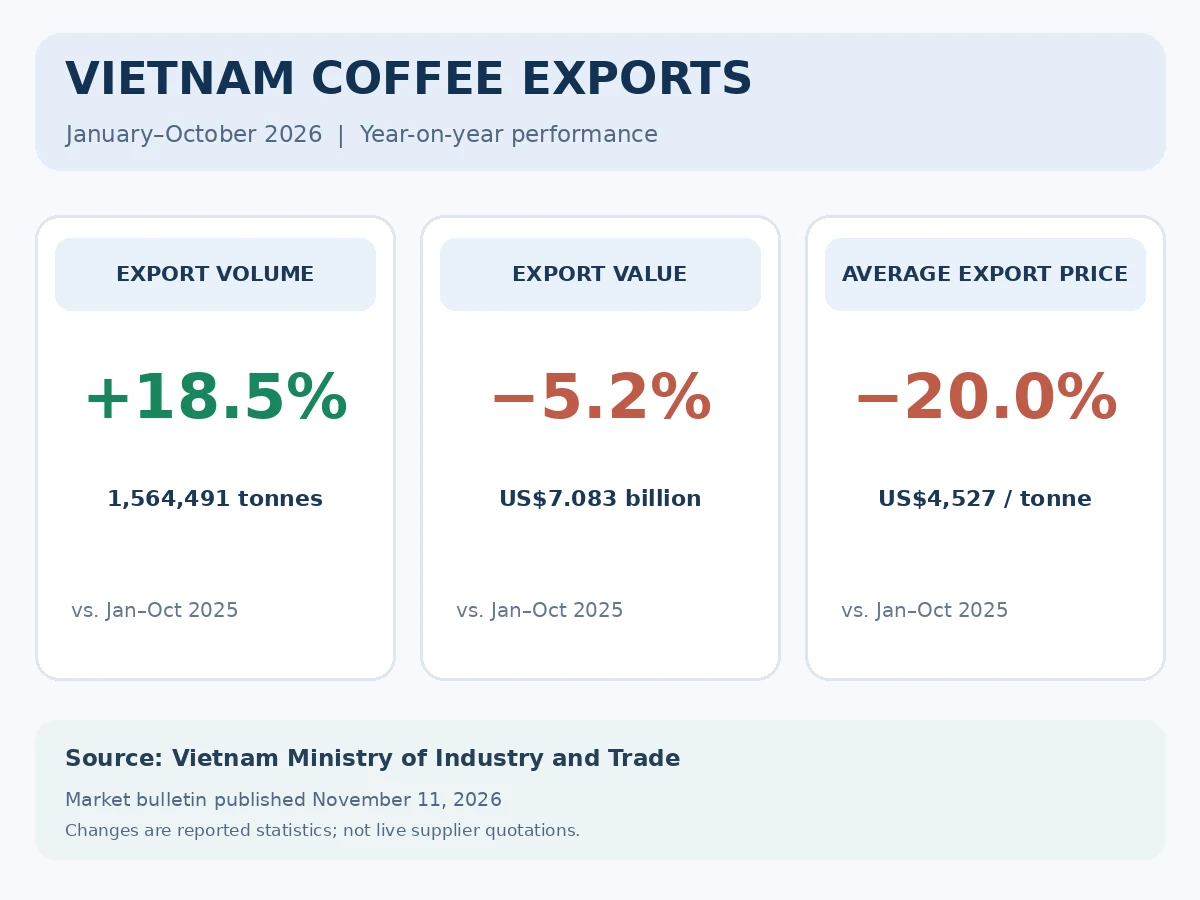
The average export price in October alone was US$4,606/tonne, down 19.8% from October 2025.
These figures cover Vietnam's coffee exports as reported by Customs. They should not be interpreted as the current transaction price of a specific Robusta grade.
Which international markets are importing Vietnamese coffee?
The European Union remains a major destination for Vietnamese coffee. During the first ten months of 2026, Vietnam exported approximately 681,800 tonnes to the EU, worth US$2.89 billion, according to the Ministry of Industry and Trade.
Other notable developments included:
- United States: Approximately 109,800 tonnes, with volume increasing 47.0% year-on-year.
- China: Approximately 59,900 tonnes, an increase of 49.0% by volume.
- Russia: Approximately 83,700 tonnes, up 30.3% by volume.
These figures illustrate the geographical diversity of demand but do not establish that every supplier can serve every destination.
International buyers must still verify product specifications, import restrictions and delivery arrangements.
How will Vietnam's 2026–2027 Robusta harvest affect the coffee market?
The beginning of Vietnam's 2026–2027 coffee harvest is a key factor influencing market expectations. New-crop availability generally increases as harvesting and processing advance, although actual shipment readiness depends on weather, drying conditions, storage and logistics. The International Coffee Organization's October 2026 report identified the Vietnamese harvest and rising London certified inventories as factors weighing on Robusta prices. Buyers should monitor supply without assuming that prices will continue falling.
Three factors to watch
1. Harvest progress and weather
Rainfall can delay picking, drying or processing. Even when cherries have been harvested, green beans may not be ready for export until the required moisture and quality conditions are achieved.
2. International Robusta market movements
Exchange-traded coffee prices influence commercial expectations, but physical export prices also depend on origin differentials, contracts and shipment specifications.
3. Available export-quality inventory
The total harvest is not the same as immediately available export inventory. Cleaning, grading, testing, bagging and transportation all affect shipment schedules.
For buyers negotiating deliveries toward the end of 2026 or early 2027, a realistic shipment window may be as important as the headline price.
Robusta vs Arabica: Which Vietnamese coffee should buyers choose?
Robusta and Arabica serve different commercial requirements, so importers should select coffee according to their final product and quality targets. Vietnam is especially important in the global Robusta supply chain, while Arabica is also produced in selected higher-altitude regions. Robusta is widely used in blends and soluble coffee, whereas Arabica is often selected for different aroma, acidity and specialty profiles. Neither type is automatically superior for every application.
Comparing Vietnamese coffee types
| Criteria | Robusta | Arabica |
|---|---|---|
| Botanical species | Coffea canephora | Coffea arabica |
| Typical flavour profile | Fuller body, more pronounced bitterness | Often more aromatic and acidic |
| Common applications | Instant coffee, espresso blends, commercial roasting | Specialty roasting, retail and blended products |
| Typical caffeine concentration | Generally higher | Generally lower |
| Important buying criteria | Screen size, defects, moisture, cup profile | Grade, processing, defects, cup profile |
| Supplier evaluation | Samples, testing, traceability | Samples, testing, traceability |
These are broad characteristics; sensory quality varies considerably with origin, variety, processing and roasting.
What does Screen 16 or Screen 18 mean?
Screen size refers to the grading of green coffee beans using sieves with defined openings. For example, Screen 18 relates to an opening of approximately 18/64 inch.
A screen designation describes bean-size sorting. It is not a guarantee of cup quality or food safety.
Buyers should specify the required screen distribution and allowable undersize percentage rather than relying on a label alone.
What should buyers check before importing Robusta coffee from Vietnam?
Before importing Vietnamese Robusta coffee, buyers should request a clearly defined product specification and supporting documentation for the proposed shipment. Essential checks include the coffee type, screen size, moisture, defects, processing method, traceability and packaging. Importers should also confirm food safety requirements, including relevant contaminants and pesticide residues, in their destination market. The objective is to compare products consistently and avoid disputes after shipment.
Green coffee sourcing checklist
| Area | What buyers should request |
|---|---|
| Coffee specification | Robusta type, grade, screen size |
| Moisture | Agreed maximum and testing method |
| Physical defects | Defect limits and sampling procedure |
| Processing | Natural, washed or other specified method |
| Sensory quality | Representative sample and cupping results when relevant |
| Food safety | Applicable pesticide and contaminant test reports |
| Traceability | Origin, processing facility and lot identification |
| Packaging | Bag material, liner, net weight and labeling |
| Shipment | Quantity, Incoterm, port and readiness date |
| Documentation | Invoice, packing list, transport documents and applicable certificates |
For a new supplier, requesting a representative sample before committing to a commercial shipment can reduce misunderstandings.
Why does moisture control matter?
Green coffee requires appropriate moisture management to support storage stability and maintain product quality.
Excessive moisture can increase the risk of deterioration during transportation. Importers should therefore agree on a measurable moisture limit, suitable packaging and the testing procedure used at shipment.
No single numerical specification should be assumed for all Robusta grades or buyers.
How should buyers compare FOB and CIF coffee quotations?
International buyers should compare coffee quotations using identical specifications and commercial assumptions. A low unit price may exclude testing, packaging, freight or services included in another quotation. FOB and CIF quotations also allocate transport-related responsibilities differently, meaning they cannot always be compared by their headline prices. Buyers should confirm the named port, Incoterms version, shipment date, insurance requirements and payment terms before evaluating the total purchasing cost.
What belongs in a coffee request for quotation?
A professional RFQ should identify:
- Coffee type and grade, including screen size.
- Required quantity and packaging.
- Moisture and defect specifications.
- Processing method and sample requirements.
- Destination port and preferred Incoterm.
- Shipping schedule and quotation validity.
- Required quality and traceability documents.
- Payment, inspection and claim procedures.
For example, an importer seeking commercial-grade green Robusta should request offers based on the same grade and quality criteria from each potential supplier.
Where relevant, buyers should also verify whether their coffee supply chain meets the traceability and due-diligence requirements applicable to their importing market.
Where can international buyers find Vietnamese coffee suppliers?
International buyers can explore the Vexim Trade Coffee, Tea & Beverages category to review available product listings and submit sourcing enquiries. The platform provides a starting point for comparing supplier information, but current product availability and export quotations require direct confirmation. Buyers should treat verification records as evidence of specified checks rather than guarantees of shipment quality or transaction performance.
Vexim Trade separates supplier review into business-document verification, factory or production-source verification, and delivery-history checks.
Learn more about how Vexim Trade verifies suppliers.
For further guidance on evaluating Vietnamese companies, read Verified Vietnamese Food Suppliers in 2026.
These resources help buyers prepare questions and review available information before negotiating commercial terms.
Frequently asked questions about Vietnam coffee prices November 2026
International coffee importers often need to distinguish domestic market prices from export offers, understand how harvest timing affects shipment readiness, and identify which quality documents should accompany a proposed order. These questions cannot be answered by a price chart alone. The following answers provide practical starting points for buyers comparing Vietnamese Robusta suppliers and preparing commercial purchasing decisions.
Is the VND 81,300–82,000/kg figure an export price?
No. It is a published domestic price reference for November 17, 2026, not a confirmed FOB or CIF export quotation. Export prices vary according to grade, processing, volume, shipment timing and contractual terms. Buyers should obtain written quotations for their required specifications.
Why did Vietnam's export volume increase while revenue declined?
Vietnam's coffee export volume increased 18.5% during January–October 2026, while export value decreased 5.2%. The Ministry of Industry and Trade also reported a 20% decline in average export prices compared with the previous year. Lower unit prices help explain the difference between volume growth and revenue performance.
Does the new harvest guarantee lower coffee prices?
No. New supply may put downward pressure on prices, but the market also responds to global demand, competing origins, weather, exchange rates and logistics. Importers should avoid assuming that seasonal supply increases will produce continuous price declines.
Is Screen 18 Robusta always better than Screen 16?
Not necessarily. Screen size describes the physical grading of green coffee beans, not the complete quality profile. Cup quality, defects, moisture, processing and the buyer's intended application also influence suitability.
What documents should buyers request for a coffee shipment?
Common documents include the commercial invoice, packing list, transport document, product specification and relevant quality reports. Certificates of origin, phytosanitary documentation or additional compliance records may be necessary depending on the importing country and the contractual arrangement.
Conclusion: What should international coffee buyers do next?
Vietnam's coffee market in November 2026 combines increased export volumes, lower average export prices and the beginning of a new harvest. These conditions make timely market information valuable, but successful sourcing still depends on product quality, documentation, realistic shipment schedules and supplier due diligence.
Rather than purchasing solely on price, international buyers should establish clear specifications and compare offers on equivalent terms.
Explore Vietnamese coffee products and suppliers on Vexim Trade to begin preparing your next sourcing enquiry.
Sources and data notes
- Vietnam Ministry of Industry and Trade — Agricultural, Forestry and Fishery Market Bulletin, November 11, 2026
- International Coffee Organization — Coffee Market Report, October 2026
- Vietnam.vn — Domestic Coffee Prices, November 17, 2026
- Vexim Trade — Coffee, Tea & Beverages
- Vexim Trade — How We Verify Suppliers
Editorial note: Domestic price references are dated November 17, 2026. Export figures cover January–October 2026. These statistics do not represent live quotations, guaranteed supplier inventory or future price forecasts.
Sourcing request
Have a product in mind? Send us your brief.
We match it to a Vietnamese producer that fits, and tell you plainly when none does. A written reply by the start of your next business day.
Request a quoteRelated news
November 17, 2026
Vietnam pepper prices November 2026: Export Trends and Buyer GuideNovember 18, 2026
Vietnam Robusta Coffee Grades: Screen 16 vs 18 Buyer GuideNovember 18, 2026
Vietnam cashew market November 2026: Prices and Exports