
Vietnam cinnamon and star anise exports 2026: Buyer Guide
Vietnam cinnamon and star anise exports 2026 show continued growth in both shipment volumes and export value. Discover the latest trade figures, cassia and star anise product forms, food safety considerations and practical sourcing guidance for international buyers.
By Dang Duc Dung·Published
In this article
Vietnam cinnamon and star anise exports 2026: What do the latest figures show?
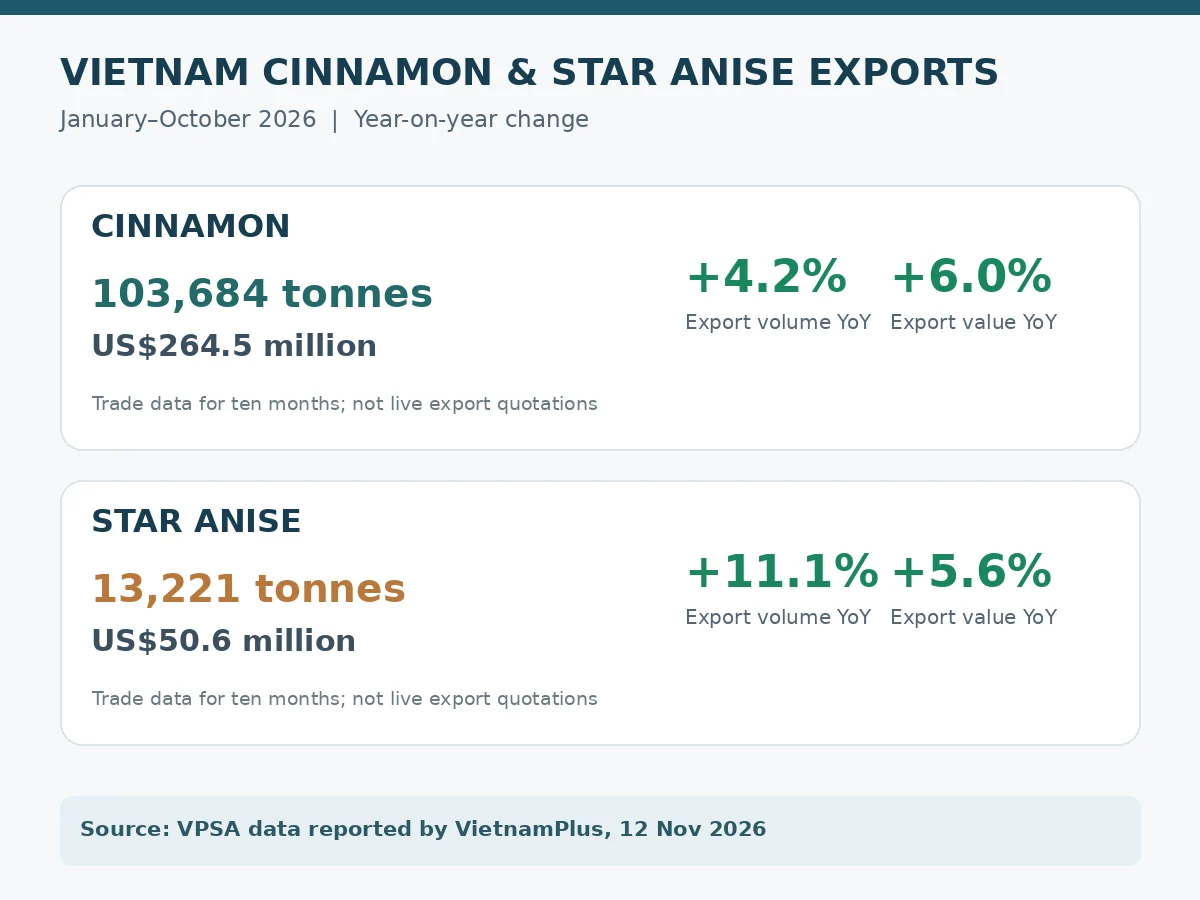
Vietnam cinnamon and star anise exports 2026 increased in both volume and value during January–October, according to VPSA statistics reported on November 12. Cinnamon shipments reached 103,684 tonnes, up 4.2% year-on-year, while star anise shipments totaled 13,221 tonnes, up 11.1%. The figures indicate stronger export activity, although they do not establish current supplier inventory, transaction prices or future demand.
Vietnam's cinnamon and star anise export performance
| Indicator | Cinnamon | Star anise |
|---|---|---|
| Export volume, Jan–Oct 2026 | 103,684 tonnes | 13,221 tonnes |
| Export value | US$264.5 million | US$50.6 million |
| Volume growth YoY | +4.2% | +11.1% |
| Value growth YoY | +6.0% | +5.6% |
Source: Vietnam Pepper and Spice Association, reported by VietnamPlus on November 12, 2026.
What changed in October 2026?
Star anise exports accelerated in October, reaching approximately 1,959 tonnes worth US$7 million.
According to market reporting based on VPSA data, October shipments increased 18.2% in volume and 30.6% in value compared with September 2026.
This monthly recovery provides additional evidence of changing shipment activity, but a single strong month does not guarantee sustained demand or higher future prices.
Buyer takeaway: Use national export statistics to understand the market, then request current stock availability and quotations from individual suppliers.
Why is Vietnam an important source of cinnamon and star anise?
Vietnam is an established exporter of cassia cinnamon and star anise, supplying international food manufacturers, spice distributors and ingredient buyers. Its commercial relevance comes from established growing regions, multiple product forms and export-oriented processing businesses. However, suitability depends on the importing market and the exact specification requested. Buyers should evaluate the supplier's documented capabilities rather than assuming that national export performance guarantees consistent quality.
Cinnamon production and processing
Vietnamese cassia cinnamon is associated with northern mountainous growing regions, including Yen Bai and Lao Cai.
Commercial cinnamon products can include:
- Whole cinnamon sticks and rolled quills.
- Split cassia bark.
- Broken cinnamon pieces.
- Cut cinnamon.
- Ground cinnamon powder.
These forms serve different applications in retail, spice blending, food manufacturing and ingredient processing.
Star anise production
Star anise is cultivated in northern Vietnam, including Lang Son, where it has a strong commercial and geographical association.
The spice is valued for its distinctive aroma and recognizable star-shaped fruit.
Common export products include whole dried star anise, broken pieces and powder.
For food applications, buyers should confirm that the supplied product is the appropriate food-grade species, Illicium verum, with documented botanical identity.
Cassia vs Ceylon cinnamon: What should international buyers know?
Vietnamese cinnamon exports are primarily associated with cassia, which differs from Ceylon cinnamon in botanical identity and typical composition. Cassia generally has a stronger, more robust flavour profile, while Ceylon cinnamon is often described as lighter and more delicate. Buyers should distinguish these products at the quotation stage because price, aroma, coumarin content and intended food applications can differ.
Cassia and Ceylon cinnamon compared
| Criteria | Vietnamese cassia | Ceylon cinnamon |
|---|---|---|
| Common botanical association | Cinnamomum cassia | Cinnamomum verum |
| Typical aroma | Stronger and more pungent | Milder and more delicate |
| Bark characteristics | Often thicker and harder | Often thinner, layered quills |
| Coumarin | Generally higher | Generally lower |
| Commercial applications | Spice processing, blends, food manufacturing | Specialty foods, retail, premium applications |
These are general characteristics rather than guaranteed specifications for every shipment.
Buyer takeaway: Confirm the botanical species, product form and laboratory requirements before approving an order.
Which cinnamon and star anise grades should buyers choose?
Importers should choose cinnamon and star anise grades according to the intended processing method, customer expectations and destination-market requirements. A retail buyer may prefer visually uniform whole products, while an industrial manufacturer may prioritize defined cut sizes or powder specifications. Commercial labels such as Grade A, Grade AA or premium can vary between sellers and should never replace measurable contractual specifications.
Common forms of Vietnamese spices
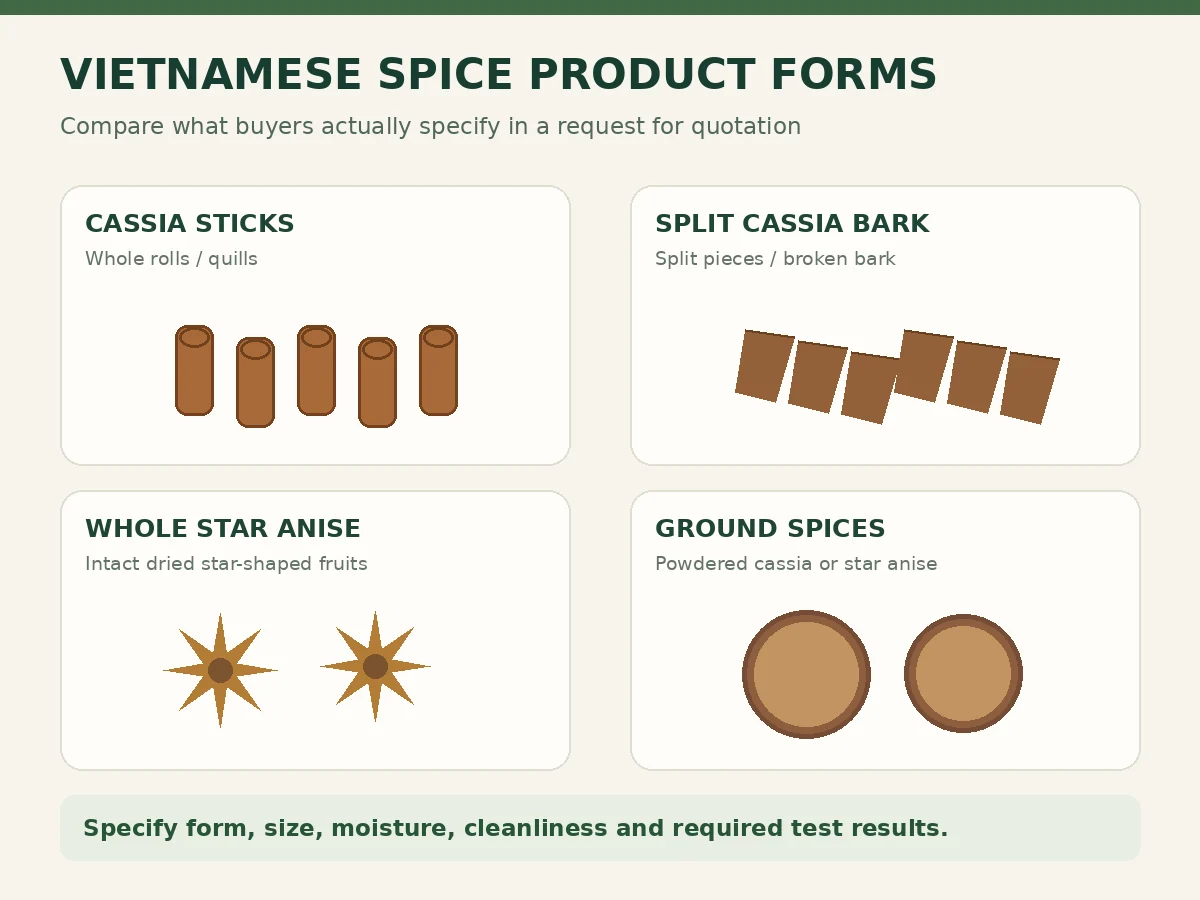
| Product form | Main characteristics | Buyer considerations |
|---|---|---|
| Cassia cinnamon sticks | Rolled or cut bark | Length, diameter, appearance, cleanliness |
| Split cassia bark | Split or irregular bark pieces | Size distribution, foreign matter, moisture |
| Broken cinnamon | Smaller pieces | Uniformity, contamination control |
| Cinnamon powder | Finely ground material | Particle size, botanical identity, microbial quality |
| Whole star anise | Intact dried fruits | Whole-fruit percentage, appearance, cleanliness |
| Broken star anise | Fragments and pieces | Broken ratio, foreign matter, intended use |
| Star anise powder | Milled dried star anise | Identity, particle size, food safety testing |
For each product, buyers should agree on acceptable tolerances and a testing procedure.
A higher-sounding grade name does not necessarily mean a product is more suitable for a particular industrial application.
What food safety risks should buyers check before importing Vietnamese spices?
Food safety verification is essential when importing cinnamon or star anise because natural spices may be exposed to environmental contamination, unsuitable drying conditions or insufficient processing controls. Buyers should establish destination-specific requirements before shipment and request appropriate testing evidence. Particular attention may be needed for pesticide residues, heavy metals, microorganisms, foreign matter and the botanical identity of star anise.
Cinnamon: Heavy metals and coumarin
A European Commission Joint Research Centre report published in September 2025 identified authenticity and safety concerns in cinnamon products sampled from the EU market.
The investigation highlighted potential problems involving lead contamination, coumarin content and product authenticity.
For buyers, the findings support several practical precautions:
- Request appropriate heavy-metal test results.
- Verify pesticide residue requirements.
- Confirm the botanical identity of the product.
- Assess coumarin where relevant to the intended application.
- Request documentation connecting laboratory results with the supplied batch.
An important regulatory distinction applies: European Union Regulation (EC) No 1334/2008 establishes coumarin limits for certain categories of finished food. It should not be interpreted as one universal coumarin limit applying to every raw cinnamon shipment.
Star anise: Identity and product integrity
For star anise, botanical identity should be treated as a critical product specification.
Buyers should request evidence that the product is food-grade Illicium verum and that unsuitable or unidentified plant material has been excluded.
Additional checks may include moisture, foreign matter, microbial quality, contaminants and batch traceability.
Buyer takeaway: Agree on destination-specific testing requirements before production or packing, not after the goods reach customs.
What should buyers check before ordering cinnamon and star anise from Vietnam?
Before ordering Vietnamese cinnamon or star anise, international buyers should prepare a detailed request for quotation identifying the botanical species, product form, quality standards and intended destination. Suppliers should provide sufficient evidence for buyers to assess manufacturing capabilities and shipment readiness. A structured evaluation reduces the risk of receiving unsuitable grades, incomplete documentation or products that do not meet the importing market's rules.
Importer's quality and sourcing checklist
| Inspection area | What buyers should request |
|---|---|
| Product identification | Botanical species and product type |
| Commercial form | Sticks, split bark, whole star anise or powder |
| Physical quality | Size, appearance, moisture and foreign matter |
| Food safety | Applicable pesticide, heavy-metal and microbiological test reports |
| Additional controls | Coumarin testing for cinnamon where required |
| Traceability | Origin, processing facility and batch identification |
| Packaging | Net weight, materials, liner and labeling |
| Shipment | Quantity, readiness date, destination and Incoterm |
| Documentation | Invoice, packing list and applicable regulatory certificates |
Why is a batch-specific test report important?
A certificate or laboratory result issued for an unrelated shipment may not establish the quality of the goods currently being offered.
Buyers should therefore verify sample identification, batch numbers, testing dates, laboratory information and the connection between test results and the proposed shipment.
For new suppliers or sensitive applications, independent sampling and inspection may be appropriate.
How should buyers compare cinnamon and star anise export quotations?
International buyers should compare export quotations on equivalent product and delivery terms rather than choosing the lowest advertised price. Differences in processing, cleanliness, moisture, testing, packaging and shipment conditions can materially affect the total cost. A quotation should identify what is included, which specifications apply and whether the supplier can deliver within the required period. Without these details, price comparisons may be misleading.
Information to include in an RFQ
- Product name and botanical species.
- Required product form and commercial grade.
- Quantity in kilograms or metric tonnes.
- Moisture, size and defect specifications.
- Required laboratory tests and certificates.
- Packaging and labeling requirements.
- Destination port and preferred Incoterm.
- Shipment schedule and quotation validity.
- Payment terms and inspection arrangements.
For FOB or CIF offers, buyers should also confirm the named port and applicable Incoterms version.
No current market-wide FOB price is quoted in this report because prices differ by product, grade and contract terms. Historical averages should not be presented as live supplier offers.
Where can international buyers find Vietnamese cinnamon and star anise suppliers?
International buyers can explore the Vexim Trade cinnamon and star anise category to compare listed products and submit sourcing enquiries. Available listings include different cinnamon bark forms and dried star anise products. However, product descriptions, displayed prices and verification information should be reviewed within their stated scope. Buyers should confirm available stock, specifications, certificates, samples and quotation terms directly before making purchasing commitments.
Browse Vietnamese Cinnamon and Star Anise Suppliers on Vexim Trade
For an example of a cassia product listing, explore:
Vietnam Cinnamon Sticks and Cigar Cassia — Product Listing
To understand the platform's verification process, read:
How Vexim Trade Verifies Suppliers
Supplier verification is not equivalent to an independent guarantee that every shipment meets a buyer's quality requirements.
Frequently asked questions about Vietnam cinnamon and star anise exports 2026
International spice buyers frequently ask whether Vietnam supplies cassia or Ceylon cinnamon, how to verify star anise authenticity and which documents are needed for import clearance. These questions affect both commercial suitability and regulatory risk. The following answers clarify essential purchasing considerations using the available trade information and general food safety principles, while recognizing that destination requirements must be checked separately.
Is Vietnamese cinnamon the same as Ceylon cinnamon?
No. Vietnamese commercial cinnamon is predominantly associated with cassia, while Ceylon cinnamon comes from a different botanical species. They differ in bark characteristics, flavour profile and typical coumarin content. Buyers should confirm the exact species and specification rather than purchasing based on the word "cinnamon" alone.
Are Vietnam's cinnamon and star anise export prices rising?
The January–October 2026 data show increases in export value and shipment volume for both products. However, this does not establish a universal rise in current market prices. Actual quotations depend on quality, grade, quantity, processing and shipment conditions. Buyers should request current supplier offers.
What is the difference between whole and broken star anise?
Whole star anise generally contains intact dried fruits, while broken star anise consists of pieces or fragments. Buyers may choose different forms according to presentation, processing requirements and cost considerations. Both require appropriate identity and safety checks.
What should EU buyers know about coumarin in cinnamon?
Coumarin is naturally present in cinnamon, particularly cassia. EU legislation includes limits for certain finished food categories. Buyers should assess how the ingredient will be used and confirm the applicable rules for the finished product, rather than assuming a single EU coumarin limit applies to all raw cinnamon.
Does a supplier verification badge guarantee shipment quality?
No. Verification records indicate particular checks completed for a company or production source. They do not automatically establish that a given shipment meets the buyer's specifications. Samples, inspection procedures, test reports and contractual requirements remain necessary.
Which documents are usually required for importing Vietnamese spices?
Buyers commonly request a commercial invoice, packing list, transport document, specification sheet and applicable test reports. Certificates of origin, phytosanitary certificates or other regulatory documents may also be needed depending on the destination country, product and contract.
Conclusion: What does the 2026 market mean for international buyers?
Vietnam's cinnamon and star anise exports recorded positive growth through October 2026, reinforcing the country's importance in international spice sourcing. For importers, however, trade growth is only one part of the purchasing decision.
Reliable sourcing requires verified product identity, clear specifications, relevant food safety documentation and realistic commercial terms.
International buyers seeking these products can explore cinnamon and star anise listings on Vexim Trade and prepare a detailed request for quotation.
Sources and references
- VietnamPlus — Vietnam's Pepper and Spice Exports Target US$2.4 Billion in 2026, November 12, 2026
- Nhan Dan — Vietnam's Pepper and Spice Exports, November 12, 2026
- European Commission Joint Research Centre — Cinnamon Authenticity and Safety Investigation, September 24, 2025
- EUR-Lex — Regulation (EC) No 1334/2008
- Vexim Trade — Cinnamon and Star Anise Suppliers
- Vexim Trade — How We Verify
Data note: Export statistics cover January–October 2026. This article does not provide live FOB quotations or forecast future prices. Buyers should verify destination-specific import requirements before placing an order.
Sourcing request
Have a product in mind? Send us your brief.
We match it to a Vietnamese producer that fits, and tell you plainly when none does. A written reply by the start of your next business day.
Request a quoteRelated news
November 18, 2026
Vietnam star anise sourcing guide 2026: Quality and ExportsNovember 17, 2026
Vietnam pepper prices November 2026: Export Trends and Buyer GuideNovember 5, 2026
Vietnam Foodexpo 2026: 500+ Exhibitors and a Global Buyer’s Sourcing Guide