
Verified Vietnamese Food Suppliers in 2026: A Buyer’s Guide After Vietnam’s $1 Trillion Trade Milestone
Vietnam's merchandise trade surpassed $1 trillion in the first ten months of 2026, according to official figures released on November 3. For international buyers exploring Vietnamese food and agricultural suppliers, market growth is only the starting point. Discover how VEXIM Trade helps buyers compare product specifications, understand supplier verification badges, review certificates, and submit sourcing requests while maintaining control over supplier selection.
By Dang Duc Dung·Published
In this article
Finding verified Vietnamese food suppliers is becoming increasingly important as Vietnam strengthens its position in international trade. On November 3, 2026, Vietnam's National Statistics Office reported that the country's combined merchandise exports and imports reached 1.01055 trillion in the first ten months of 2026, marking the first time the figure has exceeded1 trillion.
The milestone reflects the expanding scale of Vietnam's international trade. However, higher national trade volumes do not automatically guarantee that every manufacturer, exporter, or trading company can meet a buyer's requirements.
For international businesses sourcing food and agricultural products, supplier transparency, product specifications, certification information, and clear quotation procedures remain essential.
This guide explains how buyers can assess Vietnamese sourcing opportunities using official market information and the supplier discovery, comparison, verification, and quotation features available on VEXIM Trade.
What Does Vietnam's $1 Trillion Trade Milestone Mean for International Buyers?
Vietnam's merchandise trade surpassed $1 trillion in the first ten months of 2026, according to figures released on November 3. This achievement reflects the country's substantial role in global supply chains, but it combines both imports and exports across multiple industries. For food and agricultural buyers, the milestone offers useful market context rather than direct evidence of individual supplier reliability.
According to the National Statistics Office, Vietnam recorded the following preliminary trade figures.
Vietnam's Latest Trade Performance – January to October 2026
| Indicator | Reported value | Year-on-year change |
|---|---|---|
| Total merchandise trade | $1,010.55 billion | +32.3% |
| Merchandise exports | $499.24 billion | +27.5% |
| Merchandise imports | $511.31 billion | +37.4% |
| October exports | $64.67 billion | +51.4% |
| October imports | $57.36 billion | +43.1% |
| October trade balance | +$7.31 billion | Monthly surplus |
| January–October trade balance | -$12.07 billion | Cumulative deficit |
Source: National Statistics Office of Vietnam, November 3, 2026. Preliminary merchandise trade figures.
Vietnam's October trade surplus was the second consecutive monthly surplus reported in 2026.
Nevertheless, the cumulative trade balance remained negative because imports exceeded exports over the full ten-month period.
The country's growing export activity includes manufacturing, agricultural products, forestry products, and seafood.
For international buyers, these developments reinforce the importance of understanding both the broader market and the specific companies participating in it.
The latest figures also update the earlier VEXIM Trade market report on Vietnam's $945 billion trade turnover through October 15.
Rather than making sourcing decisions solely from national statistics, buyers can use the data as a starting point for identifying potential markets and assessing suppliers individually.
Official source: National Statistics Office – October and Ten-Month Socioeconomic Report, 2026.
Why Is Supplier Verification More Important Than National Export Growth?
Supplier verification helps buyers assess whether an individual company has provided evidence supporting its business identity, manufacturing relationships, or export experience. National export growth shows commercial activity at a country level, but it cannot establish the capabilities of a specific supplier. Buyers therefore need company-level information before evaluating quotations, requesting samples, or entering international purchasing agreements.
For example, two businesses may both advertise food products from Vietnam while operating under different commercial arrangements.
One may manufacture products at its own facility, while another may source products from a partner factory.
Both arrangements can be legitimate, but their documentation, responsibilities, and operational capabilities may differ.
International buyers should understand these distinctions when reviewing suppliers.
The Information Gap Between Market Data and Supplier Data
| Market-level information | Supplier-level information |
|---|---|
| National export growth | Individual company documentation |
| Industry production trends | Actual manufacturing or sourcing capabilities |
| Total trade turnover | Product specifications and MOQ |
| Export market performance | Relevant quality certificates |
| Overall logistics conditions | Supplier-specific lead times |
| Country trade relationships | Available shipment evidence |
A supplier with an attractive quotation may still require additional verification before an order can proceed.
Likewise, a company operating in a major export market should not automatically be considered fully verified.
The objective of supplier verification is to provide greater transparency about the evidence available for review.
It does not eliminate commercial risk or replace independent product testing, inspections, or contractual safeguards.
How Can Buyers Find Verified Vietnamese Food Suppliers on VEXIM Trade?
Buyers can use VEXIM Trade to search Vietnamese food and agricultural products, compare available specifications, review supplier verification records, and submit quotation requests. The platform focuses on making supplier information easier to evaluate rather than treating every listed business as equally verified. Buyers retain control over supplier selection and can communicate with chosen suppliers through the platform's sourcing process.

VEXIM Trade operates as a B2B sourcing platform connecting international and domestic buyers with Vietnamese food manufacturers, cooperatives, and trading companies.
Its marketplace provides product information such as specifications, minimum order quantities, available certifications, indicative prices, and supplier details.
The platform also provides information about the checks completed for each supplier.
Step 1: Search Products and Supplier Categories
Buyers should begin by identifying their required product category, technical specifications, and target purchasing volume. VEXIM Trade allows users to search products by name, grade, category, or supplier. The results provide a starting point for examining available product offers and the businesses associated with them, helping buyers narrow their options before requesting quotations.
The platform currently concentrates on food and agricultural sourcing from Vietnam.
Its core categories include agricultural ingredients, processed food products, spices, and other food-related categories available in the marketplace.
For products that are not listed, buyers can submit custom requirements through the sourcing request function.
Not every product category or supplier is guaranteed to be available.
Start here: Browse VEXIM Trade Products and Suppliers.
Step 2: Compare Product Specifications Before Choosing a Supplier
Product comparison helps buyers evaluate available offers using consistent purchasing criteria. VEXIM Trade allows users to select up to three products and compare information such as specifications, minimum order quantities, export ports, certificates, and reference prices. These comparisons help identify potential differences before buyers contact suppliers, although displayed information still requires confirmation.
For example, two product listings may describe similar goods but have different requirements for packaging, order volume, or shipment preparation.
Buyers should review the exact specifications rather than assuming that products with similar names are interchangeable.
Reference prices should also be interpreted carefully because final quotations can vary by quantity, packaging, shipment date, and trade terms.
Step 3: Review Supplier Verification Records
After identifying suitable product listings, buyers should examine the associated supplier profiles and available verification badges. VEXIM Trade records three independent types of supplier review: business documents, factory evidence or partner-factory contracts, and delivery-history evidence. Each check has a defined scope, meaning approval of one check does not automatically confirm completion of the others.
A supplier may have approved business documentation without completing a factory-related review.
Another supplier may have suitable shipment evidence but still require additional checks in other areas.
Buyers should review the individual results and their limitations.
A verification badge does not guarantee product quality, delivery performance, or the outcome of a transaction.
Learn more: How VEXIM Trade Verifies Suppliers.
Step 4: Submit a Request for Quotation
A Request for Quotation (RFQ) allows buyers to communicate their purchasing requirements and obtain commercial information from potential suppliers. On VEXIM Trade, buyers can request a quotation from a supplier they select or submit an open sourcing request if they have not chosen a supplier. The request should include enough detail to support an accurate response.
Buyers who select a specific supplier have their request directed to that supplier first.
If the supplier cannot meet the requirements, the platform's published buyer process states that permission is requested before alternative suppliers are suggested.
An open request may be used when buyers need assistance identifying potentially suitable companies.
VEXIM Trade states that buyers receive an initial update within one business day. This is not a guarantee that a final supplier quotation or completed sourcing match will be available within that time.
Buyer guide: How Sourcing Works on VEXIM Trade.
How Do VEXIM Trade's Supplier Verification Badges Work?
VEXIM Trade uses separate verification checks to communicate what supplier evidence has been reviewed and approved by its staff. The system distinguishes company documentation, manufacturing or partner-factory evidence, and export or shipment records. The badges are not universal guarantees of supplier performance, and buyers should understand each check before interpreting a profile's verification status.
Understanding the Three Independent Supplier Checks
| Verification check | Evidence reviewed | What buyers should understand |
|---|---|---|
| Check 1: Document Review | Business registration and applicable company documents | Confirms a defined document review, not every aspect of the company's identity or finances |
| Check 2: Factory or Partner Contract Review | Factory evidence or contractual relationship with a partner factory | A partner contract does not prove factory ownership or an on-site inspection |
| Check 3: Delivery History Review | Suitable export or shipment evidence | Does not guarantee future delivery or establish that an end buyer received the goods |
Source: VEXIM Trade – How We Verify Suppliers.
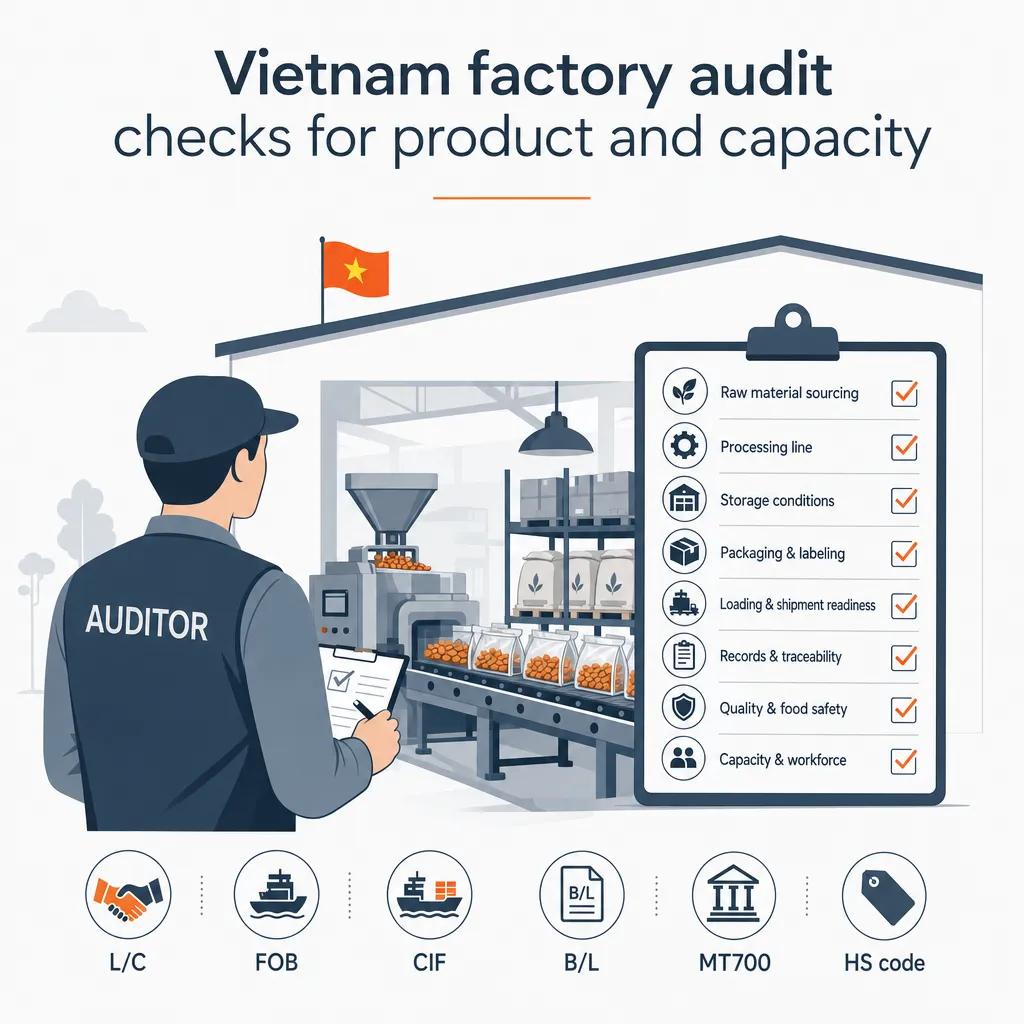
A supplier profile may display one approved review while other checks remain incomplete or unapproved.
For the document review, VEXIM Trade states that the company's supplied tax information is not independently verified with the tax authority.
For factory-related evidence, trading companies may submit contracts showing relationships with partner factories instead of claiming direct factory ownership.
For shipment history, reviewed documents provide information about specific export activity but do not guarantee future fulfillment.
The key principle is that verification should communicate the scope of evidence reviewed, not imply that all commercial risks have been eliminated.
What Should Buyers Check Before Requesting Food Supplier Quotations?
Buyers should examine product specifications, available certificates, pricing terms, production lead times, and export documentation before requesting quotations. These details help suppliers determine whether they can meet the intended order and allow buyers to compare offers more consistently. For food and agricultural goods, destination-market compliance and product quality requirements are especially important.
How Should Buyers Interpret Supplier Certificates?
Buyers should check whether a certificate relates to the supplier itself or a partner entity, whether its validity period remains current, and whether the certified scope is relevant to the intended product. VEXIM Trade may display certificate holder and expiry information, but the presence of a certificate on a profile does not automatically prove independent authentication by the issuing authority.
The platform distinguishes certificates associated with the supplier from those associated with another entity, such as a partner manufacturing facility.
Buyers should review the displayed information carefully and request additional evidence when required.
Depending on the product and destination market, relevant documents may include food safety management certifications, organic certifications, laboratory reports, or other applicable compliance records.
Certification requirements vary by product and importing country.
Why Should Buyers Compare More Than the Listed Price?
Reference prices provide useful initial information, but they do not necessarily represent binding commercial offers. International buyers should consider minimum order quantities, shipment terms, packaging requirements, production schedules, and additional logistics costs before comparing suppliers. A lower listed price may not produce the lowest total delivered cost once all purchasing conditions have been considered.
VEXIM Trade describes displayed product prices as indicative quotations supplied within a stated validity period.
The final commercial price must be confirmed with the supplier.
Buyer Comparison Checklist
| Evaluation criterion | Information to confirm |
|---|---|
| Product specifications | Grade, composition, processing method, packaging |
| Minimum order quantity | Required purchasing volume |
| Price | Currency, validity, quantity basis |
| Incoterms | FOB, CFR, CIF, or other agreed terms |
| Export port | Available shipment location |
| Lead time | Production and shipment preparation period |
| Certifications | Holder, validity, scope |
| Supplier verification | Which independent checks are approved |
| Quality control | Samples, testing and inspection arrangements |
The platform can help buyers identify comparable product listings, but final decisions should be based on confirmed information appropriate to the transaction.
What Information Should Buyers Include in an RFQ?
A useful RFQ should explain what the buyer needs, how much is required, where the goods will be delivered, and which technical or compliance requirements apply. Clear specifications make it easier for suppliers to determine whether they can fulfill an enquiry and prepare relevant quotations. Incomplete requests may require additional clarification before a meaningful comparison is possible.
Recommended RFQ Information
| Field | Information to provide |
|---|---|
| Product requirement | Product name and detailed specification |
| Product grade | Applicable grade, standard or quality criteria |
| Order volume | Required quantity and unit |
| Packaging | Preferred packaging and labeling |
| Destination | Import country and destination port |
| Delivery terms | Preferred Incoterms |
| Certifications | Required certificates or testing |
| Shipment timing | Target dispatch or delivery period |
| Additional requirements | Samples, inspection, shelf life, or other conditions |
For food and agricultural products, buyers should also communicate any mandatory destination-market rules that may influence the supplier's ability to fulfill the order.
Submitting accurate requirements does not guarantee supplier availability, but it can improve the relevance of potential quotations.
Buyers who are still exploring sourcing options can use the open RFQ process instead of choosing a specific supplier immediately.
Submit requirements through: VEXIM Trade Request for Quotation.
How Does VEXIM Trade Handle Buyer Privacy and Commercial Transactions?
VEXIM Trade's published buyer process separates supplier discovery from the final commercial transaction. Buyers can browse listings, compare products, and submit RFQs without a buyer-side sourcing fee. Their email address and telephone number are not disclosed to suppliers through quotation requests until they approve an introduction. Contracts and payments are handled directly between the buyer and the chosen supplier.
The platform does not hold buyer funds or act as a payment escrow service.
Buyers should therefore review payment terms and confirm appropriate commercial safeguards with their chosen supplier.
VEXIM Trade also states that sponsored placements are labeled and do not determine which suppliers are matched to an RFQ.
These distinctions matter because transparent sourcing platforms should help buyers understand the relationship between supplier information, platform services, and the final commercial agreement.
How Can Vietnamese Manufacturers and Exporters Join VEXIM Trade?
Vietnamese manufacturers, cooperatives, and trading companies can apply to join VEXIM Trade by creating a supplier account and submitting their company information for review. Registration alone does not automatically publish a supplier profile or approve verification checks. The platform reviews supporting documents and separately authorizes publication, allowing suppliers to present available products and evidence of their capabilities.
Supplier applications may include business registration, company details, product information, minimum order quantities, lead times, export ports, and relevant certifications.
Factory operators can submit appropriate manufacturing evidence, while trading companies can provide information about partner factories.
The platform's published onboarding information indicates that food-related supplier categories are prioritized, with other categories assessed according to availability.
Suppliers retain control over certain information disclosed publicly, subject to the platform's publication and consent procedures.
Supplier information: How to Join VEXIM Trade.
Frequently Asked Questions About Verified Vietnamese Food Suppliers
International buyers researching verified Vietnamese food suppliers often want to understand the difference between a listed company and a reviewed supplier, what verification badges mean, and how the quotation process works. These practical questions are especially important when purchasing from overseas businesses for the first time. The following answers reflect VEXIM Trade's published sourcing and verification procedures.
1. Are All Suppliers on VEXIM Trade Fully Verified?
No. VEXIM Trade records separate verification checks, and not every supplier has completed all three. Buyers should review each supplier's approved checks and supporting information before making decisions. The platform distinguishes documented review results from general claims about supplier reliability. Additional testing, inspections, or commercial due diligence may still be necessary.
2. Is It Free for International Buyers to Use VEXIM Trade?
Yes. According to VEXIM Trade's published buyer guide, browsing products, comparing listed specifications, and submitting sourcing requests are free for buyers. However, the sourcing service should not be confused with the commercial transaction itself. Buyers remain responsible for the price of goods and any separately agreed costs relating to samples, inspections, shipping, or other services.
3. Can Buyers Compare Multiple Products Before Sending an RFQ?
Yes. VEXIM Trade allows buyers to select up to three products for comparison. Available comparison fields include specifications, minimum order quantities, export ports, certificates, and reference prices. The feature helps buyers review product differences before requesting quotations, although it does not establish that all listed products are technically equivalent or commercially interchangeable.
4. Does a Verification Badge Guarantee Product Quality?
No. A verification badge identifies a particular check approved by the platform's reviewing staff. It does not guarantee the quality of every product batch, successful delivery, or the financial reliability of the supplier. Buyers should still confirm samples, quality requirements, inspection arrangements, and appropriate payment protections before completing a purchase.
5. Can Buyers Request Suppliers for Products Not Currently Listed?
Yes. VEXIM Trade provides an open sourcing request option for buyers who have not selected a supplier or cannot find a suitable listed product. Buyers can submit their technical requirements, expected volume, and destination details for review. The platform may identify potentially relevant suppliers, but availability and the ability to meet specifications are not guaranteed.
6. Do Buyers Pay VEXIM Trade or the Supplier?
Buyers conclude their commercial agreements and make payments directly to the supplier they select. VEXIM Trade states that it does not hold customer funds. This makes it important for both parties to agree on appropriate payment terms, documentation, inspection requirements, and contractual responsibilities before transferring money or arranging shipment.
Conclusion: Why Does Transparent Supplier Information Matter in 2026?
Vietnam's $1 trillion merchandise trade milestone highlights the scale of its participation in global commerce, but the reliability of an individual supplier must still be assessed separately. For buyers sourcing food and agricultural goods, transparent documentation, comparable product information, and clearly defined verification procedures can support more informed purchasing decisions in an increasingly complex international market.
VEXIM Trade offers a platform for discovering Vietnamese food and agricultural suppliers, reviewing available product information, examining verification records, and submitting sourcing requests.
Its value lies in making relevant information accessible while keeping verification limits and commercial responsibilities clear.
As international sourcing continues to evolve, buyers benefit from combining market intelligence with careful supplier evaluation rather than relying on broad trade statistics alone.
Explore Verified Vietnamese Food Suppliers on VEXIM Trade
VEXIM Trade connects international buyers with Vietnamese food and agricultural suppliers through searchable product listings, comparison tools, individual supplier verification records, and sourcing requests. Buyers can explore available offers, check which reviews have been completed, and contact selected suppliers. The platform supports informed sourcing decisions while leaving final commercial agreements and payments to the buyer and supplier.
Looking for Vietnamese food and agricultural suppliers?
Start by exploring available categories, comparing product specifications, and reviewing supplier verification information.
Understand Supplier Verification
VEXIM Trade — Discover Suppliers. Compare Information. Source with Confidence.
References
- National Statistics Office of Vietnam – October and Ten-Month Socioeconomic Report, November 3, 2026
- VietnamPlus – Vietnam Posts Second Straight Monthly Trade Surplus in October, November 3, 2026
- VEXIM Trade – Official Marketplace
- VEXIM Trade – How Sourcing Works for Buyers
- VEXIM Trade – How We Verify Suppliers
- VEXIM Trade – Information for Vietnamese Suppliers
Editorial cutoff: November 3, 2026. Market figures are preliminary. Platform features and supplier verification statuses may change. Supplier checks do not replace independent due diligence or applicable regulatory requirements.
Sourcing request
Have a product in mind? Send us your brief.
We match it to a Vietnamese producer that fits, and tell you plainly when none does. A written reply by the start of your next business day.
Request a quoteRelated news
October 21, 2026
Vietnamese Food Wholesale Suppliers: US Buyer GuideOctober 17, 2026
Import Instant Noodles from Vietnam: Buyer's GuideOctober 28, 2026
Vietnam EFTA Free Trade Agreement 2026: New Opportunities for Global Buyers