
Vietnam cashew market November 2026: Prices and Exports
Vietnam cashew market November 2026 shows firm export activity and relatively stable wholesale kernel prices. Explore updated WW180, WW240 and WW320 quotations, trade developments, quality considerations and practical sourcing insights for international buyers.
By Dang Duc Dung·Published
In this article
Vietnam cashew market November 2026: What are the key developments?
The Vietnam cashew market November 2026 is characterized by substantial export activity and relatively narrow movements in selected processor quotations. Industry reports place January–October export revenue at approximately US4.38 billion. On November 16, SVC Foods reported WW320 kernels at US7.15/kg FOB Ho Chi Minh City, while WW240 and WW180 remained at US8.05/kg and US9.85/kg. These prices are company-specific quotations, not universal market benchmarks.
Key market indicators
| Indicator | Latest reported figure | Reporting period |
|---|---|---|
| Vietnam's cashew export revenue | Approximately US$4.38 billion | Jan–Oct 2026 |
| WW180, whole white kernels | US$9.85/kg FOB | SVC, Nov 16 |
| WW240, whole white kernels | US$8.05/kg FOB | SVC, Nov 16 |
| WW320, whole white kernels | US$7.15/kg FOB | SVC, Nov 16 |
| WW320 price change | −US$0.05/kg | Compared with Nov 3 |
Sources: VINACAS-related market reporting and SVC Foods, November 2026.
The figures represent different types of information: national export revenue measures completed trade, while the FOB prices represent one supplier's offers for specific products and shipment periods.
Buyer takeaway: Confirm the exact grade, packaging, shipment window and quotation validity before comparing offers.
What are Vietnamese cashew kernel prices in November 2026?
Vietnamese whole white cashew kernel prices remained relatively stable in SVC Foods' November 16 bulletin. The supplier quoted WW180 at US9.85/kg, WW240 at US8.05/kg and WW320 at US$7.15/kg under FOB Ho Chi Minh City terms for late-November and early-December shipments. These figures provide a useful dated market example, but another processor may quote differently because of grading, quality, inventory and commercial conditions.
Indicative FOB quotations — November 16, 2026
| Grade | Quotation (USD/kg) | USD/metric tonne |
|---|---|---|
| WW180 | 9.85 | 9,850 |
| WW240 | 8.05 | 8,050 |
| WW320 | 7.15 | 7,150 |
Source: SVC Foods, November 16, 2026. All prices are the published quotations of one company, not a national price index.
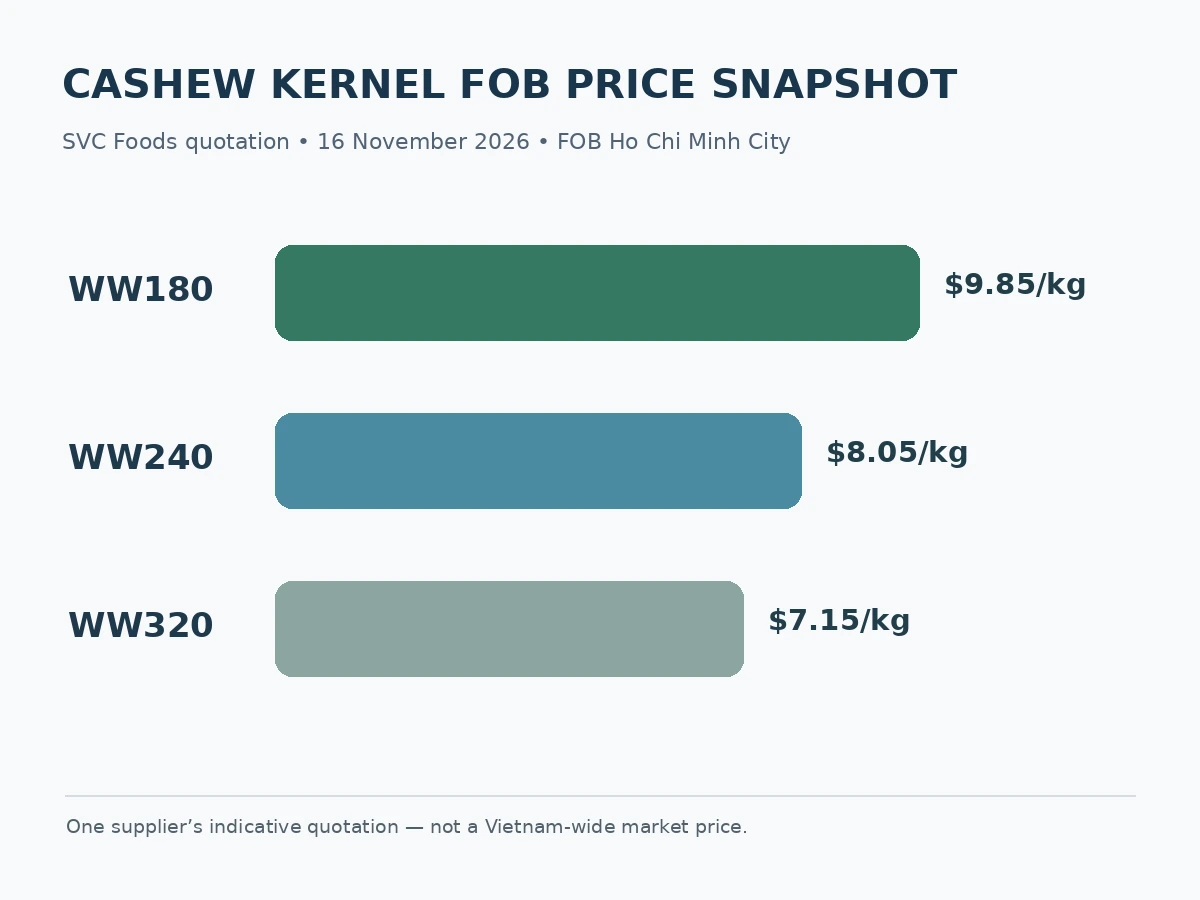
The same bulletin reported roasted and salted A240 at US8.10/kg and A320 at US7.55/kg.
The differences between raw whole white kernels and value-added products underline why buyers should not compare prices without first confirming the processing method.
Why do cashew prices differ by grade?
Kernel prices depend partly on size and appearance, but several other factors influence the final offer:
- Kernel count: Larger whole kernels often command a premium.
- Processing: Roasting, seasoning and additional handling affect costs.
- Defect tolerances: Colour, broken rate and other characteristics must meet agreed limits.
- Packaging: Vacuum packing, cartons and retail-ready formats have different costs.
- Shipment timing: Available stock and loading schedules can affect negotiations.
- Commercial terms: Freight, insurance, inspection and payment conditions matter.
A lower quoted price does not necessarily indicate better value if the offered product fails to meet the importer's specifications.
How are Vietnam's cashew exports performing in 2026?
Vietnam continues to be a major processor and exporter of cashew kernels. Industry reporting cited by Vietnam's Ministry of Agriculture and Environment showed exports exceeding 594,000 tonnes and approaching US4.2 billion during the first nine months of 2026. A subsequent November report placed ten-month export revenue at US4.38 billion. Buyers should pay attention to the reporting period and product coverage when comparing statistics from different publications.
Export indicators and their significance
| Indicator | Reported performance | Buyer interpretation |
|---|---|---|
| Jan–Sep export volume | Over 594,000 tonnes | Large-scale international shipments |
| Jan–Sep export value | Nearly US$4.2 billion | Significant export trade |
| Jan–Sep volume growth | +3.52% year-on-year | Increased shipments in the reported period |
| Jan–Sep value growth | +7.35% year-on-year | Export value grew faster than volume |
| Jan–Oct export revenue | Approximately US$4.38 billion | Later industry-reported cumulative value |
Sources: Vietnam Ministry of Agriculture and Environment and November industry reporting. Figures are reproduced with their respective reporting periods.
The nine-month and ten-month figures should not be subtracted to calculate October sales because the underlying reports may use different statistical coverage or revisions.
What is changing in the cashew industry?
Vietnam's processing industry faces pressure to improve value addition while managing raw-material costs.
Industry discussions have emphasized the importance of:
- Greater consistency in finished-kernel quality.
- Stronger traceability of imported and domestic raw cashew nuts.
- Development of roasted and retail-ready products.
- More reliable processing and delivery schedules.
- Improved market diversification.
For global buyers, the advantage of a well-developed processing sector must be weighed against the capabilities of the particular supplier and shipment being evaluated.
Which international markets are buying Vietnamese cashews?
China, the United States and European countries remain important destinations for Vietnamese cashew kernels. Market information published by Vietnam's Ministry of Agriculture and Environment indicates that exports to China reached approximately 125,000 tonnes during the first nine months of 2026, worth US$907 million. Demand from other markets also contributes to competition for particular grades and shipment schedules, although country-level figures do not prove that an individual supplier has available stock.
Why does destination demand matter to importers?
Different purchasing markets can prioritize different commercial requirements.
Retail distributors may value appearance, uniform sizing and presentation. Industrial food manufacturers may prioritize consistent input specifications, processing suitability and cost efficiency.
Food safety requirements also vary by destination.
Buyers should therefore evaluate the specification required for their own market rather than assuming that a product accepted by one importer will automatically qualify for another.
Which Vietnamese cashew grades should international buyers choose?
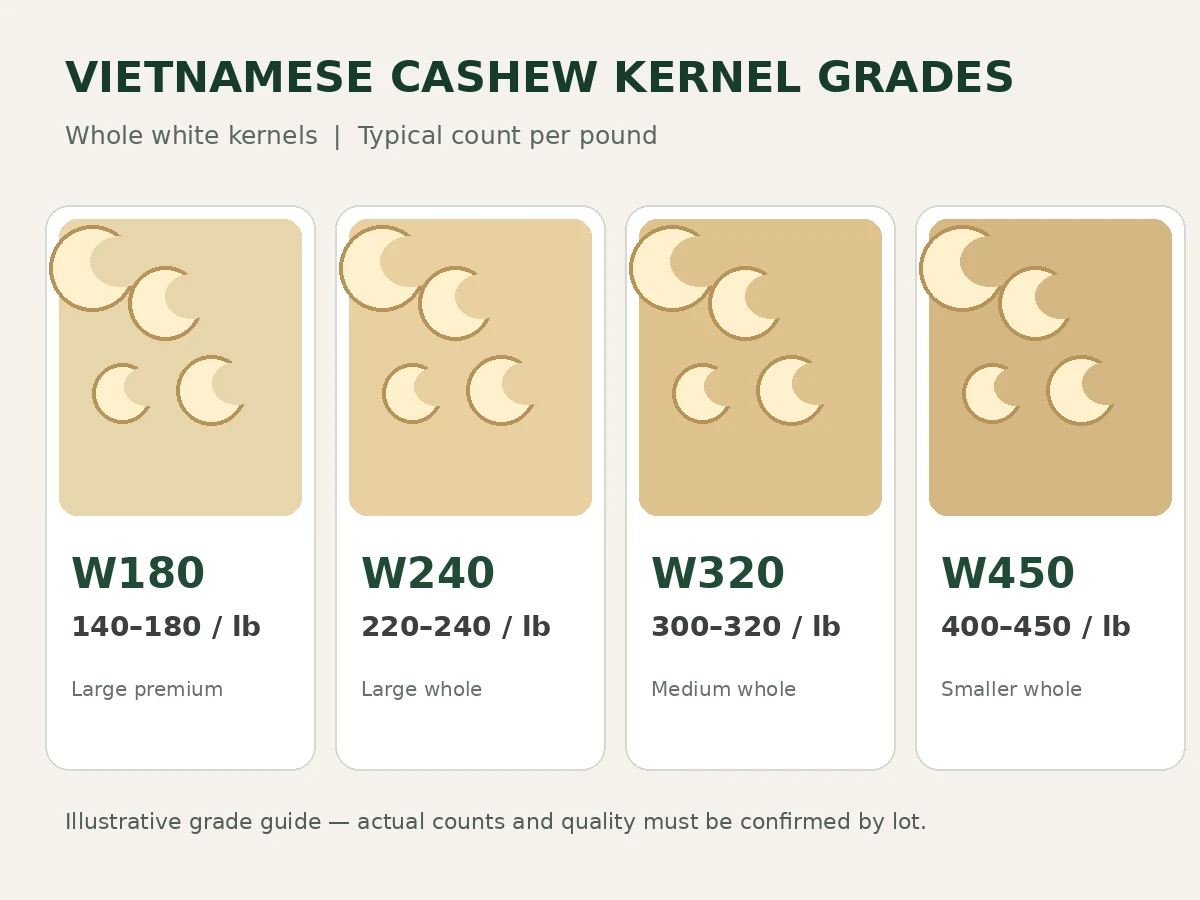
Vietnamese cashew kernels are commonly offered as whole white grades such as W180, W240, W320 and W450. The numerical designation broadly relates to the kernel count per pound: lower counts indicate larger kernels. For buyers, this distinction is useful when selecting ingredients for premium snacks, retail packs or food manufacturing. However, size does not by itself establish freshness, food safety, processing quality or consistency between batches.
Common whole white cashew grades
| Grade | Typical kernel count per pound | Commercial positioning |
|---|---|---|
| W180 | 140–180 | Large, premium whole kernels |
| W240 | 220–240 | Large whole kernels |
| W320 | 300–320 | Medium whole kernels |
| W450 | 400–450 | Smaller whole kernels |
Counts are general commercial grading references. Actual specifications and accepted tolerances must be agreed with the supplier.
Is W180 always the best choice?
Not necessarily. W180 may suit products where large kernel appearance is important, but W320 can be more appropriate for applications where uniform ingredient performance and cost matter.
Broken kernels and pieces may also be appropriate for bakery, confectionery and ingredient manufacturing.
An effective purchasing decision considers product use, required grade, accepted defect limits and total landed cost.
What should buyers check before ordering cashews from Vietnam?
International buyers should begin with a written specification covering the kernel grade, moisture, defects, packaging and required food safety evidence. Cashews are agricultural food products, so product appearance alone is insufficient to establish their suitability. Buyers should request relevant test reports, traceability information and representative samples before approving major orders, while confirming all applicable import requirements for their destination market.
Quality and sourcing checklist
| Area | What buyers should confirm |
|---|---|
| Product type | Raw or roasted kernels; whole or broken |
| Grade | W180, W240, W320 or another agreed grade |
| Kernel appearance | Colour, size, defects and breakage limits |
| Moisture | Contractual maximum and testing method |
| Food safety | Applicable aflatoxin, pesticide and microbiological requirements |
| Processing | Cleaning, sorting, roasting and handling controls |
| Traceability | Origin, production facility and lot information |
| Packaging | Food-grade materials, net weight and inner liners |
| Documentation | Product specifications and relevant certificates |
| Delivery | Incoterm, port, quantity and loading window |
Why are aflatoxin tests important?
Aflatoxins are contaminants that can occur in certain agricultural foods. Importers should determine the limits that apply to their destination market and the intended product use.
For European Union destinations, buyers can consult the European Commission's contaminants framework, including Regulation (EU) 2023/915 and its applicable amendments.
Testing requirements must be matched to the product category, and laboratory results should be linked to the relevant batch.
A general statement that a factory follows international standards is not a substitute for appropriate evidence of shipment conformity.
How can buyers compare cashew export quotations effectively?
Comparing cashew quotations requires more than checking the price per kilogram. Buyers should request identical product grades, quantities and quality criteria so that competing offers can be evaluated fairly. Differences in packaging, inspection, shipment timing and delivery terms may significantly change the overall cost. A commercially attractive quotation should also explain what the supplier can deliver, when the goods will be ready and which documents will accompany shipment.
Information to include in a cashew RFQ
- Required grade and product form.
- Quantity in kilograms or metric tonnes.
- Kernel specifications and defect tolerances.
- Packaging type and carton weight.
- Required testing and certificates.
- Destination port and Incoterm.
- Desired shipment schedule.
- Payment and inspection arrangements.
- Quotation validity period.
For example, an importer seeking WW320 should compare offers based on the same kernel grade, food safety limits, packaging and shipping period.
The SVC price references in this article can help frame market discussions, but they should not replace fresh written quotations.
Where can buyers find Vietnamese cashew kernel suppliers?
International buyers can explore Vexim Trade's cashew kernel category to compare supplier listings, product forms and available sourcing information. The platform provides a starting point for identifying potential Vietnamese suppliers, but individual products must still be evaluated for quality, inventory and delivery capability. Buyers should confirm which business documents have been checked and which product-level evidence remains outstanding before placing an order.
Explore Cashew Kernel Suppliers on Vexim Trade
For a detailed pre-order checklist, read the existing Veximtrade article:
How to Import Cashew Kernels from Vietnam: 7 Questions to Ask Before Your First Order
To understand the platform's supplier-review process, see:
How Vexim Trade Verifies Suppliers
Supplier verification and shipment inspection are separate activities. Buyers should not assume that a supplier listing guarantees every lot will meet the required specification.
Frequently asked questions about Vietnam cashew market November 2026
International buyers often ask whether current price references represent nationwide export prices, which whole-kernel grades are most suitable and how the industry's growth affects shipment availability. These questions require separate answers because supplier quotations, national trade statistics and product quality describe different commercial conditions. The following FAQs clarify the practical distinctions for buyers preparing cashew sourcing decisions in late 2026.
Are the November 2026 prices official Vietnamese market prices?
No. The quoted WW180, WW240 and WW320 prices come from SVC Foods' November 16 supplier bulletin. They are dated, supplier-specific FOB quotations rather than a government-administered market index. Other offers may differ.
Why is WW180 more expensive than WW320?
WW180 represents larger whole kernels with a lower typical count per pound. Larger kernels may command a premium for certain retail and presentation-focused applications. However, the exact price difference depends on grade quality, demand and supplier terms.
Does rising export revenue guarantee stable supply?
No. National export revenue does not establish available inventory at any particular factory. Buyers should confirm production or processing schedules, finished-stock availability and shipment readiness directly.
What food safety documents should cashew importers request?
Buyers should request specifications and relevant testing evidence, including contaminant reports when required. Other documents depend on the product and importing market. The applicable requirements should be confirmed before shipment.
Should buyers choose FOB or CIF?
The choice depends on logistics capability, insurance arrangements and the complete commercial offer. Buyers should confirm the named port and agreed Incoterms version, then compare all relevant landed costs and responsibilities.
Can buyers source different cashew grades from one supplier?
Some processors may offer multiple whole and broken-kernel grades. However, availability, processing capabilities and minimum order quantities vary. Buyers should submit a detailed RFQ and obtain confirmation for each required grade.
Conclusion: What should international buyers do next?
Vietnam's cashew sector remains an important source of processed kernels for global buyers. November 2026 market reports show substantial export activity, while selected supplier quotations indicate relatively narrow price changes across major whole white grades.
For importers, the best sourcing strategy combines market awareness with well-defined product specifications, batch-level evidence and transparent commercial terms.
Browse Vietnamese Cashew Suppliers on Vexim Trade and prepare a quotation request covering your required grade, quantity and shipment period.
Sources and references
- Vietnam Ministry of Agriculture and Environment — Sustainable Supply Chains Enhance Vietnam's Cashew Industry
- SVC Foods — Cashew Market Update, November 16, 2026
- Vietnam's Cashew Industry and 2026 Export Outlook — VINAGRI News, November 14, 2026
- European Commission — Food Contaminants Legislation
- Vexim Trade — Cashew Kernels
- Veximtrade — How to Import Cashew Kernels from Vietnam
Editorial note: Export figures refer to the reporting periods stated above. FOB prices are supplier-specific quotations dated November 16, 2026. They are not live market-wide prices or guaranteed transaction offers.
Sourcing request
Have a product in mind? Send us your brief.
We match it to a Vietnamese producer that fits, and tell you plainly when none does. A written reply by the start of your next business day.
Request a quoteRelated news
November 17, 2026
Vietnam pepper prices November 2026: Export Trends and Buyer GuideNovember 17, 2026
Vietnam coffee prices November 2026: Robusta Buyer GuideNovember 18, 2026
Vietnam star anise sourcing guide 2026: Quality and Exports