
Import Instant Noodles from Vietnam: Buyer's Guide
Planning to import instant noodles from Vietnam? Learn how to assess pho and noodle suppliers, verify product specifications, review U.S. requirements and request a wholesale quotation.
By Dang Duc Dung·Published
In this article
1. Why import instant noodles from Vietnam? Key Opportunities for Buyers
Buyers looking to import instant noodles from Vietnam can explore a variety of packaged noodle products, including traditional Vietnamese instant pho and flavored instant noodles. Vietnam offers sourcing opportunities for food importers and wholesale distributors seeking to expand their Asian food portfolios. However, successful sourcing requires careful evaluation of product specifications, supplier capabilities, packaging, commercial terms, and applicable U.S. import regulations.
Distinctive Vietnamese Food Identity
Vietnamese instant pho offers international buyers a product category closely associated with Vietnam’s culinary heritage. Its distinctive rice noodles, broth-inspired flavors, and convenient preparation formats can appeal to distributors seeking differentiated Asian food products. For importers targeting specialty grocery stores or Asian retail chains, authentic product positioning and clear ingredient information are important factors when evaluating potential suppliers and building a competitive product portfolio.
Retail-Friendly Product Formats
Many instant noodle products are designed for ambient storage and convenient preparation.
Depending on the manufacturer and product formulation, available formats may include single-serving packets, multipacks, cups, and retail cartons.
Buyers should confirm storage conditions, shelf life, and shipping specifications for each individual product rather than assuming that all instant noodles have the same requirements.
Opportunities Across Different Distribution Channels
Potential customers include:
- U.S. food importers handling packaged Asian foods.
- Regional wholesale distributors.
- Asian grocery stores and supermarket chains.
- Specialty food retailers.
- Brand owners exploring private-label manufacturing, where supported by the producer.
The appropriate distribution channel depends on the product's positioning, price, packaging, and target consumer.
2. Vietnamese Instant Pho and Noodle Products: What Can Buyers Source?
The first step in evaluating a product is understanding exactly what is being offered.
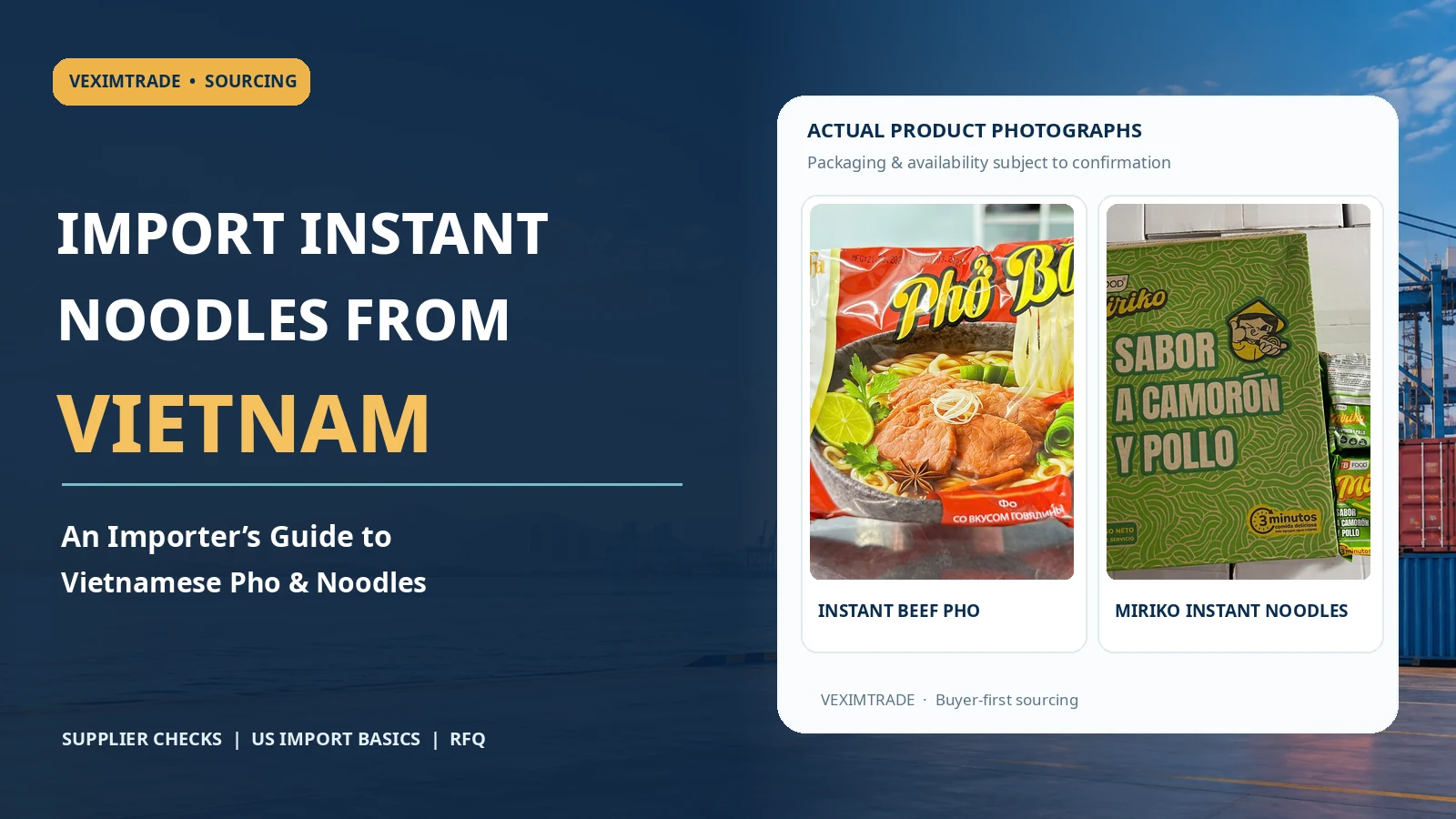
Based on product materials currently being reviewed for sourcing discussions, examples include instant pho and packaged instant noodles.
Instant Pho: Beef and Chicken Variants
Vietnamese instant pho products may be offered in beef-inspired and chicken-inspired varieties.
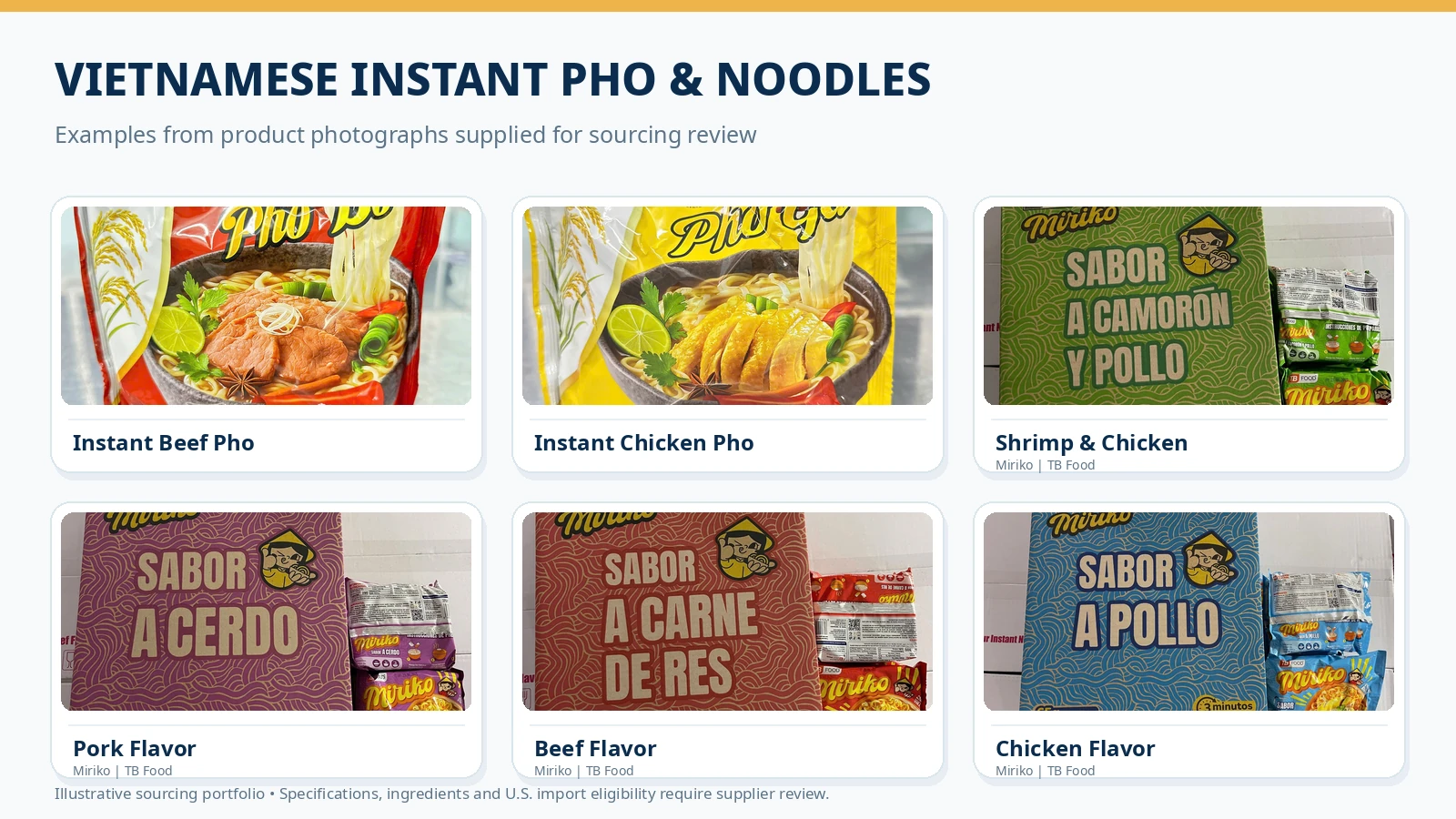
The product photographs provided for sourcing review show packaged instant beef pho and instant chicken pho.
Before requesting a quotation, buyers should clarify:
- Rice noodle composition and texture.
- Broth seasoning ingredients.
- Net weight per serving.
- Preparation instructions.
- Shelf life and storage conditions.
- Retail packaging and carton configuration.
The appearance of a product on a package should not be treated as proof of its actual ingredients.
Miriko Instant Noodles: Multiple Flavor Options
The product photographs also show Miriko instant noodles from TB Food in four labeled flavors:
| Flavor shown on packaging | Spanish product description |
|---|---|
| Shrimp & Chicken | Camarón y Pollo |
| Pork | Cerdo |
| Beef | Carne de Res |
| Chicken | Pollo |
These flavor names are taken from the product packaging shown for review.
Important: A beef, chicken, or pork-flavored product does not necessarily contain meat in the form suggested by its name. The actual ingredient declaration and source of any animal-derived ingredients must be checked.
The packaging shown in the photographs also contains non-English labeling. U.S. retail suitability therefore needs separate review before any product is offered for import.
Product availability, factory authorization, formulations, certification status, and quotations remain subject to supplier confirmation.
3. Which U.S. Buyers Are a Good Fit for Vietnamese Instant Noodles?
Different buyers evaluate the same product in different ways.
| Buyer Type | Main Purchasing Considerations | Information to Prepare |
|---|---|---|
| Food Importer | Import eligibility, supplier records, product compliance | Ingredients, factory details, documentation |
| Wholesale Distributor | Cost, carton configuration, delivery reliability | MOQ, case packing, lead time, quotation |
| Asian Grocery Chain | Product appeal, retail packaging, shelf life | Samples, packaging artwork, product specifications |
| Private-Label Buyer | Customization and production capability | OEM capability, MOQ, artwork requirements |
For an existing branded product, importers and wholesale distributors may be the most practical starting point.
Private-label opportunities should only be discussed after confirming that the manufacturer supports the required customization and commercial volumes.
The most useful question is not simply whether a supplier can make instant noodles. It is whether the supplier can deliver the exact product the buyer needs, with the documentation and commercial terms required for the destination market.
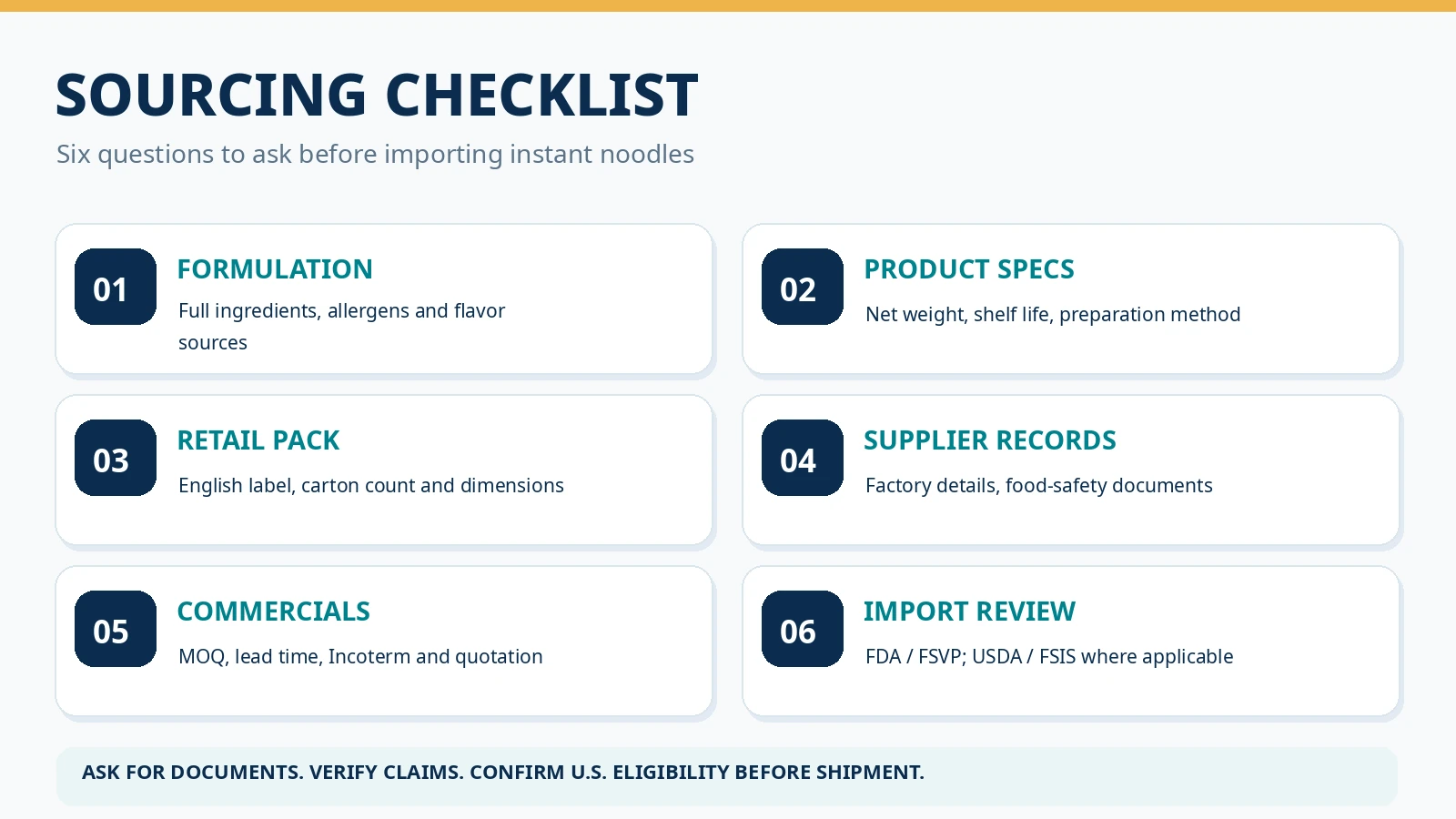
4. Seven Questions to Ask a Vietnamese Instant Noodle Supplier
A well-prepared buyer can reduce unnecessary back-and-forth by requesting the right information at the beginning of the sourcing process.
| No. | Question to Ask | Why It Matters |
|---|---|---|
| 1 | Can you provide the complete ingredient list for each SKU? | Identifies allergens, animal-derived ingredients, and regulatory concerns |
| 2 | What are the confirmed net weight, shelf life, and storage requirements? | Supports product selection and inventory planning |
| 3 | What food safety and manufacturing documents are available? | Supports supplier evaluation |
| 4 | Can the packaging meet the requirements of the destination market? | Helps identify labeling changes before production |
| 5 | What is the MOQ and how many units are packed per carton? | Supports purchasing and freight calculations |
| 6 | What Incoterms, payment terms, and production lead times are available? | Clarifies cost and commercial responsibilities |
| 7 | Can the supplier provide samples and shipment-level documents? | Supports quality review before a larger commitment |
These questions are especially important when comparing suppliers that appear similar based on product photographs alone.
Product Specifications Should Match the Actual Shipment
Buyers should ask whether the technical specification provided during sourcing will apply to the goods eventually shipped.
If ingredients, packaging, or product weight change, the supplier should communicate those changes before the buyer approves an order.
Food Safety Documents Need Verification
A supplier may provide certificates, test reports, manufacturing records, or other evidence.
Buyers should confirm what each document covers, whether it remains valid, and whether the information applies to the products and facility under consideration.
A certificate should never be presented as verified merely because a supplier has sent a photograph of it.
For additional information, see How VEXIM Trade Verifies Suppliers.
5. What Are the U.S. Import Requirements for Instant Noodles?
Instant noodles imported into the United States must meet the requirements applicable to their actual ingredients, classification, manufacturing process, and intended market. Many foods fall under FDA oversight, but products containing certain meat, poultry, or egg ingredients may require additional review under USDA/FSIS and other U.S. rules.
Importers should determine the applicable requirements before making purchasing commitments.
FDA Food Facility Registration
Foreign facilities that manufacture, process, pack, or hold food intended for consumption in the United States may be required to register with the U.S. Food and Drug Administration, unless an exemption applies.
Registration of a food facility is not the same as FDA approval of an individual product.
The FDA states that it does not generally pre-approve individual conventional food products, importers, labels, or shipments before importation.
Official source: FDA – Importing Human Foods.
Prior Notice of Imported Food
Most imported food shipments within FDA's jurisdiction require Prior Notice before arrival in the United States, subject to applicable exemptions.
The submission method and deadline depend on the transaction and transportation arrangements.
Buyers should coordinate with their customs broker and logistics partners to determine who will submit the notification.
Official source: FDA – Prior Notice of Imported Foods.
Foreign Supplier Verification Program (FSVP)
Under FDA's FSVP requirements, covered U.S. importers must evaluate and verify foreign food suppliers to ensure that imported foods meet applicable U.S. safety standards.
This responsibility may include hazard analysis, supplier evaluation, verification activities, and recordkeeping, as appropriate.
FSVP is generally an importer responsibility, although the Vietnamese manufacturer may need to provide supporting information.
Official source: FDA – FSVP Key Requirements.
Packaging and Food Labeling
Retail packaging intended for the United States should be reviewed for applicable requirements, including:
- Product identity.
- Ingredient declaration.
- Major food allergen information.
- Net quantity.
- Nutrition information when required.
- Responsible business information.
- Applicable English-language labeling requirements.
Packaging prepared for another export destination should not automatically be considered suitable for U.S. retail distribution.
USDA/FSIS and Animal-Derived Ingredients
Instant noodle seasoning may include ingredients that require closer regulatory review.
Meat, poultry, and certain egg products fall under different U.S. import requirements. Even when a finished food qualifies for an exemption from certain FSIS inspection requirements, animal-derived ingredients may still need to originate from an eligible source.
For this reason, importers should not determine U.S. eligibility from a label stating "beef flavor" or "chicken flavor."
They should request the complete formulation, ingredient origin information, and a product-specific regulatory assessment.
Official source: USDA/FSIS – Import Guidance.
Important: No product discussed in this article should be assumed to be FDA-approved, USDA-approved, or cleared for U.S. import solely because it is available for sourcing review.
6. Packaging, MOQ and Landed Cost: What Buyers Should Compare
A competitive unit price does not necessarily mean a competitive landed cost.
Before selecting a supplier, buyers should compare both the product and the commercial arrangements.
Minimum Order Quantity
MOQ refers to the minimum quantity a supplier is willing to produce or sell for an order.
It may differ between existing retail packaging, customized labels, and private-label products.
The actual MOQ should be confirmed directly with the manufacturer.
Carton and Shipping Configuration
Buyers should request the number of packs per carton, gross weight, carton dimensions, pallet configuration when relevant, and loading estimates.
These details affect freight planning and warehouse operations.
Incoterms and Quotation Basis
A quotation should state its Incoterm and named place or port.
For example, an FOB quotation and a CIF quotation do not include identical responsibilities or costs.
Buyers should confirm which version of Incoterms is being used and work with their freight forwarder or customs broker when estimating total import expenses.
Estimate the Full Landed Cost
A useful landed-cost review includes the product price, applicable freight and insurance, customs duties, brokerage charges, inland transportation, and other relevant expenses.
Import duties should be verified against the applicable U.S. tariff classification and current measures. They should not be assumed from a generic rate for all goods originating in Vietnam.
The U.S. International Trade Commission's HTS database provides the official U.S. tariff schedule for reference.
7. How to Request a Wholesale Quote from Vietnam
To receive a useful quotation, buyers should specify the product, volume, destination, packaging requirements, and delivery expectations. A vague inquiry such as "please send your best noodle price" usually leaves too many questions unanswered.
A complete sourcing brief should include:
- Company name and destination market.
- Product category: instant pho or instant noodles.
- Preferred flavor and formulation requirements.
- Packaging format and net weight.
- Estimated order quantity.
- Destination port or delivery location.
- Preferred Incoterm.
- Required lead time.
- Documentation and labeling requirements.
- Sample requirements, if any.
Sample Wholesale RFQ
Subject: Vietnamese Instant Noodles – Wholesale Sourcing Inquiry We are a U.S.-based food distributor interested in sourcing Vietnamese instant noodles and instant pho. Please advise available product specifications, ingredient documentation, retail packaging, MOQ, carton configuration, production lead time, and quotation options. Our target market is the United States. We would also like to understand which documents are available for a product-specific U.S. import compliance review. Please indicate whether samples can be arranged before placing a commercial order.
This level of detail gives a sourcing team a clearer starting point for supplier matching.
8. How VEXIM Trade Supports International Buyers
VEXIM Trade helps international buyers connect with Vietnamese producers based on specific sourcing requirements.
Rather than beginning with a long, unfiltered supplier list, our approach begins with the buyer's product brief.
Step 1: Submit Your Sourcing Requirements
Tell us what you are looking for, including product type, volume, preferred specifications, destination market, and purchasing timeline.
Step 2: Review Potential Supplier Matches
We assess the request against relevant producer information and identify the details that need confirmation.
For instant noodles and pho, this may include formulation, available packaging, commercial capacity, and export documentation.
Step 3: Understand What Is Verified
Our sourcing approach distinguishes between three types of information:
| Information Status | Meaning |
|---|---|
| Stated | Information supplied by the producer |
| Verified | Information checked against available evidence |
| Still Open | Information awaiting documentation or further confirmation |
This distinction helps buyers understand what they can rely on and what needs further due diligence.
Step 4: Move Toward a Commercial Discussion
Where a suitable sourcing option is available, the next steps may involve product specifications, samples, supplier discussions, quotations, and order preparation.
Product availability, response time, quotations, and specific services remain subject to the request and supplier confirmation.
VEXIM Trade also works with other Vietnamese food categories. Buyers sourcing multiple products can consult our guide to importing cashew kernels from Vietnam for another example of supplier screening.
9. Frequently Asked Questions
Can I import Vietnamese instant noodles into the United States?
Potentially, yes. Eligibility depends on the product's ingredients, classification, origin, and applicable U.S. import rules. A product-specific review should be completed before shipment.
Are Vietnamese instant pho and instant noodles the same product?
Not necessarily. Instant pho may use rice-based noodles and a pho-style broth, while other instant noodle products may use different noodle ingredients, textures, and seasoning formulations.
Does FDA approve individual instant noodle products before importation?
FDA does not generally pre-approve individual conventional food products before importation. Applicable food safety, registration, notification, and labeling requirements must still be met.
Can beef- or chicken-flavored instant noodles be imported into the U.S.?
Their eligibility must be determined from the actual ingredients, ingredient sources, and relevant FDA, USDA/FSIS, APHIS, or other import requirements. The flavor name alone is not sufficient.
What is the minimum order quantity for Vietnamese instant noodles?
MOQ varies by manufacturer, product, packaging format, and customization requirements. Buyers should request written confirmation rather than relying on a general industry estimate.
Can I source private-label instant noodles from Vietnam?
Private-label production may be possible with suitable manufacturers. Buyers should confirm OEM capability, formulation options, minimum production quantities, packaging requirements, and lead times.
How can I contact VEXIM Trade for a sourcing quotation?
Submit your product requirements through the VEXIM Trade sourcing request form or contact the sourcing team by email.
Ready to Source Vietnamese Instant Noodles or Pho?
Looking for Vietnamese instant noodles or instant pho for your distribution business?
Tell VEXIM Trade what you need. Share your preferred product, target quantity, packaging requirements, destination market, and delivery expectations.
We can review your sourcing request, identify what information is available, and clarify which details still require confirmation with potential producers.
Email: sales@veximtrade.com
Website: https://www.veximtrade.com/
Disclaimer: This article provides general sourcing and regulatory information as of October 17, 2026. It does not confirm that any pictured product is eligible for U.S. import. Product-specific requirements should be reviewed with the relevant U.S. authorities, qualified compliance professionals, and customs brokers before shipment.
Sourcing request
Have a product in mind? Send us your brief.
We match it to a Vietnamese producer that fits, and tell you plainly when none does. A written reply by the start of your next business day.
Request a quote