
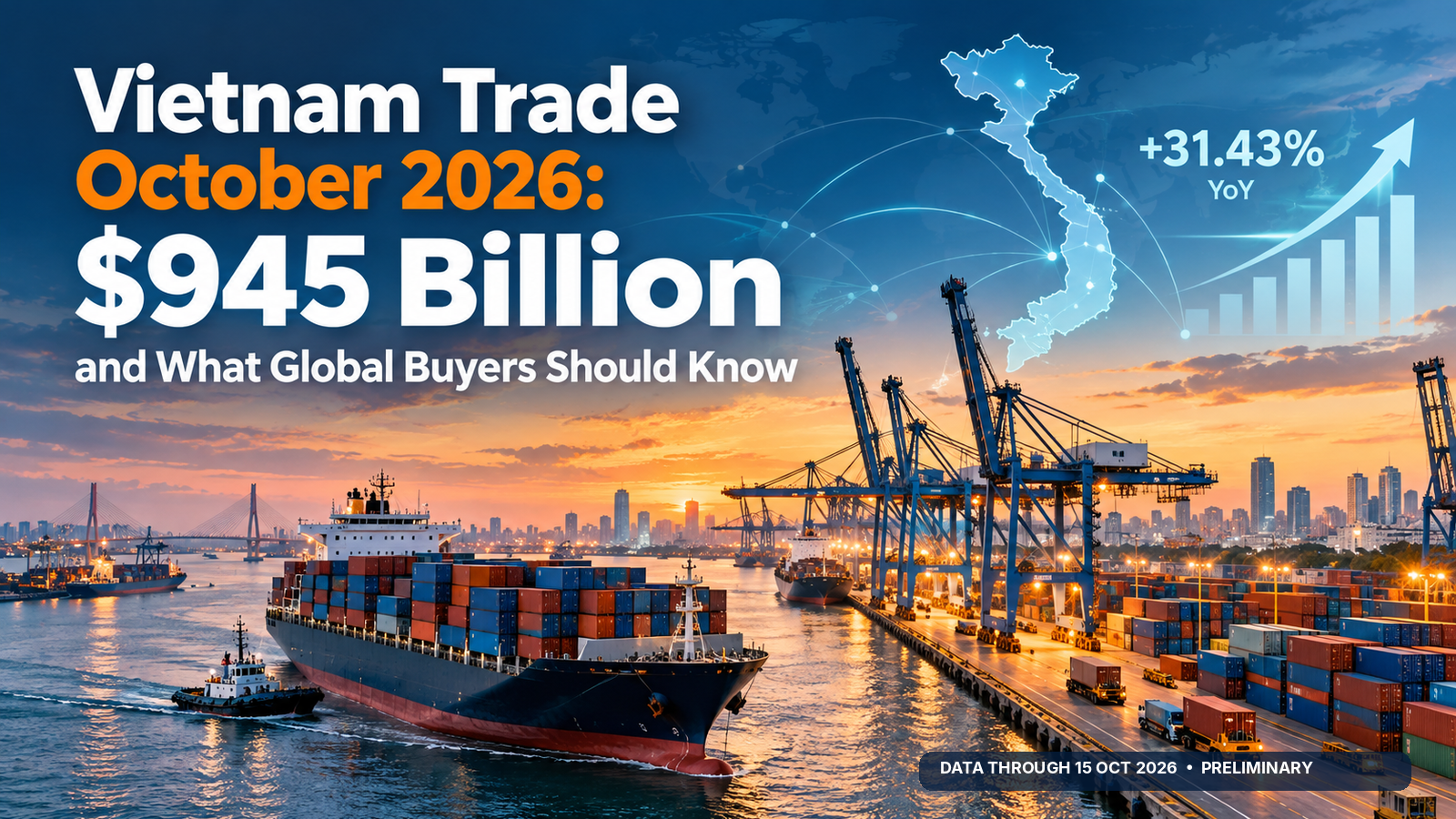
Vietnam Trade October 2026: $945 Billion and What Global Buyers Should Know
Vietnam Trade October 2026 is approaching a historic $1 trillion milestone in total merchandise trade. Preliminary customs figures show $945.07 billion in combined exports and imports by October 15, alongside a $1.82 billion surplus in the first half of the month. Discover what these developments reveal about Vietnam's manufacturing ecosystem, global sourcing opportunities, and supplier verification priorities for international buyers.
By Dang Duc Dung·Published
In this article
Vietnam Trade October 2026: What Does the $945 Billion Milestone Mean?
Vietnam's merchandise trade reached 945.07 billion during the first nine and a half months of 2026, bringing the country close to the1 trillion threshold in combined exports and imports. The figure reflects substantial cross-border commercial activity, but it does not represent export revenue alone. International buyers should examine both the scale of trade and the structure of participating industries when evaluating Vietnam as a sourcing market.
According to preliminary data from Vietnam Customs, reported by VnEconomy and Tuoi Tre News, total trade turnover increased by more than 31% compared with the same period last year.
By October 15, Vietnam had recorded:
- $945.07 billion in combined merchandise trade.
- $463.70 billion in total merchandise exports.
- $481.37 billion in total merchandise imports.
- $17.67 billion in cumulative trade deficit.
- 31.43% growth in total trade turnover year over year.
The country was approximately 54.93 billion away from reaching1 trillion in combined trade.
While this development signals the increasing size of Vietnam's participation in international commerce, the final milestone had not been reached as of the reporting cutoff.
Why Is Total Trade Turnover Important for International Buyers?
Total trade turnover measures the combined value of exported and imported merchandise over a defined period. For international buyers, it provides a broad indication of commercial activity, manufacturing integration, and cross-border supply chain participation. However, a high trade value does not automatically guarantee that individual suppliers can meet a buyer's specifications, quality requirements, or delivery schedules.
A country with expanding trade activity may offer access to more established logistics connections, experienced exporters, and industrial supply networks.
At the same time, trade figures must be interpreted carefully because they include imports of materials and components used in manufacturing.
Buyers should therefore combine national market data with direct supplier assessments.
Source: Vietnam Customs preliminary statistics, reported by VnEconomy, October 26, 2026.
What Are the Latest Vietnam Export and Import Figures for October 2026?
Vietnam's latest available customs figures show 29.25 billion in merchandise exports and27.43 billion in imports during October 1–15, 2026. Compared with the first half of September, exports increased by 12.41% while imports declined by approximately 4.9%. This produced a $1.82 billion trade surplus for the 15-day period, although the broader year-to-date trade balance remained negative.
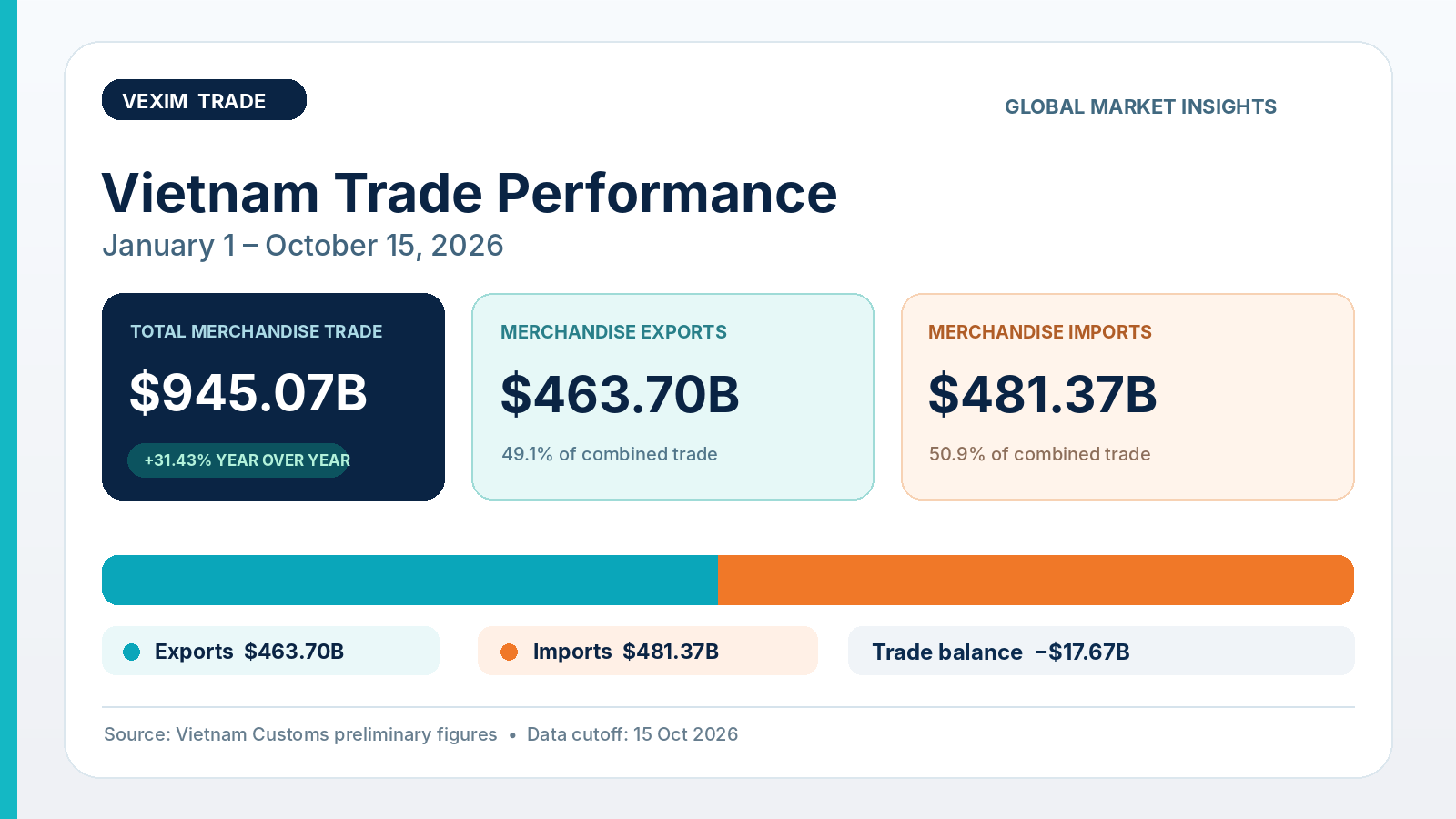
Vietnam Trade Performance – Latest Available Figures
| Indicator | Value | Reporting period |
|---|---|---|
| Total merchandise trade | $945.07 billion | January 1–October 15 |
| Total merchandise exports | $463.70 billion | January 1–October 15 |
| Total merchandise imports | $481.37 billion | January 1–October 15 |
| Cumulative trade balance | -$17.67 billion | January 1–October 15 |
| Merchandise exports | $29.25 billion | October 1–15 |
| Merchandise imports | $27.43 billion | October 1–15 |
| Trade surplus | +$1.82 billion | October 1–15 |
| Growth in cumulative trade | +31.43% | Year over year |
Sources: Vietnam Customs preliminary statistics; VnEconomy, VOV, and AsemconnectVietnam.
The results indicate strong overall trading activity, supported by a sharp increase in exports during the first half of October.
However, short reporting periods can fluctuate due to shipment schedules, customs clearance timing, and other factors.
Buyers should avoid treating a 15-day increase as proof that every industry is experiencing the same growth.
The more useful approach is to evaluate the sectors, companies, and supply chains responsible for the expansion.
Which Industries Are Driving Vietnam's Export Growth in 2026?
Vietnam's export growth in 2026 has been driven largely by manufacturing industries, particularly electronics, machinery, and related industrial supply chains. Preliminary customs data through October 15 show that the three largest export categories accounted for more than half of the country's merchandise export value. This concentration highlights Vietnam's manufacturing scale while also indicating that growth is uneven across different industries.
Major Export Categories – January 1 to October 15, 2026
| Export category | Export value | Market significance |
|---|---|---|
| Computers, electronics and components | $135.31 billion | Largest export category |
| Machinery, equipment and spare parts | $58.62 billion | Major industrial export segment |
| Phones and components | $54.34 billion | Significant technology supply chain segment |
Source: Vietnam Customs preliminary statistics, reported by Tuoi Tre News on October 27, 2026.
Together, these three categories accounted for approximately 53.5% of Vietnam's merchandise exports during the period.
Electronics and related products were the largest contributor, reflecting the scale of manufacturing operations connected to international companies.
Other export industries also contribute to Vietnam's broader trading ecosystem, although their growth rates and commercial conditions differ.
For international buyers, these figures demonstrate that Vietnam's export economy is not dependent on a single industry.
Nevertheless, successful sourcing requires analysis at the individual supplier level rather than relying on national export rankings.
Why Are Foreign-Invested Enterprises Important to Vietnam's Trade Growth?
Foreign-invested enterprises play a central role in Vietnam's export economy because they account for a large share of manufacturing and cross-border shipments. By October 15, 2026, companies in the foreign-invested sector had generated approximately $374.27 billion in exports, representing around 80.7% of national export value. Their contribution underscores Vietnam's integration into international production networks.
Foreign-invested enterprises also accounted for roughly $356.49 billion in imports during the same period.
Their activities often involve importing machinery, materials, or intermediate goods and exporting manufactured products through international supply chains.
This structure creates opportunities for supporting businesses, including domestic manufacturers, service providers, and subcontractors.
However, the significant share of foreign-invested companies also raises an important consideration for buyers: not every exporter operating in Vietnam is a locally owned manufacturer.
Some suppliers are foreign-invested factories, while others are domestic manufacturers or trading companies working with production partners.
International buyers should confirm the legal identity and operational role of each potential supplier.
The goal is to understand who manufactures the goods, who controls quality, and who is responsible for fulfilling the export contract.
Source: Tuoi Tre News – Vietnam's Export Growth, October 27, 2026.
Does Vietnam's October Trade Surplus Mean the Overall Deficit Has Ended?
Vietnam recorded a merchandise trade surplus of approximately 1.82 billion during the first half of October 2026, but its cumulative trade deficit had not disappeared. By October 15, imports still exceeded exports by roughly17.67 billion for the year. The short-term surplus improved the overall balance without reversing it, making the distinction between period-specific and cumulative figures essential.
According to Vietnam's National Statistics Office, the country recorded a $1.27 billion trade surplus in September after a prolonged sequence of monthly deficits.
The improvement continued during October 1–15, when exports increased and imports declined compared with the corresponding September reporting period.
However, the January–September trade deficit stood at $19.42 billion, showing how substantial earlier import growth had been.
Several factors may influence Vietnam's trade balance during the remainder of 2026, including:
- Demand for Vietnamese exports in major international markets.
- Purchases of imported manufacturing inputs and capital goods.
- Production schedules and changes in factory utilization.
- International shipping and customs clearance conditions.
- Changes in trade policies and purchasing behavior.
For international buyers, the current surplus is a useful economic indicator, but it should not be interpreted as a guarantee of lower prices, stronger supplier finances, or uninterrupted deliveries.
Source: National Statistics Office of Vietnam – Q3 and Nine-Month Economic Report, October 2026.
What Does Vietnam's Trade Expansion Mean for Global Sourcing Opportunities?
Vietnam's expanding trade activity may encourage international buyers to assess the country as part of a broader sourcing and supply chain diversification strategy. Strong export performance indicates substantial participation in global manufacturing, but it does not establish that Vietnam is the best sourcing location for every transaction. Buyers must compare supplier capabilities, compliance requirements, pricing, and delivery performance.
1. Broader Access to Manufacturing and Supplier Networks
Expanding export activity suggests that Vietnam continues to participate in diverse international manufacturing and production networks. For global buyers, this may create opportunities to identify factories, trading companies, and supporting suppliers across different industries. However, the availability of commercially suitable suppliers depends on production requirements, minimum order quantities, certifications, and the ability to meet destination-market regulations.
Businesses evaluating potential suppliers should begin with clear technical specifications and purchasing requirements.
A well-defined sourcing request helps suppliers provide relevant quotations and reduces misunderstandings during negotiations.
Buyers should also determine whether they require direct factory production or can work through an experienced trading company.
2. Opportunities to Diversify International Supply Chains
Supplier diversification can help international businesses reduce excessive dependence on a single sourcing location or commercial partner. Vietnam may form part of a diversified procurement network when local suppliers satisfy the buyer's operational and regulatory requirements. However, sourcing from multiple countries introduces coordination costs, documentation requirements, and quality-control challenges that must be considered alongside potential benefits.
Businesses should compare alternative suppliers using consistent evaluation criteria.
These include production capacity, quality performance, financial and contractual terms, delivery reliability, and overall landed costs.
Diversification is most effective when backup suppliers have been qualified before a disruption occurs.
3. Stronger Need for Reliable Supplier Verification
As international buyers explore new supply relationships, supplier verification becomes increasingly important for reducing commercial and operational uncertainty. National export growth cannot confirm the reliability of any individual company. Buyers should independently assess business registration, manufacturing evidence, quality procedures, and previous shipment records before entering agreements with unfamiliar suppliers.
Basic verification steps should include reviewing legal documents, confirming production capabilities, and examining relevant certifications where required.
For higher-value or technically complex transactions, buyers may also consider independent factory audits, product testing, and pre-shipment inspections.
These measures support informed sourcing decisions without assuming that every supplier in a growing export market offers the same level of reliability.
How Can International Buyers Find Reliable Vietnamese Suppliers in 2026?
International buyers can identify potential Vietnamese suppliers through business directories, sourcing platforms, trade associations, exhibitions, and direct manufacturer outreach. The most effective process begins with clear product requirements and continues through supplier screening, quotation comparison, documentation checks, and quality verification. Buyers should evaluate commercial suitability before committing to orders or payments.
Step 1: Define Clear Purchasing Requirements
Buyers should prepare a detailed purchasing brief before contacting manufacturers or trading companies in Vietnam. The document should identify required specifications, expected quantities, quality standards, destination market, and preferred delivery conditions. Clear requirements make quotations easier to compare and help suppliers determine whether they can realistically fulfill the order.
A sourcing brief should normally contain:
- Product specifications and applicable standards.
- Expected order volumes and target delivery schedule.
- Packaging and labeling requirements.
- Destination country and preferred shipping terms.
- Required inspections, testing, or certifications.
- Payment and documentation expectations.
Specific requirements reduce unnecessary negotiations with unsuitable suppliers.
Step 2: Compare Quotations and Total Delivered Costs
Supplier quotations should be compared using consistent commercial terms rather than factory prices alone. Differences in Incoterms, packaging, quality requirements, freight, insurance, customs duties, and payment conditions can materially change the final purchasing cost. International buyers should therefore establish a common cost-comparison framework before selecting a supplier or negotiating final contract terms.
For example, an EXW quotation and an FOB quotation cannot be compared directly without accounting for their different responsibilities and included costs.
Buyers should also confirm whether quotations cover inspection expenses, documentation fees, and other required services.
The objective is to identify the supplier offering the most suitable total commercial package, not simply the lowest initial price.
Step 3: Verify Supplier Documents and Delivery Capabilities
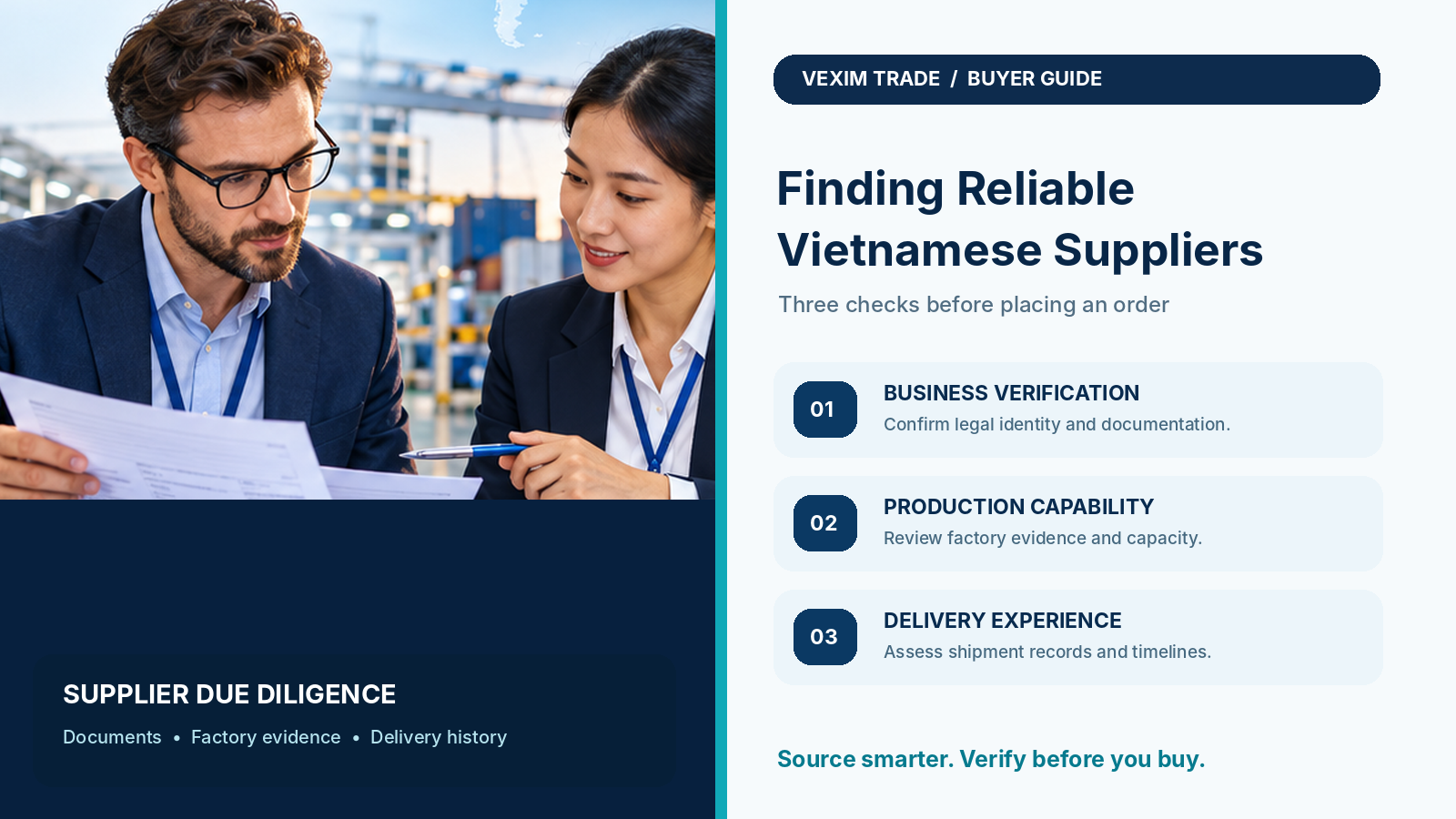
Supplier verification should establish whether a potential business partner is legitimate, operationally capable, and suitable for the intended transaction. Buyers should review company registration information, production evidence, relevant certifications, and available shipment records. Different types of suppliers require different checks, and a trading company should not automatically be assessed as though it owns a factory.
VEXIM Trade describes three independently approved supplier checks:
- Document review.
- Factory verification.
- Delivery history review.
Each approved check is recorded separately, allowing buyers to understand which aspects of a supplier have been examined.
These checks do not guarantee product quality or replace independent inspections, legal review, or contractual protections.
Learn more about the process through VEXIM Trade's Supplier Verification Guide.
What Should Importers Monitor in November 2026?
International buyers should monitor Vietnam's next official trade statistics, manufacturing activity, supplier delivery conditions, and changes in destination-market regulations during November 2026. The latest data show strong commercial activity, but a national trade milestone does not predict future shipment performance. Procurement teams should use updated information to refine sourcing plans rather than assuming that recent export growth will continue unchanged.
Key Market Indicators for International Buyers
| Indicator to monitor | Why it matters | Recommended action |
|---|---|---|
| Total trade turnover | Measures overall commercial activity | Follow updated customs data |
| Export performance | Helps identify changes in external demand | Compare relevant industry trends |
| Import demand | Reflects purchases of materials and capital goods | Monitor supplier input availability |
| Manufacturing activity | Indicates changes in industrial conditions | Reconfirm production lead times |
| Freight and logistics conditions | Influence shipment cost and reliability | Request updated logistics quotations |
| Trade and customs regulations | Affect import eligibility and duties | Verify official destination-market requirements |
The approach is particularly relevant for buyers preparing long-term supply agreements or considering additional sourcing markets.
Instead of making decisions from one headline, businesses should combine market research with supplier-level evidence.
Frequently Asked Questions About Vietnam Trade October 2026
Vietnam Trade October 2026 has attracted attention as the country's merchandise trade approaches $1 trillion, raising questions about export performance and sourcing opportunities. International buyers need to understand the difference between total trade and exports, the role of foreign-invested manufacturers, and the practical requirements for purchasing from Vietnam. These answers summarize the most relevant considerations using the latest available data.
1. Has Vietnam Reached $1 Trillion in Total Trade in 2026?
As of the latest figures reviewed on October 28, Vietnam had not yet reached 1 trillion in merchandise trade. Preliminary customs data showed945.07 billion in combined exports and imports through October 15. The country was approximately $54.93 billion below the milestone. Whether and when the threshold is reached will depend on subsequent reported trade activity.
2. What Is Vietnam's Total Export Value in October 2026?
Vietnam recorded 463.70 billion in cumulative merchandise exports from January 1 to October 15, 2026. Exports during the first half of October alone reached approximately29.25 billion. These figures should not be confused with the $945.07 billion total trade turnover, which includes both exports and imports. The October figures remain preliminary and do not represent the completed month.
3. Is Vietnam Currently Recording a Trade Surplus or Deficit?
Vietnam recorded a 1.82 billion merchandise trade surplus during October 1–15, 2026. However, the cumulative balance from January 1 to October 15 remained in deficit at approximately17.67 billion. Both figures are correct because they describe different reporting periods. Buyers should always check the relevant dates before interpreting trade balance headlines.
4. Why Are Foreign-Invested Companies Important to Vietnam's Exports?
Foreign-invested enterprises accounted for approximately 80.7% of Vietnam's total merchandise exports through October 15, 2026. Their large presence reflects the country's participation in international manufacturing networks. However, foreign-invested factories, domestic producers, and trading companies operate under different commercial structures. Buyers should evaluate each potential supplier's legal status, actual operations, and ability to fulfill export orders.
5. Does Strong Export Growth Mean Vietnamese Suppliers Are More Reliable?
No. Strong national export growth reflects aggregate trade performance, not the reliability of every supplier operating in the country. International buyers should verify business documents, assess production or trading capabilities, check relevant quality requirements, and review shipment evidence where available. Direct supplier due diligence remains essential regardless of how quickly a country's exports are growing.
6. How Can Buyers Explore Sourcing Opportunities Through VEXIM Trade?
International buyers can explore sourcing opportunities through VEXIM Trade and review the platform's supplier verification process. Businesses should prepare clear specifications, expected quantities, and destination-market requirements before submitting a sourcing enquiry. Supplier availability and suitability depend on the requested category and individual company capabilities, while buyers remain responsible for appropriate due diligence.
Conclusion: What Does Vietnam's Trade Growth Signal for Global Buyers?
Vietnam Trade October 2026 demonstrates the country's expanding integration into international commerce, with total merchandise trade reaching $945.07 billion by mid-month. Strong exports, substantial manufacturing imports, and the significant role of foreign-invested enterprises illustrate both the opportunities and complexities of the country's supply chain ecosystem. International buyers should interpret these developments as market signals rather than guarantees of supplier performance.
Vietnam's growing trade activity may encourage businesses to explore new purchasing relationships and diversify existing procurement networks.
However, successful international sourcing still depends on reliable suppliers, accurate documentation, competitive commercial terms, and consistent quality management.
As the country approaches the $1 trillion trade milestone, buyers who combine market intelligence with structured supplier evaluation may be better equipped to make informed purchasing decisions.
Explore Global Sourcing Opportunities With VEXIM Trade
VEXIM Trade provides a platform for international buyers interested in exploring sourcing relationships with Vietnamese businesses. As Vietnam's international trade expands, reliable supplier information and clear purchasing requirements become increasingly important. Buyers can review the platform's verification approach and submit sourcing enquiries to explore potentially suitable suppliers, subject to category availability and individual supplier qualifications.
Looking for reliable sourcing opportunities in Vietnam?
Explore potential Vietnamese suppliers and learn how VEXIM Trade evaluates business documents, factory evidence, and delivery history.
Visit VEXIM Trade | How We Verify Suppliers | Submit a Sourcing Request
Connect with Vietnamese suppliers. Explore opportunities. Source with greater confidence.
References
- AsemconnectVietnam – Vietnam Records Trade Surplus for Second Consecutive Period, October 28, 2026
- Tuoi Tre News – Which Products Are Driving Export Growth as Vietnam's Trade Turnover Pushes Toward $1 Trillion?, October 27, 2026
- VnEconomy – Vietnam's Trade Turnover Reaches $945 Billion by Mid-October, October 26, 2026
- Voice of Vietnam – Trade Turnover Surpasses $945 Billion by Mid-October, October 20, 2026
- National Statistics Office of Vietnam – Q3 and Nine-Month Socioeconomic Report, October 2026
Editorial cutoff: October 28, 2026. The latest merchandise trade data discussed in this article cover transactions through October 15, 2026. Figures are preliminary and may be revised.
Sourcing request
Have a product in mind? Send us your brief.
We match it to a Vietnamese producer that fits, and tell you plainly when none does. A written reply by the start of your next business day.
Request a quoteRelated news
October 27, 2026
US-Canada Tariff Talks October 2026: What Global Buyers Need to KnowOctober 28, 2026
Vietnam EFTA Free Trade Agreement 2026: New Opportunities for Global BuyersOctober 27, 2026
Global Shipping Costs Rise in October 2026