
Vietnamese Food Wholesale Suppliers: US Buyer Guide
Looking for Vietnamese food wholesale suppliers? Explore cashews, instant noodles and pho, supplier verification, US import requirements and RFQ preparation.
By Dang Duc Dung·Published
In this article
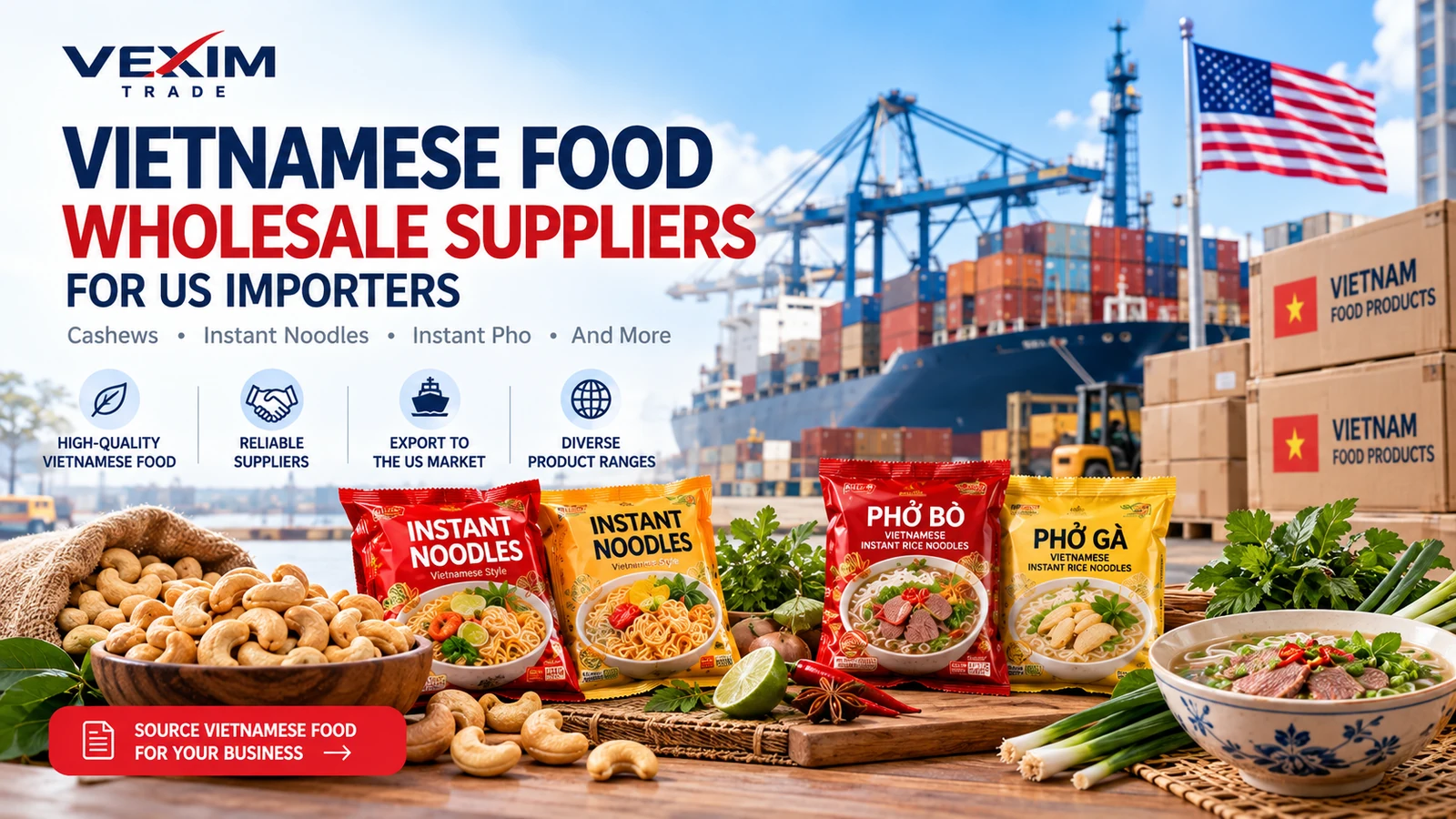
Vietnamese food wholesale suppliers can offer US importers a range of products, including cashew kernels, packaged instant noodles, and Vietnamese instant pho. However, finding a suitable supplier requires more than reviewing a catalogue. Buyers should confirm product specifications, manufacturing documents, minimum order quantities, packaging requirements, and applicable US import rules before requesting commercial quotations or approving shipments.
For importers, distributors, and food wholesalers, Vietnam is a sourcing market worth evaluating for both food ingredients and retail-ready products.
This guide explains which product categories to consider, how to compare suppliers, what documents to request, and how to prepare a sourcing inquiry through VEXIM Trade.
1. Why Choose Vietnamese Food Wholesale Suppliers?
Vietnamese food wholesale suppliers may be suitable for importers seeking agricultural products, packaged Asian foods, and Vietnamese-inspired retail products. Different manufacturers specialize in different categories, so buyers should match suppliers with their exact product requirements. Price, product consistency, documentation, production capability, and import eligibility should all be reviewed before selecting a commercial partner.
A Range of Food Categories
Vietnamese food wholesale suppliers offer sourcing opportunities across several product categories, including cashew kernels, instant noodles, instant pho, rice-based products, and packaged foods. Each category serves different buyer needs, from bulk ingredients for food manufacturers to retail-ready products for distributors. US importers should evaluate product specifications, supplier capabilities, available documentation, and applicable import requirements before selecting products for their wholesale portfolios.
Opportunities for Wholesale and Retail Distribution
Vietnamese food products can serve multiple distribution channels, including wholesale importers, foodservice suppliers, Asian grocery stores, and supermarket distributors. Wholesale buyers often prioritize consistent specifications, competitive landed costs, and reliable delivery, while retail buyers also evaluate packaging, labeling, shelf life, and consumer demand. Understanding these differences helps importers select suitable Vietnamese food suppliers and develop a sourcing strategy aligned with their target market.
Each channel has different purchasing expectations. Foodservice customers may prioritize standardized pack sizes and consistency, while retail distributors also consider consumer-facing packaging, shelf presentation, and labeling.
Supplier Verification Remains Essential
Supplier verification is essential when sourcing wholesale food from Vietnam because product quality, manufacturing capabilities, and regulatory documentation can vary between suppliers. US importers should confirm the manufacturer's identity, review product specifications, evaluate relevant food safety records, and verify production and shipping capabilities. A reliable sourcing process should clearly distinguish supplier-provided claims from information supported by evidence before buyers proceed with commercial orders.
A supplier should be evaluated against the specific product, factory location, available documents, quotation terms, and manufacturing capabilities involved in the transaction. Buyers should distinguish information stated by a supplier from information supported by verifiable evidence.
2. Which Vietnamese Food Products Can Buyers Source?
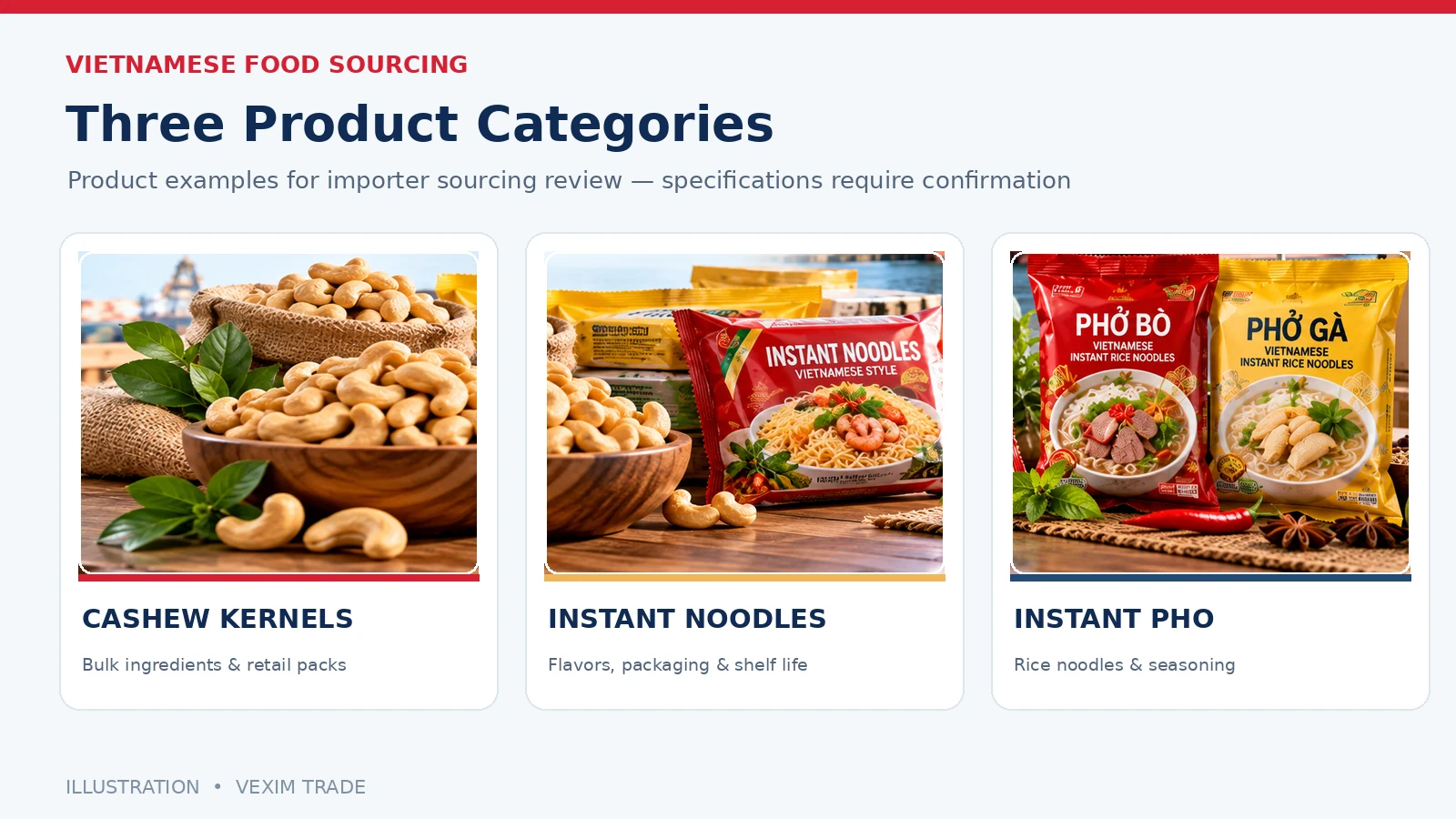
Buyers evaluating wholesale food from Vietnam can begin with three practical categories: cashew kernels, instant noodles, and instant pho. Each category serves different purchasing needs and has its own specification, packaging, and regulatory considerations. Product availability, pricing, production capacity, and suitability for the US market must be confirmed for the individual supplier and SKU.
| Product Category | Common Buyer Needs | Important Checks |
|---|---|---|
| Cashew kernels | Bulk ingredients, food processing, retail packaging | Grade, moisture, defects, allergens, packaging |
| Instant noodles | Grocery distribution and packaged-food sales | Ingredients, net weight, shelf life, labeling |
| Instant pho | Asian food distribution and specialty retail | Rice noodle specifications, seasoning, animal-derived ingredients |
These categories represent potential sourcing inquiries, not guaranteed inventory or confirmed product certifications.
Vietnamese Cashew Kernels
Cashew buyers should specify the required commercial grade, kernel condition, moisture requirements, packaging format, and intended use.
Specifications may differ between whole kernels and broken-kernel grades.
A quotation for one grade should not be compared directly with an offer for another grade unless the difference is clearly understood.
For a category-specific guide, read How to Import Cashew Kernels from Vietnam.
Vietnamese Instant Noodles
Instant noodles can be evaluated for specialty grocery distribution, wholesale food channels, and selected retail portfolios.
Buyers should request ingredient declarations, allergen details, retail pack specifications, carton configuration, and manufacturer information.
Products prepared for other export destinations may need packaging or labeling changes before being distributed in the United States.
Vietnamese Instant Pho
Instant pho may include packaged beef-style and chicken-style varieties.
Buyers should check the rice noodle composition, seasoning formulation, ingredient origin, storage conditions, and packaging specifications.
A product labeled "beef flavor" or "chicken flavor" must not be assumed to contain, or be free of, particular animal-derived ingredients without reviewing the actual formulation.
Import eligibility requires a separate assessment based on the product.
3. How to Compare Vietnamese Food Wholesale Suppliers
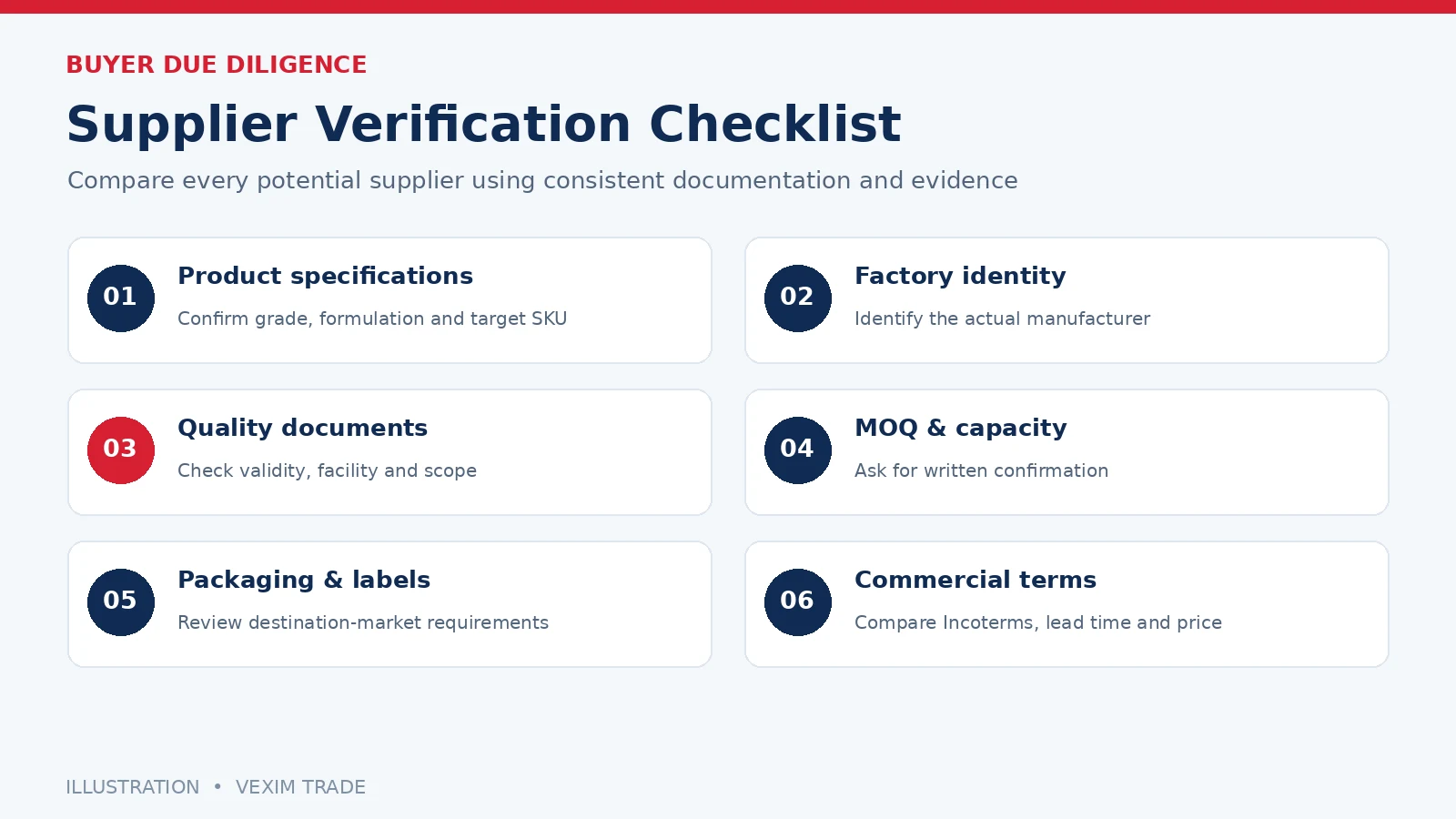
The most reliable supplier comparison uses the same requirements for every candidate. Buyers should request consistent information on product quality, manufacturing records, capacity, MOQ, packaging, and export terms. This prevents a low headline price from overshadowing important differences in product specifications, documentation, or commercial responsibilities.
| Evaluation Area | Questions to Ask | Evidence to Request |
|---|---|---|
| Product specifications | Does the SKU match our requirements? | Technical specification sheet |
| Manufacturer identity | Who manufactures and packs the product? | Company and facility information |
| Quality controls | Which controls apply to this product? | Relevant records and certificates |
| Commercial capacity | Can the supplier fulfill our proposed order? | Written capacity and lead-time confirmation |
| Packaging | Is the format suitable for our sales channel? | Pack and carton specifications |
| Pricing | What is included in the quotation? | Quote with Incoterm and validity |
| Shipment preparation | What documents can be provided? | Proposed export document list |
Confirm the Manufacturing Facility
A trading company, exporter, and manufacturer may be different legal entities.
Buyers should clarify which company is responsible for production and which company will issue the commercial documents.
Review Supporting Documents
Certificates, audit reports, and product test results should be reviewed for validity, scope, and relevance.
A certificate covering one factory or product line should not automatically be treated as evidence for another facility or SKU.
Evaluate Delivery Reliability
Buyers should ask about production lead time, carton packing, order confirmation procedures, and shipment coordination.
Past transactions, where appropriately documented, may help assess supplier performance. They should not be invented or presented as verified without supporting evidence.
4. What US Import Requirements Apply to Vietnamese Food?
US food import requirements depend on the product, ingredients, processing method, and regulatory classification. FDA oversees many conventional foods, while USDA/FSIS and APHIS requirements can apply to certain meat, poultry, egg, and animal-origin ingredients. Buyers should determine the relevant rules for each product before shipment rather than assuming that every packaged Vietnamese food follows one process.
FDA Food Facility Registration
Foreign facilities that manufacture, process, pack, or hold foods for consumption in the United States may need FDA food facility registration unless an exemption applies.
Registration does not mean FDA has approved an individual product.
FDA explains that it does not generally pre-approve conventional food products, importers, labels, or shipments before importation.
Official source: FDA – Importing Human Foods.
Prior Notice of Imported Food
Most FDA-regulated food shipments require Prior Notice before arrival, subject to applicable exemptions.
Importers should coordinate submission responsibilities and deadlines with their customs broker, logistics partner, or other responsible party.
Official source: FDA – Prior Notice of Imported Foods.
Foreign Supplier Verification Programs (FSVP)
Covered US importers must establish and follow appropriate foreign supplier verification procedures under the FSVP rule.
These can involve hazard analysis, supplier evaluation, verification activities, corrective actions, and recordkeeping, as applicable.
The manufacturer may need to provide technical and food safety information to support the importer.
Official source: FDA – FSVP Requirements.
USDA Requirements for Certain Ingredients
Some packaged foods contain meat, poultry, or egg ingredients that require additional assessment.
A product may be subject to USDA/FSIS oversight or particular ingredient-source conditions, even when its overall appearance resembles an ordinary instant noodle product.
Importers should review the actual formulation and country-of-origin information rather than relying on flavor names.
Official source: USDA/FSIS – Import Guidance.
5. What Documents Should US Buyers Request?
US buyers should request documentation that identifies the product, manufacturer, ingredients, packaging, safety controls, and proposed commercial terms. The exact document set varies by food category and transaction. Requesting complete information early helps importers evaluate the supplier, identify regulatory questions, and avoid delays when discussing samples or commercial shipments.
A practical starting checklist includes:
- Company profile and manufacturing facility information.
- Product technical specification.
- Complete ingredient list and allergen information.
- Relevant food safety documentation.
- Shelf-life and storage information.
- Retail and carton packaging specifications.
- MOQ, lead time, and quotation terms.
- Available export and shipment documents.
For bulk cashews, additional grading and quality information may be important. For instant noodles and pho, the formulation and consumer-facing label deserve particular attention.
Documentation should be assessed for the actual product being sourced.
6. MOQ, Packaging, and Landed Cost: What Matters Most?
Wholesale purchasing decisions should consider more than the factory unit price. MOQ, case packing, Incoterms, freight, duties, customs charges, and delivery requirements affect total landed cost. Buyers should compare quotations using equivalent product specifications and shipping assumptions to avoid misleading price comparisons between manufacturers.
Minimum Order Quantity
MOQ can depend on the product, existing packaging, customization, production schedule, and factory policy.
An established branded product may have different order requirements from a private-label product.
Buyers should request written MOQ confirmation for each SKU.
Carton and Packaging Specifications
Useful details include units per case, net and gross weight, case dimensions, storage requirements, and palletization where applicable.
These details support freight planning and warehouse operations.
Incoterms and Total Cost
The chosen Incoterm determines important responsibilities between buyer and seller.
Importers should calculate landed cost using the actual quotation, applicable freight and insurance, current import duties, brokerage expenses, and domestic logistics costs.
The official US tariff schedule can be consulted through the US International Trade Commission.
7. How to Request Quotes from Vietnamese Food Wholesale Suppliers
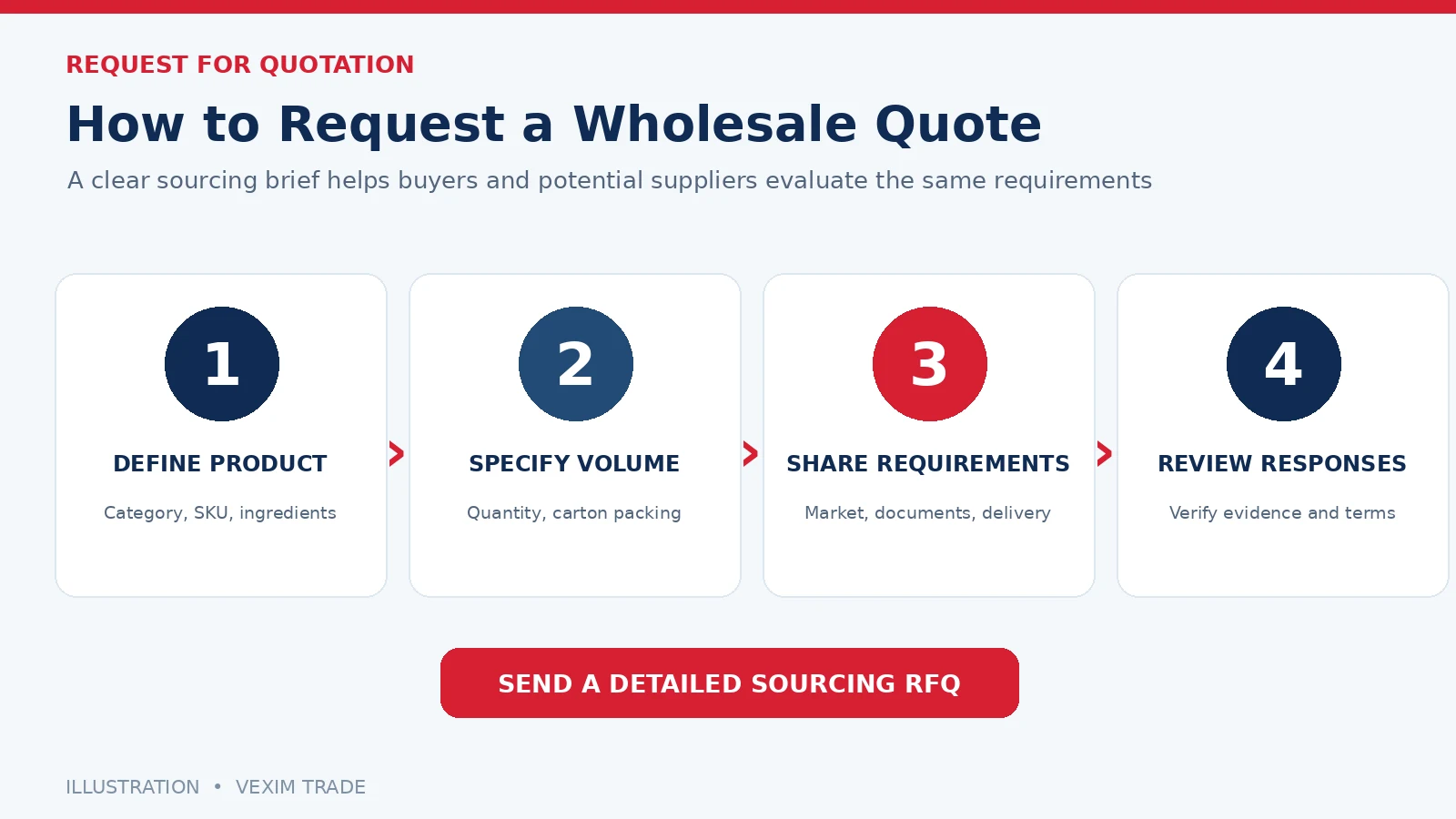
To request accurate wholesale food quotations from Vietnam, buyers should specify the product category, technical requirements, quantity, packaging, destination, and intended purchasing schedule. This allows a sourcing partner to identify potential supplier matches and determine which information remains to be confirmed. A detailed inquiry is more useful than asking several manufacturers for a general price list.
RFQ Information Checklist
| Information | Example of What to Provide |
|---|---|
| Product | Cashew kernels, instant noodles, or instant pho |
| Specification | Grade, flavor, formulation, or pack size |
| Quantity | Estimated order volume |
| Packaging | Bulk carton, retail pack, or other format |
| Destination | Country and delivery location |
| Compliance | Required documents and labeling |
| Commercial terms | Preferred Incoterm and purchasing timeline |
Sample Wholesale Food RFQ
Subject: Vietnamese Food Wholesale Sourcing Inquiry
Hello VEXIM Trade Team,
We are a US-based importer interested in sourcing food products from Vietnam.
Our product categories include cashew kernels, instant noodles, and instant pho.
Please advise which sourcing opportunities may be available, together with product specifications, manufacturer details, estimated MOQ, available documentation, packaging options, lead times, and quotation procedures.
We would also like to understand which supplier claims have been verified and which information remains subject to confirmation.
Our destination market is the United States.
Thank you.
8. How VEXIM Trade Supports International Food Buyers
VEXIM Trade provides a starting point for international buyers seeking suitable Vietnamese sourcing opportunities. The process begins with a purchasing brief and an assessment of available supplier information. Product availability, pricing, certifications, verification status, and commercial capacity must be confirmed for each inquiry rather than assumed from general product listings.
An effective sourcing process should distinguish:
- Stated: Information provided by a potential supplier.
- Verified: Information supported by reviewed evidence.
- Still Open: Details that require additional checking.
Buyers can also review How VEXIM Trade Verifies Suppliers to learn about the company's supplier-information approach.
For a productive first discussion, include the destination market, product specifications, order volume, and documentation requirements.
9. Frequently Asked Questions
Where can I find Vietnamese food wholesale suppliers?
Buyers can research manufacturers, exporters, and sourcing partners specializing in particular Vietnamese food categories. The most effective starting point is a detailed product brief followed by checks of the supplier's identity, product specifications, available records, and commercial capabilities.
Can I source cashews, instant noodles, and pho from one supplier?
Possibly, but it should not be assumed. Different factories may specialize in different product categories. Buyers should verify which company manufactures each product and how the proposed sourcing and shipment arrangements would work.
What is the MOQ for Vietnamese wholesale food products?
There is no universal MOQ. Order quantities vary by manufacturer, SKU, packaging format, customization needs, and production schedule. Written product-specific confirmation is required.
Does FDA registration mean a Vietnamese food is approved for US import?
No. FDA food facility registration is not individual product approval. Imported food must still meet applicable food safety, labeling, notification, and other regulatory requirements.
Do instant noodles with chicken or beef flavor require USDA review?
They may, depending on the actual ingredients and their sources. Flavor names alone are not sufficient to determine jurisdiction or import eligibility. A formulation-based assessment is needed.
Can US buyers request samples before ordering?
Sample availability depends on the supplier. Buyers should ask whether samples represent the proposed commercial product and confirm sample costs, logistics, and applicable import requirements before shipping.
Can VEXIM Trade assist with private-label food sourcing?
Potential private-label options depend on the manufacturer's capabilities and the product. Buyers should provide packaging, branding, formulation, and order-volume requirements for supplier assessment.
What is the first step in requesting a quotation?
Prepare a sourcing brief with the product category, specifications, estimated volume, packaging needs, destination market, and timeline. Submit this information to VEXIM Trade so relevant options and outstanding questions can be reviewed.
Find Vietnamese Food Wholesale Suppliers with VEXIM Trade
Looking to source Vietnamese food for your US import or distribution business?
Whether you are evaluating cashew kernels, instant noodles, or instant pho, VEXIM Trade can review your requirements and help clarify the next steps in supplier sourcing.
Tell us what you want to buy, where you plan to sell it, and which specifications matter most.
Submit a Sourcing Request – VEXIM Trade
Email: sales@veximtrade.com
Website: https://www.veximtrade.com/
Updated October 21, 2026. This article is provided for general sourcing information. No particular manufacturer, product availability, certification, quotation, or US import eligibility is guaranteed. Buyers should verify relevant information for each product and shipment.
Official References
Sourcing request
Have a product in mind? Send us your brief.
We match it to a Vietnamese producer that fits, and tell you plainly when none does. A written reply by the start of your next business day.
Request a quoteRelated news
October 21, 2026
Vietnamese Instant Pho Wholesale: US Buyer ChecklistOctober 17, 2026
Import Instant Noodles from Vietnam: Buyer's GuideOctober 27, 2026
US-Canada Tariff Talks October 2026: What Global Buyers Need to Know