
Vietnam EFTA Free Trade Agreement 2026: New Opportunities for Global Buyers
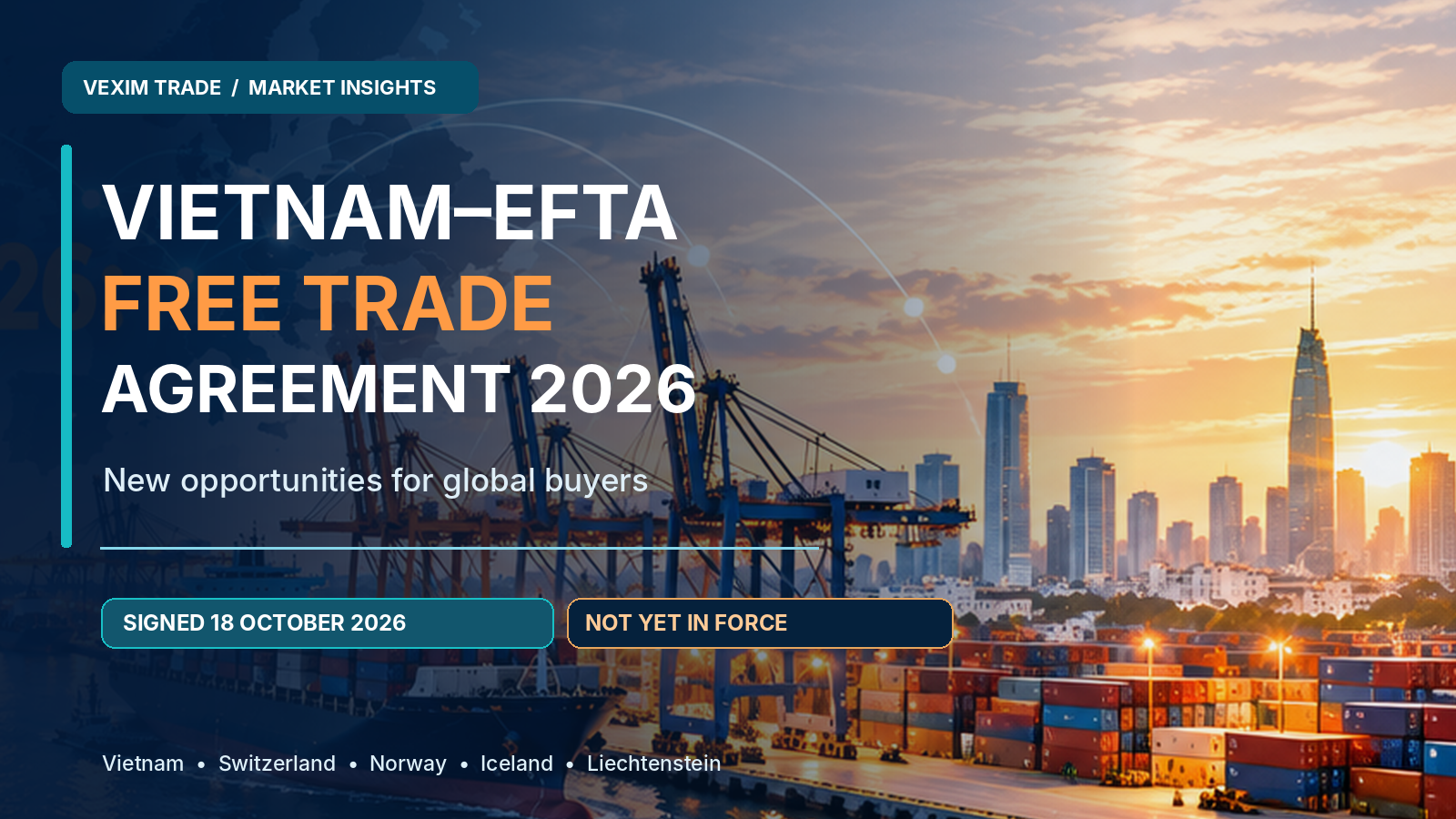
The Vietnam EFTA Free Trade Agreement 2026 was signed on October 18, opening a new path for trade with Switzerland, Norway, Iceland, and Liechtenstein. But the agreement has not entered into force, so buyers cannot yet claim its preferential tariffs. Explore the latest official updates, future market access, rules of origin, supplier checks, and practical sourcing opportunities.
By Dang Duc Dung·Published
In this article
The Vietnam EFTA Free Trade Agreement 2026 marks a significant development in international commerce after Vietnam and four European countries officially signed a comprehensive trade agreement in Hanoi on October 18, 2026. The agreement involves Switzerland, Norway, Iceland, and Liechtenstein, with plans to reduce trade barriers, improve market access, and strengthen economic cooperation.
On October 27, new reports highlighted EFTA members' expectations for stronger trade and investment with Vietnam. However, the agreement has not yet entered into force, and its preferential tariff commitments are not currently available solely because of the signing.
For international buyers, this development raises an important question: how can businesses prepare for future trade opportunities while managing current customs requirements and supplier risks?
What Does the Vietnam EFTA Free Trade Agreement 2026 Change?
The Vietnam EFTA Free Trade Agreement 2026 establishes a framework for deeper trade and investment cooperation between Vietnam and the four EFTA countries. Signed on October 18, the agreement covers goods, services, investment, rules of origin, intellectual property, and sustainable development. Although the agreement has been signed, businesses must wait for its entry into force before claiming the new preferential tariff treatment.
The European Free Trade Association confirmed the signing in an official announcement on October 18.
The agreement follows more than 14 years of negotiations, which began in 2012 and concluded in July 2026.
It aims to promote cooperation across several commercial areas, including customs procedures, market access, technical standards, and international investment.
Key Developments in the Vietnam–EFTA Trade Agreement
| Date | Development | Status |
|---|---|---|
| July 2, 2012 | Free trade negotiations launched | Completed |
| July 2, 2026 | Negotiations formally concluded | Completed |
| October 18, 2026 | Vietnam and EFTA signed the agreement | Signed |
| October 27, 2026 | Reports highlight expected trade and investment benefits | Published |
| October 28, 2026 | Entry into force remains pending | Not yet effective |
The agreement represents an important step toward stronger commercial relationships between Vietnam and several high-income European economies.
However, signing an FTA is not the same as implementing it.
Importers should continue following the applicable tariff schedules and customs rules until the relevant authorities confirm that the agreement has entered into force.
Source: European Free Trade Association – EFTA and Viet Nam Sign Free Trade Agreement.
Which European Countries Are Included in the Vietnam–EFTA Agreement?
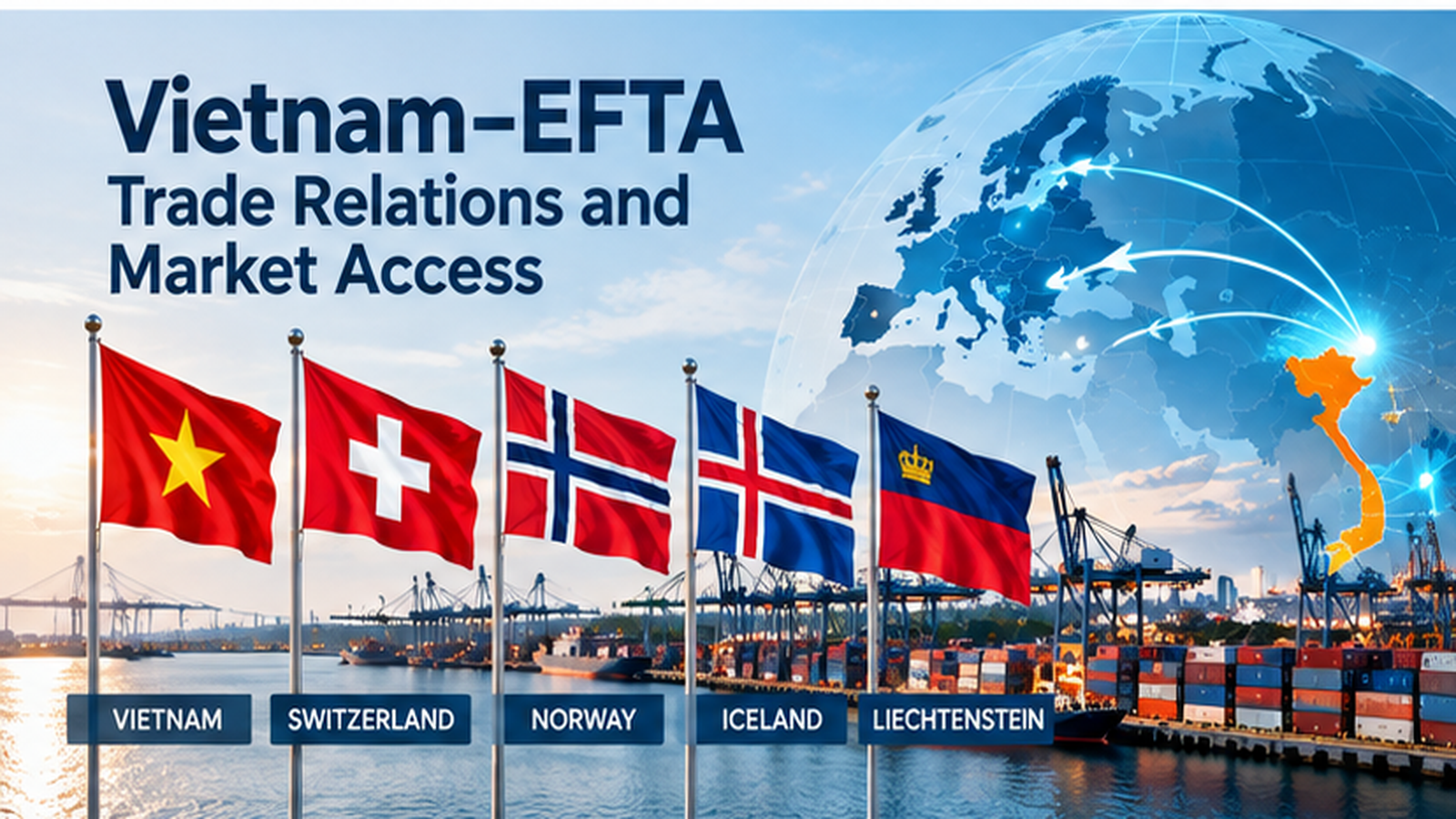
The Vietnam–EFTA agreement includes four European countries: Switzerland, Norway, Iceland, and Liechtenstein. These countries belong to the European Free Trade Association but are not members of the European Union. For international buyers, this distinction is important because EFTA and the EU operate under different trade arrangements, and customs treatment must be checked for the actual destination market.
The Four EFTA Member Countries
| Country | Commercial relevance | Potential areas to evaluate |
|---|---|---|
| Switzerland | High-income market and international business hub | Industrial goods, specialized products, supplier partnerships |
| Norway | Established trading economy | Manufacturing supply chains, seafood, industrial trade |
| Iceland | Smaller import market with specialized industries | Distribution partnerships and specialized sourcing |
| Liechtenstein | Small, highly industrialized economy | Specialized manufacturing and B2B relationships |
These examples identify possible commercial areas for market research, not guaranteed demand or tariff preferences.
According to EFTA, bilateral merchandise trade with Vietnam reached approximately EUR 4.8 billion in 2025, with a trade surplus of about EUR 2.5 billion in Vietnam's favor.
The EFTA trade statistics exclude gold from the Swiss figures.
The 2025 trade relationship included electrical machinery, mechanical equipment, footwear, apparel, seafood, and pharmaceutical products.
The agreement could support further diversification in international sourcing and supplier relationships.
However, businesses should evaluate each EFTA country separately because purchasing behavior, regulations, and import requirements are not identical.
Source: EFTA – Vietnam Country and Agreement Information.
How Could the Vietnam–EFTA Agreement Reduce Import Tariffs?
The Vietnam–EFTA agreement is designed to eliminate or reduce customs duties on qualifying products according to negotiated schedules. These benefits will depend on the importing country, product classification, applicable phase-out period, and preferential rules of origin. The tariff commitments cannot be treated as current rates until the agreement enters into force for the relevant parties.
One of the clearest publicly announced benefits concerns Norwegian exports entering Vietnam.
According to the Norwegian government, approximately 50% of Norwegian goods exports to Vietnam are expected to qualify for duty-free treatment when the agreement becomes effective.
The share is projected to exceed 98% within seven years.
These figures describe commitments affecting Norwegian exports to Vietnam, not an automatic duty-free rate for Vietnamese exports to Norway or all EFTA countries.
Overview of Expected Tariff Developments
| Trade direction | Expected development | Important qualification |
|---|---|---|
| Norway → Vietnam | Around 50% of Norwegian goods exports duty-free at entry into force | Subject to qualifying products and applicable rules |
| Norway → Vietnam | More than 98% duty-free within seven years | Based on announced Norwegian commitments |
| Vietnam → EFTA markets | Preferential treatment under country-specific schedules | Depends on product, destination, and origin |
| Other EFTA states → Vietnam | Scheduled tariff reductions for qualifying goods | Product-specific implementation periods apply |
Importers should consult the official tariff schedules rather than assuming that every shipment will receive the same reduction.
Businesses should also compare the expected preferential tariff with any existing duty-free treatment already available under current rules.
Sources: Norwegian Government – Free Trade Agreement With Vietnam and EFTA – Vietnam FTA Documentation.
When Will the Vietnam–EFTA Free Trade Agreement Enter Into Force?
As of October 28, 2026, no confirmed entry-into-force date has been published on EFTA's official agreement page. The agreement must complete the required domestic approval procedures before its preferential provisions become operational. Businesses should therefore continue using existing customs rules and monitor official announcements rather than treating proposed tariff schedules as benefits already available.
The agreement's implementation process is particularly relevant for companies preparing contracts that may extend into 2027.
Buyers should clarify the expected shipment dates, customs entry dates, and responsibility for import duties.
A supplier quotation based on future tariff reductions should clearly identify those reductions as assumptions.
For binding customs decisions, businesses should consult the relevant authorities or qualified customs professionals.
Why Do Rules of Origin Matter Under the Vietnam–EFTA Agreement?
Rules of origin determine whether goods qualify for preferential treatment under a free trade agreement. Under the Vietnam–EFTA framework, eligible products must meet the applicable origin criteria and supporting documentation requirements. Exporting goods from Vietnam alone does not necessarily establish Vietnamese preferential origin, particularly when production involves imported materials, third-country processing, or international trading intermediaries.
The agreement includes a dedicated rules-of-origin annex and product-specific origin provisions.
It also contains templates for relevant certificates and origin declarations.
Key Origin Requirements for Buyers
| Verification area | What buyers should check |
|---|---|
| Product classification | Correct HS code and applicable tariff line |
| Manufacturing location | Where meaningful production takes place |
| Input materials | Origin and processing of imported components |
| Origin criteria | Applicable product-specific rules |
| Supporting documents | Origin declaration or certificate as required |
| Shipment records | Consistency between commercial and transport documents |
A supplier may manufacture products in Vietnam using materials imported from several countries.
Whether those goods qualify for preferential treatment depends on the specific origin rule, not merely the supplier's business registration or shipping address.
Buyers should request relevant manufacturing information and documentary support before assuming a product will qualify.
The official agreement includes Annex 2F – Rules of Origin and its associated appendices, available through EFTA.
Source: EFTA – Vietnam FTA, Rules of Origin and Annexes.
Can Goods Shipped Through Vietnam Automatically Qualify for EFTA Preferences?
No. Shipping goods through Vietnam or purchasing them from a Vietnamese trading company does not automatically give them Vietnamese preferential origin. Eligibility depends on the applicable origin provisions and evidence of qualifying production or processing. Importers should confirm the actual manufacturing process and supporting records before requesting preferential treatment, once the agreement becomes effective.
This distinction is especially important for businesses using multinational supply chains.
Simple transshipment, repackaging, or changes in commercial documentation should not be assumed to alter a product's origin.
Buyers should also distinguish between the legal exporter, the manufacturer, and the country of origin.
Incorrect origin claims can create customs delays, additional charges, or compliance risks.
What Opportunities Could the Agreement Create for International Buyers?
The Vietnam–EFTA agreement could create opportunities for international buyers by improving future market access and encouraging new commercial relationships between Vietnam and the four EFTA countries. The agreement may support sourcing diversification, investment partnerships, and more predictable trading conditions. However, actual benefits will depend on implementation, supplier capabilities, product compliance, and the commercial requirements of individual buyers.
Potential Commercial Opportunities
| Opportunity | Potential benefit | Buyer consideration |
|---|---|---|
| International sourcing | Explore additional Vietnamese supplier networks | Verify supplier capability and quality |
| Trade diversification | Reduce excessive dependence on a single market | Compare total landed costs |
| Manufacturing partnerships | Develop new production relationships | Review technical standards and capacity |
| Cross-border investment | Explore longer-term business cooperation | Assess legal and investment conditions |
| Trade facilitation | Benefit from future administrative cooperation | Confirm implemented procedures |
The agreement should not be interpreted as a guarantee that every industry will experience increased demand.
For example, an importer may still find an existing supplier more competitive after accounting for transportation expenses, compliance costs, and product specifications.
Instead, the agreement offers businesses an opportunity to review sourcing strategies and prepare for potentially improved trade conditions.
Vietnamese manufacturers and trading companies may also benefit from stronger commercial connections with European customers.
How Can Buyers Evaluate Vietnamese Suppliers for EFTA Markets?
International buyers preparing to source from Vietnam should assess supplier reliability, production capabilities, quality standards, and destination-market compliance before placing orders. The Vietnam–EFTA agreement may improve future trade conditions, but it does not automatically qualify individual suppliers for preferential tariffs or guarantee product performance. A structured procurement process remains essential for reducing commercial risks.

Supplier evaluation should include several important checks.
1. Legal registration and business identity
Confirm the supplier's registered company details, legal operating status, and role in the transaction.
2. Production or sourcing capabilities
Determine whether the business manufactures goods directly or works with a partner factory.
3. Product and quality requirements
Request appropriate technical specifications, testing evidence, and relevant certifications where required.
4. Export documentation
Review the supplier's ability to prepare commercial invoices, packing lists, shipping records, and relevant origin documents.
5. Commercial terms
Compare minimum order quantities, production lead times, payment conditions, and agreed Incoterms.
VEXIM Trade provides international buyers with access to Vietnamese supplier listings and a process for reviewing supplier information.
Its verification framework distinguishes between document checks, factory or partner-contract reviews, and delivery-history evidence.
Buyers can review the process through How VEXIM Trade Verifies Suppliers.
These checks support supplier assessment but do not replace independent inspections or transaction-specific compliance verification.
What Regulatory Requirements Should Buyers Check Before Importing?
International buyers should review the import requirements of the destination EFTA country before confirming shipments from Vietnam. Although the trade agreement provides a framework for cooperation, customs duties are only one part of import compliance. Product safety, labeling, technical standards, documentary requirements, and relevant sector-specific regulations may continue to apply regardless of preferential tariff eligibility.
The agreement includes provisions relating to technical barriers to trade and sanitary and phytosanitary measures.
However, the presence of these provisions does not automatically eliminate national product requirements.
Importers should verify compliance for the relevant country and product.
Practical Compliance Checklist
| Requirement | Questions to confirm |
|---|---|
| Customs classification | Is the HS classification correct? |
| Rules of origin | Does the product meet the applicable origin rule? |
| Product standards | Are mandatory technical requirements satisfied? |
| Labeling | Are local language and consumer information rules met? |
| Food or agricultural requirements | Are any SPS certificates or inspections required? |
| Documentation | Are invoices, shipping documents, and origin records complete? |
| Tariff eligibility | Is the FTA effective for the importing country and product? |
For businesses serving several European countries, it is important to distinguish EFTA markets from the European Union.
EFTA membership does not mean that every member follows identical regulatory arrangements.
The relevant requirements should be confirmed for each destination.
How Should International Buyers Prepare for the Vietnam–EFTA Agreement?
International buyers can prepare for the future implementation of the Vietnam–EFTA agreement by identifying eligible product categories, reviewing potential suppliers, and monitoring official tariff schedules. Rather than postponing all sourcing activity, procurement teams can evaluate suppliers under existing rules while developing additional cost scenarios for possible future preferences. This approach supports informed decisions without depending on uncertain implementation dates.
A practical preparation process involves four stages.
Step 1 – Review the official agreement
Consult EFTA's published treaty documents, tariff schedules, and rules-of-origin annexes.
Step 2 – Identify sourcing opportunities
Compare potential Vietnamese suppliers against product requirements, capacity, quality, and delivery expectations.
Step 3 – Calculate total landed costs
Evaluate current duties first, then develop separate future scenarios based on the agreement's published commitments.
Step 4 – Monitor implementation
Track ratification, entry-into-force announcements, customs guidance, and tariff schedule updates.
Buyer Preparation Checklist
| Action | Current priority | Purpose |
|---|---|---|
| Read official FTA documents | High | Understand future obligations |
| Verify supplier credentials | High | Reduce procurement uncertainty |
| Confirm product requirements | High | Assess market eligibility |
| Calculate current duties | High | Establish a reliable cost baseline |
| Model potential future tariff savings | Medium | Support procurement planning |
| Monitor ratification and implementation | Ongoing | Avoid premature preferential claims |
Buyers should also consider contracting terms that clearly allocate responsibilities if duties change between order confirmation and delivery.
A confirmed supplier relationship can be useful even before new trade preferences become available.
Frequently Asked Questions About the Vietnam EFTA Free Trade Agreement 2026
International buyers frequently ask when the new Vietnam–EFTA agreement will take effect, which countries are covered, and whether products can receive lower import duties. These questions are important because signed trade agreements do not automatically change customs treatment. The following answers address practical sourcing and compliance concerns using information available as of October 28, 2026.
1. Has the Vietnam EFTA Free Trade Agreement 2026 Officially Been Signed?
Yes. Vietnam and the four EFTA countries signed the free trade agreement in Hanoi on October 18, 2026. The participating EFTA countries are Switzerland, Norway, Iceland, and Liechtenstein. The signing establishes the agreed framework, but the treaty has not yet entered into force. Buyers cannot claim its future preferential tariffs solely because the signing ceremony has taken place.
2. Is EFTA the Same as the European Union?
No. EFTA is a separate European trade association comprising Switzerland, Norway, Iceland, and Liechtenstein. These four countries are not members of the European Union. Although there are economic relationships between EFTA members and the EU, their trade arrangements are not identical. Buyers should verify the applicable agreement and destination-market regulations rather than treating all European countries as a single customs market.
3. Will All Vietnamese Exports to EFTA Countries Become Duty-Free?
Not automatically. Future tariff treatment will depend on the destination country's commitments, the product's tariff classification, origin eligibility, and the agreement's implementation schedule. Some products may already enjoy low or zero duties under current rules. Importers should check the relevant tariff annex and applicable national customs guidance before estimating potential savings.
4. When Can Importers Start Using Vietnam–EFTA Preferential Tariffs?
Importers can use the new preferential tariffs only after the agreement enters into force for the relevant countries and the goods satisfy applicable requirements. As of October 28, 2026, EFTA lists the entry-into-force date as pending. Businesses should monitor official updates and avoid using anticipated reductions as confirmed customs rates for current shipments.
5. How Can International Buyers Find Vietnamese Suppliers?
Buyers can begin by preparing a clear sourcing request that describes required specifications, quantities, destination, delivery terms, and relevant certifications. They can then compare potential suppliers and review their documentation before negotiating orders. VEXIM Trade offers Vietnamese supplier listings, primarily in food and agricultural categories, and accepts sourcing enquiries for other requirements, subject to availability.
What Is the Outlook for Vietnam–EFTA Trade After October 2026?
The Vietnam–EFTA agreement provides a foundation for stronger commercial cooperation between Vietnam and four European economies. Its signing in October 2026 is an important development, but the real impact will depend on ratification, implementation, and businesses' ability to use the agreed provisions. International buyers should continue monitoring official developments while assessing potential suppliers and trade opportunities.
The agreement could support greater diversification of Vietnam's international commercial relationships over time.
It may also encourage investment cooperation, technology exchange, and deeper business connections.
However, market access improvements should be evaluated alongside supplier competitiveness, logistical conditions, and regulatory compliance.
Businesses that prepare reliable supplier networks and accurate documentation may be better positioned to respond once the agreement becomes operational.
Explore Vietnamese Sourcing Opportunities With VEXIM Trade
VEXIM Trade helps international buyers explore sourcing opportunities from Vietnam through supplier listings and structured sourcing requests. As trade relationships with European markets develop, buyers may need reliable information about potential suppliers, export capabilities, and product requirements. The platform offers a starting point for sourcing enquiries while making supplier verification information available for review.
Looking for Vietnamese suppliers or exploring new international sourcing markets?
Submit your purchasing requirements, including product specifications, expected quantities, destination country, and preferred delivery terms.
VEXIM Trade – Explore Suppliers
Explore Vietnam. Evaluate suppliers. Build stronger global sourcing relationships.
Official References
- European Free Trade Association – EFTA and Viet Nam Sign Free Trade Agreement, October 18, 2026
- EFTA – Vietnam FTA, Treaty Text, Tariff Schedules and Rules of Origin
- Vietnam Ministry of Industry and Trade – Signing of the Vietnam–EFTA Free Trade Agreement
- Norwegian Government – Free Trade Agreement With Vietnam Signed, October 18, 2026
- VietnamPlus – EFTA Expects Trade and Investment With Vietnam to Grow, October 27, 2026
Editorial cutoff: October 28, 2026. The Vietnam–EFTA agreement has been signed but has not yet entered into force. Future tariff treatment remains subject to ratification, implementation, and product-specific requirements. This article provides general market information rather than transaction-specific customs or legal advice.
Sourcing request
Have a product in mind? Send us your brief.
We match it to a Vietnamese producer that fits, and tell you plainly when none does. A written reply by the start of your next business day.
Request a quoteRelated news
October 28, 2026
Vietnam Trade October 2026: $945 Billion and What Global Buyers Should KnowOctober 27, 2026
US-Canada Tariff Talks October 2026: What Global Buyers Need to KnowOctober 27, 2026
Global Shipping Costs Rise in October 2026