
Vietnamese Instant Pho Wholesale: US Buyer Checklist
Looking for Vietnamese instant pho wholesale? Learn how US importers can compare beef and chicken pho, evaluate suppliers, check documentation and request a quote.
By Dang Duc Dung·Published
In this article
Vietnamese instant pho wholesale sourcing starts with three questions: What is in the product, can the supplier meet your order requirements, and can the finished product legally enter your destination market? For US importers and distributors, beef-style and chicken-style instant pho can be worth evaluating, but packaging photographs alone are not enough. Buyers should verify ingredients, supplier records, labeling, MOQ, and shipping terms before committing to an order.
For a wholesale buyer, the objective is not simply to find a manufacturer selling inexpensive noodles. It is to find a reliable product and supplier combination that matches the purchasing brief.
This guide explains what to check when sourcing Vietnamese instant pho, which documents to request, and how to submit a clear request for quotation (RFQ).
1. Vietnamese Instant Pho Wholesale: What Should Buyers Check First?
When evaluating Vietnamese instant pho wholesale options, buyers should begin with the exact SKU, formulation, packaging format, and intended destination market. These details determine which supplier questions, commercial terms, and import requirements matter. A beef-style pho product may have different ingredients and regulatory considerations from a chicken-style version, even when both appear similar on the shelf.
Before approaching a producer, prepare a short product brief covering:
- Preferred pho variety and flavor.
- Rice noodle and seasoning specifications.
- Target retail pack size.
- Estimated purchasing volume.
- Destination market and delivery location.
- Labeling and language requirements.
- Expected delivery window.
A complete brief makes it easier to compare relevant supplier responses rather than receiving unrelated product catalogues.
What Makes Vietnamese Instant Pho Different?
Vietnamese instant pho is inspired by traditional pho, a Vietnamese noodle dish known for its rice noodles and seasoned broth.
Packaged versions may use dried rice noodles, seasoning sachets, dehydrated vegetables, and other ingredients, depending on the manufacturer.
For wholesalers, the important differences include noodle texture, flavor formulation, preparation instructions, ingredient composition, portion size, and retail presentation.
These details should be verified for each product rather than assumed from the product name.
2. Beef Pho vs Chicken Pho: Which Product Fits Your Market?
Beef-style and chicken-style instant pho may appeal to different customers, but importers should compare them using product documentation rather than flavor names alone. The actual ingredients, allergens, shelf life, serving size, and packaging format determine whether a particular SKU fits the buyer's market. The supplier should provide the full formulation before any conclusion is made about US import eligibility.
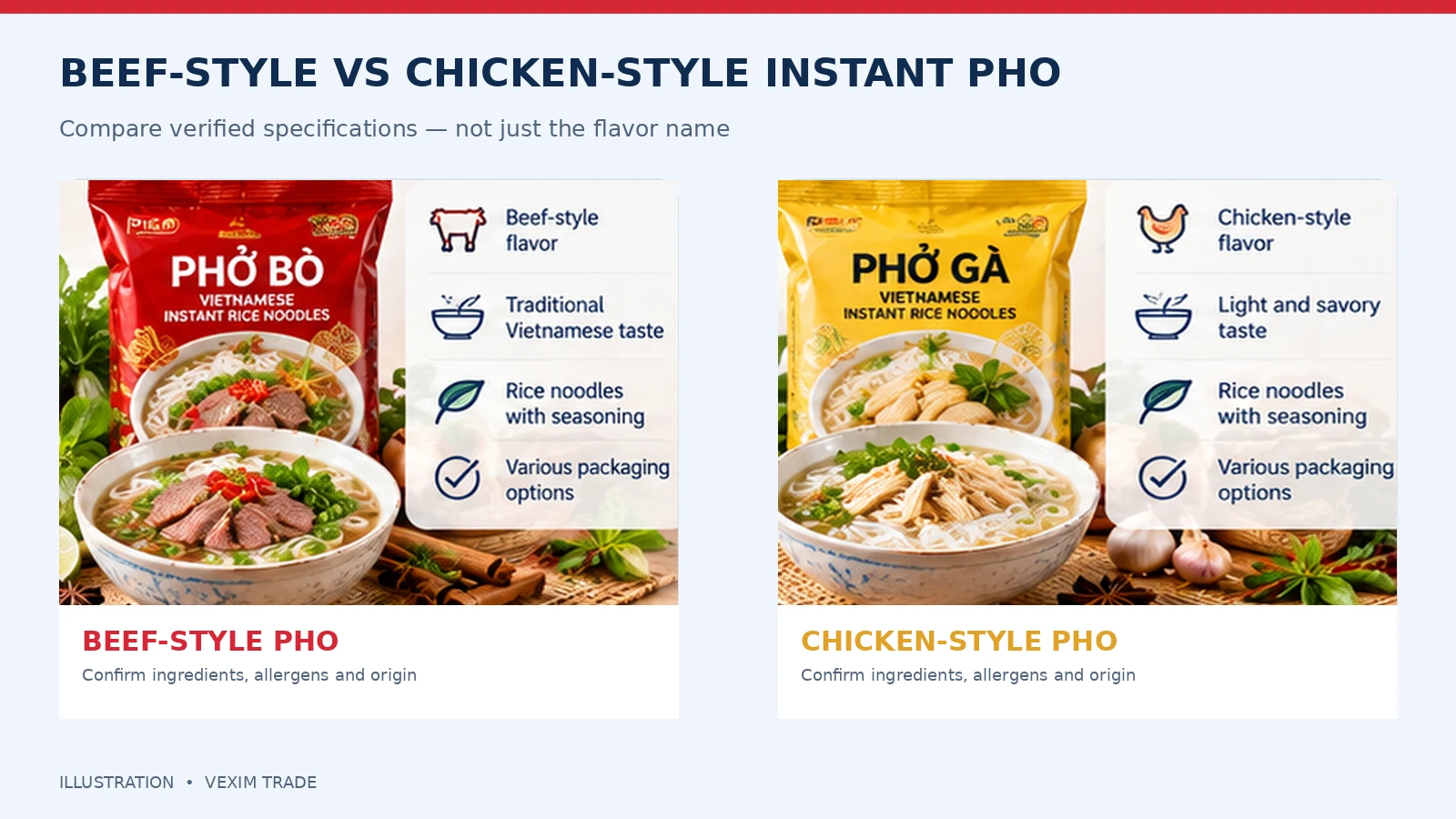
| Product Category | What Buyers Should Confirm | Potential Retail Positioning |
|---|---|---|
| Beef-style instant pho | Beef-derived ingredients, broth composition, allergen information | Vietnamese-inspired beef pho |
| Chicken-style instant pho | Poultry-derived ingredients, seasoning composition, allergen information | Convenient chicken pho |
| Other pho formulations | Actual ingredients, noodle base, preparation format | Specialty or differentiated food ranges |
These are sourcing categories, not confirmed claims about the formulation or regulatory eligibility of specific products.
Beef-Style Instant Pho
Buyers should request the complete ingredient list, including the composition and origin of any beef-related seasoning components.
A product described as "beef flavor" may use different combinations of flavorings, extracts, or animal-derived ingredients.
Those differences can affect the applicable import rules.
Chicken-Style Instant Pho
Chicken-style pho requires the same level of ingredient review.
In particular, importers should determine whether poultry-derived ingredients are present and whether additional USDA-related restrictions or documentation requirements apply.
Key purchasing principle: Never confirm US import eligibility based on the front-of-pack flavor description.
3. Seven Questions to Ask an Instant Pho Supplier in Vietnam
A Vietnamese instant pho supplier should be able to explain the product specifications, ingredient sources, manufacturing documentation, packaging, MOQ, and shipping terms relevant to the buyer's order. Some information can be supplied immediately, while other details may require factory confirmation. Buyers should distinguish verified documentation from statements that have not yet been supported by evidence.
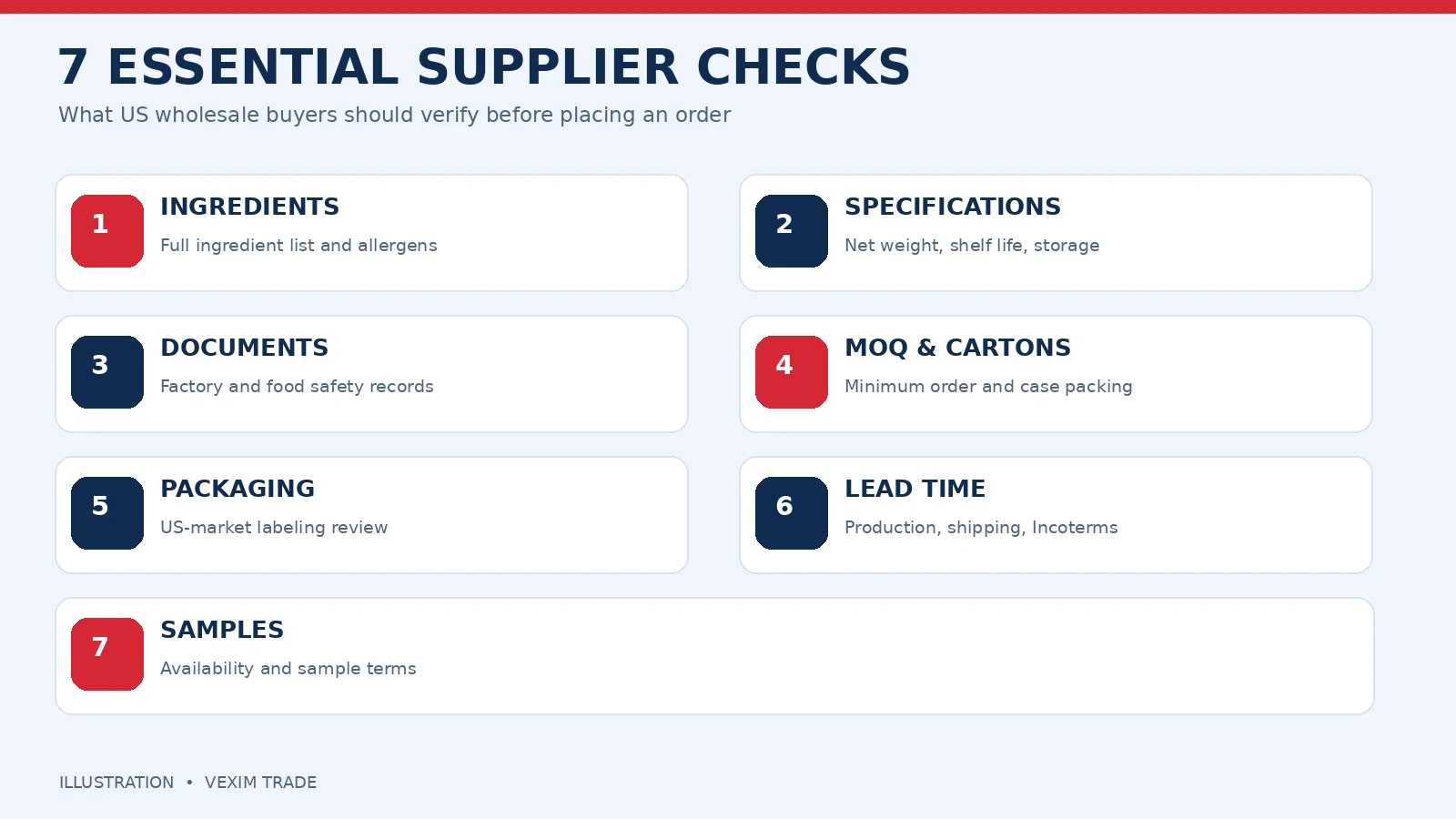
| No. | Supplier Question | Why It Matters |
|---|---|---|
| 1 | What is the complete ingredient list for each SKU? | Determines formulation, allergens, and potential import restrictions |
| 2 | What are the net weight, shelf life, and storage requirements? | Supports inventory and distribution planning |
| 3 | What manufacturing and food safety documents are available? | Helps evaluate supplier controls and claims |
| 4 | What are the MOQ and units per carton? | Supports purchasing and freight calculations |
| 5 | Can the packaging be prepared for the US market? | Helps identify required labeling changes |
| 6 | What are the production lead time and available Incoterms? | Clarifies commercial and logistics responsibilities |
| 7 | Can samples and shipment-related documents be provided? | Supports evaluation before a larger order |
Check Whether the Documents Apply to the Actual Product
A food safety certificate does not automatically cover every SKU produced by a manufacturer.
Buyers should check the issuing organization, validity, facility, scope, and supporting evidence.
If a supplier changes a formulation or production location, previously supplied documents may need to be reassessed.
Confirm the MOQ Before Discussing the Final Price
Minimum order quantity can vary by product, packaging, branding, and factory schedule.
An existing branded retail product may have different purchasing conditions from a customized or private-label product.
No specific MOQ should be treated as confirmed until the producer provides written commercial terms.
4. Can Vietnamese Instant Pho Be Imported into the United States?
Vietnamese instant pho may be imported into the United States when the product satisfies all applicable US requirements. The rules depend on its actual ingredients, manufacturing process, regulatory classification, and shipment arrangements. FDA requirements are relevant to many packaged foods, while certain meat, poultry, and egg ingredients can trigger additional USDA/FSIS or APHIS considerations.
Importers should complete a product-specific compliance review before confirming a commercial shipment.
FDA Food Facility Registration and Prior Notice
Foreign facilities that manufacture, process, pack, or hold food for US consumption may need FDA food facility registration, unless an exemption applies.
Most food shipments regulated by FDA also require Prior Notice before arrival, subject to applicable exemptions.
However, food facility registration is not equivalent to FDA approval of an individual instant pho product.
Official sources:
FSVP: Importer Verification Responsibilities
Under the Foreign Supplier Verification Programs (FSVP) rule, covered US importers must conduct appropriate foreign supplier verification activities.
These responsibilities may involve hazard analysis, supplier evaluation, verification procedures, and recordkeeping, depending on the circumstances.
A Vietnamese manufacturer may need to provide documentation supporting the importer's review.
Official source: FDA – Foreign Supplier Verification Programs.
USDA/FSIS: Review Meat and Poultry Ingredients Carefully
This is particularly important for beef-style and chicken-style instant pho.
USDA/FSIS regulates certain imported meat, poultry, and egg products. Some foods containing small quantities of those ingredients may qualify for specific FSIS inspection exemptions, but relevant ingredient-source and APHIS conditions may still apply.
There is no reliable shortcut based only on a product's flavor label.
Buyers should request:
- The complete ingredient declaration.
- Identification of animal-derived ingredients.
- The origin and supplier of relevant ingredients.
- Manufacturing and processing information.
- A product-specific regulatory determination.
Official source: USDA/FSIS – Import Guidance.
If eligibility is uncertain, resolve it with qualified regulatory specialists and the relevant US authorities before shipment.
5. Packaging and Labeling Requirements for US Distribution
Packaging intended for the US market should be reviewed before a wholesale order is placed. A Vietnamese retail package may not contain all information required for US distribution, even when it is suitable for another market. Buyers should check the language, product identity, ingredient declaration, allergens, nutrition labeling, and other applicable requirements before approving printed packaging.
Important items to review include:
| Packaging Detail | Buyer Check |
|---|---|
| Product identity | Accurate product name and description |
| Ingredient list | Complete, current ingredient information |
| Allergens | Declaration of applicable major food allergens |
| Nutrition information | Appropriate Nutrition Facts labeling when required |
| Net quantity | Accurate quantity presentation |
| Business information | Required manufacturer, distributor, or responsible firm details |
| Preparation instructions | Clear directions consistent with the actual product |
| Shelf life and lot coding | Product-specific documentation and traceability |
The FDA recognizes nine major food allergens, including wheat, soybeans, fish, crustacean shellfish, and sesame. Whether any of these are relevant must be determined from the actual formulation.
Official source: FDA – Food Allergies and Labeling.
Should Buyers Request Packaging Samples?
Yes, where feasible. Physical samples help buyers assess pack quality, presentation, preparation experience, and the information visible to retail customers.
Before placing an order, confirm whether the approved sample represents the same formulation and packaging specifications that will be used for commercial production.
6. How to Compare Wholesale Quotes and Landed Costs
A wholesale quote should be evaluated alongside MOQ, carton configuration, Incoterms, lead time, and the costs of importing and distributing the product. The lowest factory price does not always deliver the lowest total purchasing cost. Buyers should make sure competing quotations cover the same SKU, specification, quantity, shipping basis, and responsibilities before selecting a supplier.
A useful quotation should identify:
- Product name and SKU.
- Net weight per retail pack.
- Units per carton and carton dimensions.
- Minimum order quantity.
- Unit price and currency.
- Incoterm and named place.
- Estimated production lead time.
- Payment terms.
- Sample arrangements.
- Quotation validity period.
Avoid Comparing FOB and CIF Prices Directly
A quote under FOB terms allocates freight and risk responsibilities differently from CIF terms.
Buyers should request a consistent quotation basis when comparing suppliers.
Import duties, brokerage charges, domestic transport, and other expenses should also be considered when estimating landed cost.
Before agreeing to the final price, confirm current tariff classification and applicable duties with a licensed customs broker.
The official US tariff schedule is available from the US International Trade Commission.
7. How to Request Vietnamese Instant Pho Wholesale Quotes
The fastest way to begin a useful sourcing discussion is to send a precise RFQ covering the product, target quantity, packaging, destination, and required documents. This gives VEXIM Trade the information needed to assess available sourcing options and identify questions that must be confirmed with potential producers. Requests with incomplete information may require additional clarification.
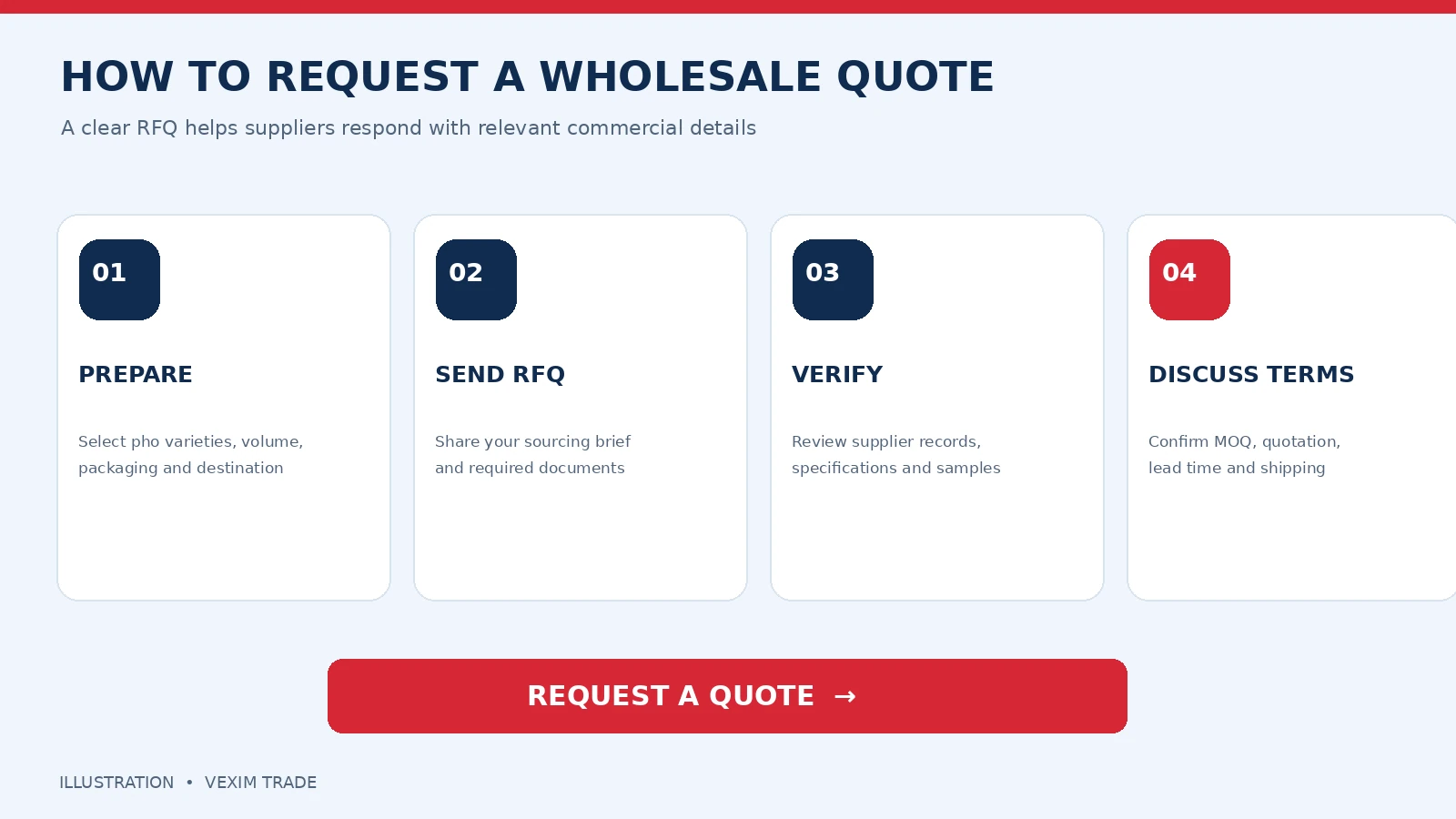
Sample RFQ for US Food Distributors
Subject: Vietnamese Instant Pho – Wholesale Sourcing Inquiry
Hello VEXIM Trade Team,
We are a food importer/distributor interested in sourcing Vietnamese instant pho for the US market.
Our preliminary requirements are:
- Product: Beef-style and/or chicken-style instant pho.
- Packaging: Retail packs.
- Target order quantity: To be discussed.
- Destination market: United States.
- Labeling: Suitable for applicable US retail requirements.
- Documents requested: Full ingredients, product specifications, available food safety records, and packaging information.
- Commercial information: MOQ, carton packing, lead time, and available quotation terms.
Please advise which sourcing options can be reviewed, what information has been verified, and what remains subject to supplier confirmation.
Thank you.
What Happens After an RFQ?
A useful first response should clarify whether suitable producers or products are being evaluated, which requirements are achievable, and what further information is needed.
Buyers should not assume that a preliminary product match guarantees supply, a fixed price, or regulatory clearance.
8. How VEXIM Trade Supports Vietnamese Instant Pho Sourcing
VEXIM Trade helps international buyers submit sourcing requirements and evaluate available Vietnamese supplier information. For instant pho, product availability and factory documentation must be confirmed for the specific request. Rather than treating every product photo as evidence of ready-to-ship inventory, the sourcing process should distinguish the supplier's statements from independently checked records.
VEXIM Trade uses three information categories:
| Information Status | Meaning |
|---|---|
| Stated | A claim or detail supplied by the manufacturer |
| Verified | Information reviewed against supporting evidence |
| Still Open | Information awaiting confirmation or additional records |
Buyers can review How VEXIM Trade Verifies Suppliers to understand the company's approach to document checks, factory visits, and delivery-history verification.
For companies sourcing additional food products from Vietnam, VEXIM Trade also provides a separate guide to importing Vietnamese cashew kernels.
Ready to Discuss Your Product Requirements?
VEXIM Trade welcomes detailed inquiries from importers, distributors, and wholesale buyers.
Submit your target pho variety, volume, packaging requirements, destination, and preferred delivery schedule so the team can assess suitable options and indicate what remains to be confirmed.
9. Frequently Asked Questions
Where can I find Vietnamese instant pho wholesale suppliers?
Start with a sourcing brief that describes your target product, order volume, packaging, and destination. VEXIM Trade can review the request against available sourcing information. Any manufacturer match, product availability, commercial terms, and verification status should be confirmed before a purchasing decision.
Can I buy beef and chicken instant pho in bulk?
Bulk sourcing may be possible, depending on the manufacturer and SKU. Buyers should first confirm that the varieties are available, obtain complete ingredient information, and request the MOQ, carton configuration, lead time, and commercial quotation in writing.
What is the MOQ for Vietnamese instant pho?
There is no single confirmed MOQ for every Vietnamese instant pho supplier. Order quantities depend on the producer, product, production schedule, packaging, and customization requirements. Requesting a product-specific quotation is the most reliable way to establish the applicable MOQ.
Are beef-flavored and chicken-flavored instant pho products allowed into the US?
Eligibility depends on the actual formulation and relevant US import rules. A flavor name alone cannot establish whether a product contains regulated animal ingredients or qualifies for any exemption. Buyers should complete a product-specific FDA, USDA/FSIS, and APHIS review as applicable.
Does an FDA registration number mean the pho product is FDA-approved?
No. Food facility registration and product approval are different concepts. FDA does not generally pre-approve individual conventional food products before importation. A product must still comply with applicable safety, labeling, import notification, and other regulatory requirements.
Can I request samples before placing a wholesale order?
Sample availability depends on the supplier and selected SKU. Buyers should confirm sample quantity, cost, shipment arrangements, and whether the sample represents the proposed commercial formulation. Import requirements for samples must also be checked before shipping them into the US.
Can VEXIM Trade arrange private-label Vietnamese pho?
Private-label capability must be confirmed with a suitable manufacturer. Custom packaging, formulation adjustments, production volumes, printing requirements, and lead times may affect feasibility and cost. Buyers should describe their requirements in the initial RFQ so the team can assess potential options.
Request a Vietnamese Instant Pho Wholesale Quote
Looking for a Vietnamese instant pho supplier for your US distribution business?
Send VEXIM Trade your sourcing requirements and receive a clear response about the product information available, possible next steps, and outstanding supplier questions.
Visit VEXIM Trade – Request a Quote
Email: sales@veximtrade.com
Website: https://www.veximtrade.com/
VEXIM Trade – Matching international buyers with Vietnamese sourcing opportunities through transparent supplier information.
Updated: October 21, 2026. This article provides general commercial and regulatory information. Product availability, prices, MOQ, certifications, and US import eligibility must be confirmed for each supplier and SKU. It is not legal, customs, or food regulatory advice.
Official References
Sourcing request
Have a product in mind? Send us your brief.
We match it to a Vietnamese producer that fits, and tell you plainly when none does. A written reply by the start of your next business day.
Request a quoteRelated news
October 21, 2026
Vietnamese Food Wholesale Suppliers: US Buyer GuideOctober 17, 2026
Import Instant Noodles from Vietnam: Buyer's GuideOctober 27, 2026
US-Canada Tariff Talks October 2026: What Global Buyers Need to Know