
Vietnam star anise sourcing guide 2026: Quality and Exports
Vietnam star anise sourcing guide 2026 helps international buyers evaluate Illicium verum, compare whole and broken grades, review export quality standards and prepare reliable supplier quotations using the latest Vietnamese trade data.
By Dang Duc Dung·Published
In this article
Vietnam star anise sourcing guide 2026: What should buyers know?
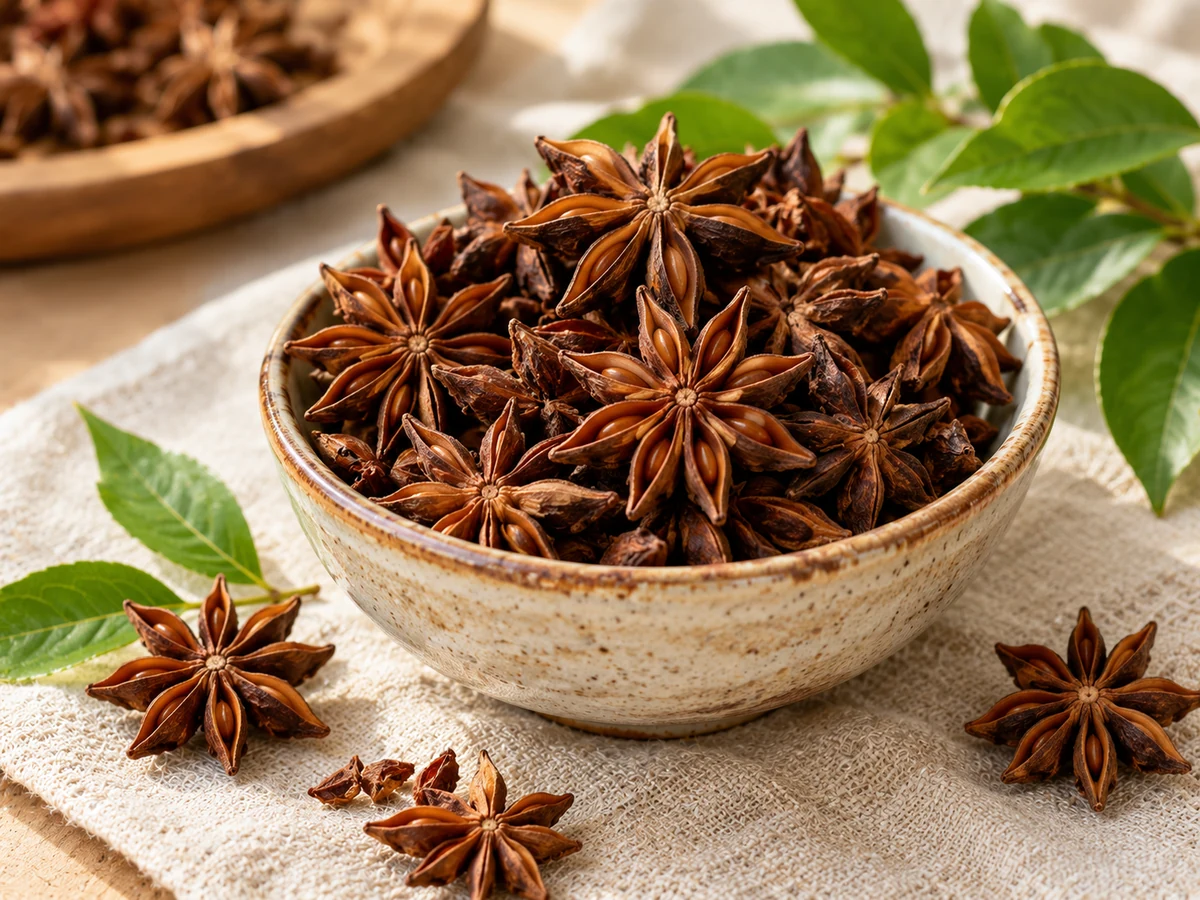
Vietnamese star anise is an established export spice, particularly associated with the northern province of Lang Son. International buyers typically source whole dried fruits, broken pieces or ground products for food manufacturing and spice distribution. The essential purchasing requirement is to confirm genuine food-grade Illicium verum, then assess quality, laboratory evidence and supplier capabilities before agreeing on price and delivery terms.
Key considerations for international importers
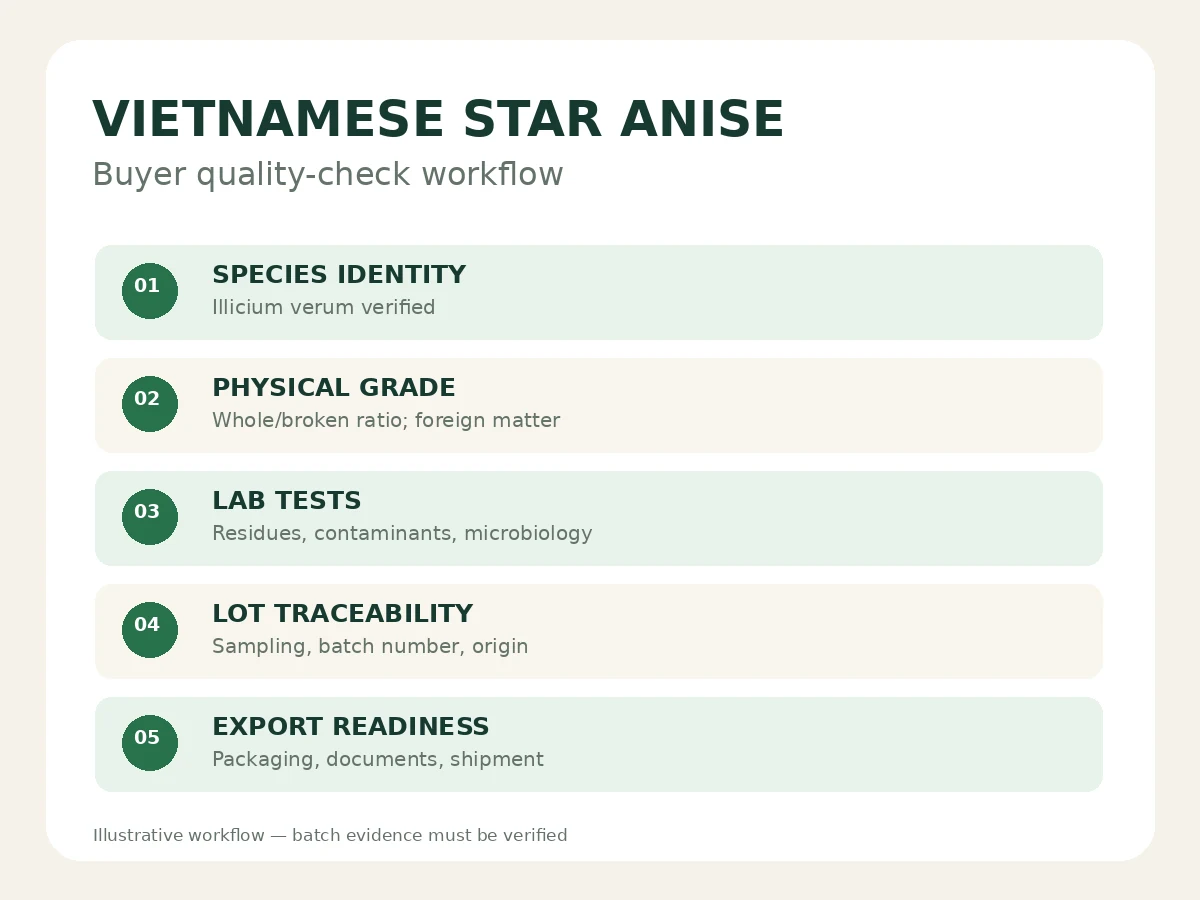
A reliable sourcing strategy should address five areas:
- Botanical identity: Confirm Illicium verum.
- Physical quality: Define whole-fruit proportion, moisture and defect limits.
- Food safety: Assess contaminants and pesticide residues under the importing market's rules.
- Traceability: Identify the production or collection source and processing batch.
- Commercial terms: Agree on packaging, shipment schedule and documentation.
These factors determine whether the proposed product is suitable for the buyer's intended application.
How is Vietnam's star anise export market performing in 2026?
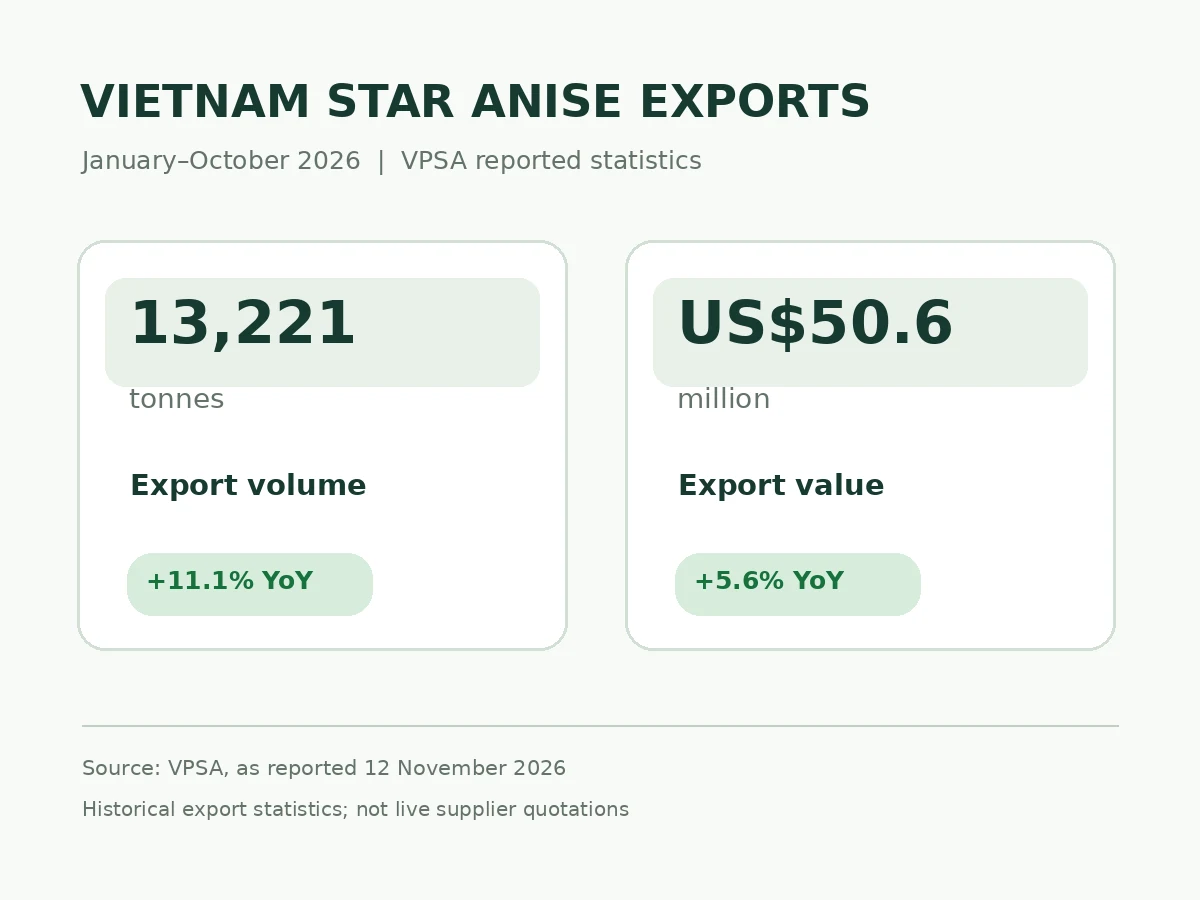
Vietnam's star anise exports recorded positive growth during January–October 2026. According to VPSA figures published in November, exports reached 13,221 tonnes worth US$50.6 million, increasing 11.1% in volume and 5.6% in value year-on-year. The difference between volume and value growth suggests that the aggregate export unit value declined over the period, although it does not establish the current price of any specific grade.
Vietnam star anise export performance — January to October 2026
| Indicator | Reported result |
|---|---|
| Export volume | 13,221 tonnes |
| Export value | US$50.6 million |
| Volume growth year-on-year | +11.1% |
| Value growth year-on-year | +5.6% |
| October export volume | 1,959 tonnes |
| October export value | Approximately US$7.0 million |
Sources: VPSA statistics reported by VOV and PTEXIM, November 2026.
October shipments increased by approximately 18.2% compared with September, according to PTEXIM's market report.
What does export growth mean for buyers?
Higher national export volumes indicate market activity, but they do not guarantee available inventory at individual processing facilities.
Buyers should distinguish between industry-wide statistics and supplier-specific offers.
Buyer takeaway: Request current inventory confirmation, representative samples and a dated quotation for the exact grade and shipment window.
What is Vietnamese star anise, and why does botanical identity matter?
Food-grade star anise comes from Illicium verum, a species whose dried star-shaped fruits are used as a culinary spice. Botanical identification is critical because other members of the Illicium genus, including Japanese star anise (Illicium anisatum), are not suitable substitutes for food use. Similar external appearances can make identification challenging, so buyers should not rely on photographs or a supplier's general description alone.
Why is Japanese star anise a safety concern?
Japanese star anise is associated with toxic compounds and is not interchangeable with edible Illicium verum.
For international buyers, this creates an important purchasing requirement: suppliers should demonstrate appropriate botanical identification and controls that prevent substitution or mixing.
Relevant evidence may include authenticated reference samples, botanical verification procedures, traceable sourcing records and analytical testing where necessary.
What standard applies to star anise?
ISO 11178:1995 — Star anise (Illicium verum Hook. f.) — Specification provides requirements for the dried fruits of the star anise tree.
The International Organization for Standardization confirmed this edition remains current following its 2024 review.
The standard also includes recommendations relating to storage and transport.
Importers should understand that referencing ISO 11178 does not automatically mean a supplier is independently certified or that every batch has passed an inspection.
Buyer takeaway: Include the applicable standard and specific acceptance criteria in the purchase contract.
Which Vietnamese star anise grades should buyers choose?
Vietnamese star anise is traded in several commercial forms, including whole dried fruits, broken pieces and powder. The appropriate grade depends on the buyer's intended application and quality expectations. Whole fruits may be preferred where visual presentation matters, while broken material or powder may suit certain industrial processes. Commercial labels such as Grade A or Grade AA are not universally consistent and should be supported by measurable specifications.
Common commercial forms of star anise
| Product form | Characteristics | Buyer considerations |
|---|---|---|
| Whole star anise | Dried fruits with relatively intact star-shaped structures | Whole-fruit proportion, appearance, moisture |
| Broken star anise | Fragments of dried star anise | Broken ratio, cleanliness, intended processing use |
| Star anise powder | Ground dried star anise | Botanical identity, particle size, microbial controls |
| Selected premium whole fruits | Whole products selected to meet an agreed specification | Uniformity, defects, agreed grading method |
Is Grade AA always better than Grade A?
Not necessarily.
The meaning of commercial grade labels varies between suppliers. A Grade AA product from one exporter may not meet the same acceptance criteria as another supplier's Grade AA product.
Instead of relying on the label alone, buyers should specify the minimum proportion of whole fruits, acceptable defects, moisture level and relevant laboratory requirements.
The supplier should confirm how each characteristic is measured.
What food safety requirements apply to imported star anise?
Star anise intended for food use must comply with the requirements of its destination market. Important controls may include pesticide residues, environmental contaminants, microbial hazards and botanical authenticity. The applicable legal limits depend on the importing jurisdiction and product classification. Buyers should establish these requirements before shipment and request laboratory evidence corresponding to the actual consignment, rather than relying solely on general certificates or promotional claims.
Key food safety considerations
| Risk area | Recommended verification |
|---|---|
| Botanical substitution | Confirm food-grade Illicium verum |
| Pesticide residues | Test against relevant destination-market MRLs |
| Heavy metals | Check applicable contaminant limits |
| Microbiological quality | Request relevant testing based on product risk |
| Foreign matter | Define acceptable physical contamination limits |
| Moisture | Agree on a maximum and a testing method |
| Traceability | Link laboratory reports to identifiable lots |
What should European Union buyers check?
The European Union applies food safety legislation covering pesticide residues and contaminants.
Buyers should consult the current European Commission pesticide database and relevant EU legal requirements when establishing an import specification.
Regulation (EC) No 396/2005 provides the framework for pesticide maximum residue levels, while Regulation (EU) 2023/915 addresses specified contaminants in foods.
Additional official controls may apply to certain products from particular origins. These measures can change, so importers should check the current product-and-origin-specific rules rather than assuming that every star anise shipment faces identical border checks.
Useful references include the European Commission's pesticide database and the Centre for the Promotion of Imports from developing countries (CBI) guidance for herbs and spices.
What should buyers check before ordering star anise from Vietnam?
Before placing an international star anise order, buyers should prepare a written specification and request evidence addressing product identity, physical quality, food safety and shipment readiness. A complete request for quotation should also identify quantity, packaging and delivery conditions. This approach allows suppliers to offer comparable products and reduces the likelihood of disputes involving inconsistent grades, incomplete certificates or unsuitable goods.
International buyer's sourcing checklist
| Inspection area | Required information |
|---|---|
| Botanical species | Illicium verum |
| Product form | Whole, broken or powder |
| Product grade | Agreed physical acceptance criteria |
| Moisture | Specified maximum and test method |
| Quality tests | Relevant contaminant and microbiological reports |
| Origin | Production or collection area |
| Traceability | Lot number and processing facility |
| Packaging | Food-grade materials, weight and labeling |
| Shipment | Quantity, port, Incoterm and lead time |
| Documentation | Invoice, packing list and applicable certificates |
Why should buyers request batch-specific test reports?
A laboratory report for a different lot may not describe the shipment being purchased.
Buyers should check the sample identification, test date, laboratory details and connection between the report and proposed goods.
For new suppliers, representative samples or independent inspection may be appropriate.
Buyer takeaway: Confirm the specification and inspection process before accepting the commercial offer.
How should Vietnamese star anise be stored and packaged for export?
Dried star anise should be protected against moisture, contamination, excessive handling and unsuitable storage conditions. Packaging must support the agreed shipment duration and destination requirements. Importers should discuss the condition of the dried product, inner packaging, carton or bag strength, labeling and container handling before ordering. Proper storage and transport controls are particularly important for preserving product integrity during international shipments.
Practical points include:
- Requesting clean, food-appropriate packaging materials.
- Confirming net weight and package dimensions.
- Protecting goods against moisture exposure.
- Providing adequate product and lot identification.
- Establishing acceptable storage conditions.
- Agreeing on inspection procedures before container loading.
Exact packaging specifications should be determined by the product form, transport conditions and customer requirements.
How can buyers compare Vietnamese star anise export quotations?
International buyers should compare star anise quotations based on equivalent products and delivery conditions. A lower price may reflect a different whole-fruit percentage, moisture specification, packaging method or level of processing. Without a standardized RFQ, suppliers may offer goods that are not commercially comparable. Buyers should evaluate the complete proposal, including testing, shipment timing, payment conditions and the responsibilities assigned under the chosen Incoterm.
What should a professional RFQ include?
- Product name and botanical species.
- Whole, broken or powder form.
- Grade and measurable quality specifications.
- Order quantity.
- Required laboratory testing.
- Packaging and labeling.
- Destination port and agreed Incoterm.
- Shipment period.
- Payment terms.
- Quotation validity and inspection procedures.
There is no universal FOB price for all Vietnamese star anise products. Buyers should request current written quotations rather than treating historical export averages as live trading prices.
Where can international buyers find Vietnamese star anise suppliers?
International buyers can begin their search through Vexim Trade's cinnamon and star anise category, which includes product listings and supplier information. The directory offers a starting point for comparing product forms and preparing quotation requests. However, buyers should verify actual stock, specifications and shipment documentation before committing to an order. Supplier verification provides information about particular checks and does not replace independent product testing.
Explore Vietnamese Cinnamon and Star Anise Suppliers on Vexim Trade
Examples of listed products include:
Whole Illicium Verum — Vietnamese Star Anise
Premium Vietnamese Star Anise — Spring and Autumn Crops
Buyers should check the scope of each listing and confirm the details with the relevant supplier.
For more information, visit How Vexim Trade Verifies Suppliers.
Frequently asked questions about Vietnamese star anise sourcing
International spice buyers often need clarification about star anise grades, food safety standards, botanical authenticity and export documentation. These questions are important because a supplier's product description may not contain enough information to evaluate an international shipment. The following answers summarize practical considerations for importers and should be used alongside the regulations applicable in the destination country.
Is Vietnamese star anise the same as Japanese star anise?
No. Food-grade star anise is Illicium verum, whereas Japanese star anise is Illicium anisatum. The latter contains toxic compounds and must not be substituted for culinary star anise. Buyers should request evidence of botanical identity.
Is ISO 11178:1995 still current?
Yes. ISO lists ISO 11178:1995 as a published standard that was last reviewed and confirmed in 2024. It specifies requirements for dried fruits of Illicium verum. However, a supplier's reference to the standard does not automatically demonstrate conformity.
What is the difference between whole and broken star anise?
Whole star anise generally consists of largely intact fruits, while broken star anise includes fragments. The appropriate form depends on visual presentation, processing requirements and the buyer's intended application. Both forms require identity and quality checks.
Does Vietnam's export growth guarantee lower prices?
No. Export volume increased during January–October 2026, but this does not establish future price movements. Commercial prices depend on product grade, supply availability, quality, order size and shipment terms.
What documents are commonly needed for star anise imports?
Common documentation may include a commercial invoice, packing list, transport documents, product specification and applicable test reports. Additional certificates may be required depending on the destination, product and contract. Buyers should confirm these requirements before shipment.
Can a verified supplier guarantee every shipment?
No. Business or production-source verification does not automatically guarantee the condition of a particular consignment. Buyers should request batch-specific evidence, agree on inspection procedures and document contractual acceptance requirements.
Conclusion: How should buyers source Vietnamese star anise in 2026?
Vietnam's star anise export growth reinforces the country's relevance as an international spice sourcing destination. Nevertheless, effective purchasing requires clear product identification, measurable quality specifications, appropriate food safety controls and reliable shipment arrangements.
For international buyers, a structured sourcing process is more valuable than selecting suppliers based only on grade labels or advertised prices.
Explore Vietnamese Star Anise Suppliers on Vexim Trade and prepare a detailed RFQ for your next shipment.
Sources and references
- VOV — Vietnam's Pepper and Spice Exports Target US$2.4 Billion in 2026
- PTEXIM — Vietnam Spice Market Update, October 2026
- ISO — ISO 11178:1995 Star Anise Specification
- US FDA — Star Anise, Illicium Verum
- CBI — Requirements for Herbs and Spices in the European Market
- European Commission — EU Pesticides Database
- Vexim Trade — Cinnamon and Star Anise Suppliers
Editorial note: Trade figures cover January–October 2026. The article does not represent live export prices or guaranteed supplier inventory. Import regulations and product requirements should be verified before placing an order.
Sourcing request
Have a product in mind? Send us your brief.
We match it to a Vietnamese producer that fits, and tell you plainly when none does. A written reply by the start of your next business day.
Request a quote