
Vietnam Fruit and Vegetable Exports 2026: $8.27B Growth and New Sourcing Opportunities
Vietnam's fruit and vegetable exports exceeded an estimated $8.27 billion in the first ten months of 2026, rising 17.2% year over year. As global demand shifts toward year-end sourcing, international buyers need to understand seasonal availability, fresh versus processed products, quality documentation, and supplier comparison. Discover the latest market trends and practical ways to explore Vietnamese sourcing opportunities through VEXIM Trade.
By Dang Duc Dung·Published
In this article
Vietnam Fruit and Vegetable Exports 2026 exceeded an estimated $8.27 billion in the first ten months of the year, increasing 17.2% compared with the same period in 2025. The latest preliminary customs figures highlight sustained international demand for Vietnamese produce, despite changes in monthly shipment volumes.
As the year-end purchasing season approaches, export activity is increasingly influenced by harvest schedules, product availability, processing capabilities, and destination-market requirements.
For international buyers, this creates opportunities to explore different categories of Vietnamese fruits and vegetables while carefully evaluating product specifications, storage conditions, supplier information, and import compliance.
This market update examines the latest export trends and explains how buyers can use VEXIM Trade to research available products, compare supplier offers, and submit sourcing requirements.
Vietnam Fruit and Vegetable Exports 2026: What Do the Latest Figures Show?
Vietnam Fruit and Vegetable Exports 2026 reached more than 8.27 billion during January–October, according to preliminary figures reported by Vietnam Customs. The total represents 17.2% year-on-year growth. October exports alone exceeded an estimated1 billion, although the value declined from September. These results indicate a growing export sector with noticeable monthly fluctuations.
Vietnam's Fruit and Vegetable Trade Performance
| Indicator | Reported value | Period |
|---|---|---|
| Fruit and vegetable exports | Over $8.27 billion | January–October 2026 |
| Export growth | +17.2% | Year over year |
| October export value | Over $1 billion | October 2026 |
| October monthly change | -11.4% | Versus September 2026 |
| October annual change | +8.1% | Versus October 2025 |
| Fruit and vegetable imports | Over $2.7 billion | January–October 2026 |
| Sector trade surplus | Over $5.5 billion | January–October 2026 |
Source: Vietnam Customs preliminary estimates, reported by Nhan Dan on October 29, 2026.
Although October exports declined compared with September, they remained higher than the corresponding month in 2025.
This distinction matters for international buyers because seasonal production cycles and shipping schedules can influence monthly export values.
The figures also cover a broad group of products, including fresh and processed fruits and vegetables. They should not be interpreted as revenue from fresh produce alone.
For sourcing decisions, buyers should examine individual product categories and the available supplier information rather than treating national export growth as a direct indicator of current inventory or prices.
Source: Nhan Dan – Fruit and Vegetable Exports Exceed $8.27 Billion in Ten Months.
Which International Markets Are Driving Vietnamese Fruit and Vegetable Exports?
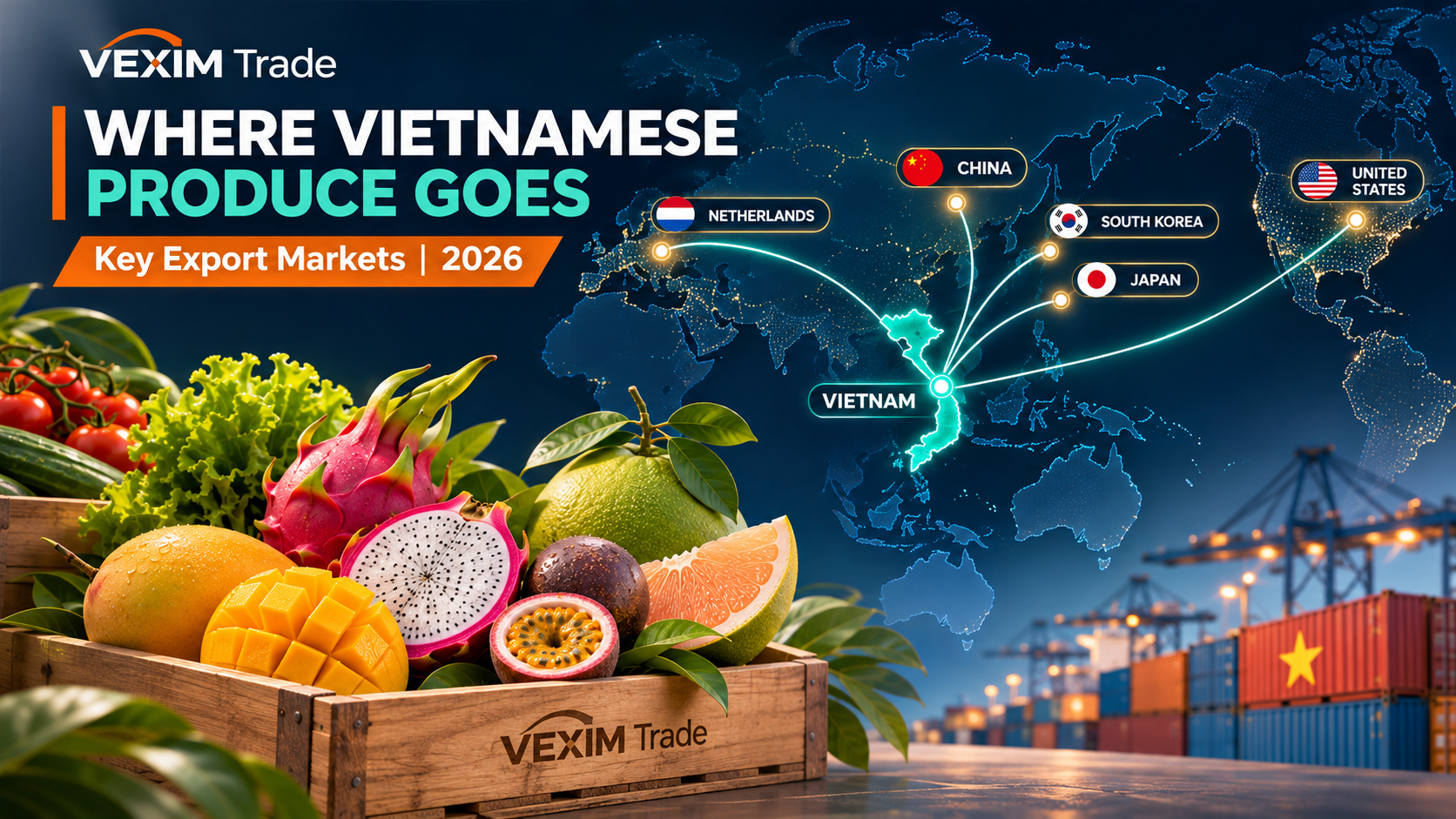
China remains Vietnam's largest fruit and vegetable export destination, followed by other important markets including the United States, South Korea, Japan, and the Netherlands. During the first nine months of 2026, exports to several destinations recorded positive growth. However, market concentration and different import requirements mean buyers should evaluate opportunities by destination and product category.
Major Export Markets – January to September 2026
| Market | Export value | Year-on-year growth |
|---|---|---|
| China | $4.72 billion | +22.4% |
| United States | $484.7 million | +19.2% |
| South Korea | $263.6 million | +11.1% |
| Japan | $193.8 million | +6.2% |
Source: Vietnam Customs statistics summarized by Nhan Dan, October 29, 2026. These figures cover nine months, not the full January–October period.
China accounted for more than 64.8% of Vietnam's fruit and vegetable export value during the first nine months.
This highlights the importance of the Chinese market to the sector, while also demonstrating why suppliers and buyers should monitor geographic concentration.
The United States remained another important destination, with Vietnamese fruit and vegetable exports reaching approximately $484.7 million during the same period.
For buyers in North America, Europe, and Northeast Asia, market growth may justify researching additional Vietnamese suppliers. However, each destination has its own requirements governing eligible products, food safety, documentation, and labeling.
Strong exports to one market do not automatically mean a product is approved for import into another.
How Is Seasonal Supply Changing Toward the End of 2026?
Seasonal availability is an important consideration for buyers sourcing Vietnamese fruits and vegetables in November and December. The peak durian harvest in the Central Highlands was entering its final stage during September and October. Industry reports suggest that other fresh fruits and processed products could become more prominent as year-end purchasing demand develops.
The Vietnam Fruit and Vegetables Association has identified several categories that may help sustain export activity toward the end of 2026.
These include dragon fruit, coconut, passion fruit, pomelo, mango, and processed fruit and vegetable products.
The actual availability of each product depends on its growing region, harvest conditions, processing format, and individual supplier capacity.
Seasonal Sourcing Considerations
| Product category | Potential sourcing consideration | Buyer priority |
|---|---|---|
| Fresh tropical fruits | Seasonal harvest cycles and variable supply | Confirm availability and cold-chain requirements |
| Dried fruits | Processing method, moisture and packaging | Review product specifications and shelf life |
| Frozen fruits and vegetables | Frozen storage and transport capacity | Confirm temperature and handling requirements |
| Canned or preserved products | Packaging, formulation and processing | Review labels, specifications and food safety documents |
| Fruit ingredients | Consistency for manufacturing applications | Check grade, composition and batch requirements |
This table provides sourcing guidance, not a forecast of confirmed product availability.
The important consideration is that different product formats require different purchasing strategies.
For example, buying fresh fruit involves distinct logistics and storage requirements compared with purchasing dried fruit ingredients for industrial use.
Buyers should define their intended application before contacting suppliers.
Source: Nhan Dan – Vietnam Fruit and Vegetable Export Outlook, October 29, 2026.
What Should Buyers Consider When Comparing Fresh and Processed Products?
International buyers should compare fresh and processed fruit and vegetable products according to their intended use, shelf-life requirements, storage capacity, destination regulations, and total procurement costs. These formats are not interchangeable. Each involves different production methods, documentation needs, packaging options, and transport conditions that can substantially affect commercial suitability.
Fresh Produce: Quality, Harvest Timing and Cold-Chain Management
Fresh produce sourcing requires close attention to harvest timing, product maturity, grading standards, and temperature management. Buyers should confirm the expected shipping window and any relevant cold-chain requirements before ordering. The ability to export one fresh commodity does not establish that a supplier or shipment is eligible for every destination country.
Fresh products may require specific phytosanitary documentation, treatment, inspection, or authorization depending on the product and importing market.
For U.S. imports, businesses should consult the USDA Animal and Plant Health Inspection Service's Agricultural Commodity Import Requirements database to check commodity-specific eligibility.
Dried and Dehydrated Products: Specifications and Shelf Life
Dried and dehydrated fruits offer a different sourcing model because processing changes moisture content, handling requirements, and expected shelf life. Buyers should evaluate the drying method, ingredient composition, additives, packaging, microbiological specifications, and storage instructions. Products described as dried fruit may differ significantly in texture, formulation, quality standards, and intended use.
Some suppliers offer vacuum-dried, freeze-dried, or other processed formats.
Buyers should not assume these methods produce equivalent products.
The most effective comparison begins with clear specifications and suitable product samples.
Frozen and Preserved Products: Processing and Distribution
Frozen and preserved products can provide alternatives when fresh supply is seasonal, but their suitability depends on processing requirements and distribution conditions. Buyers should confirm the exact product format, storage temperature, packaging integrity, manufacturing documentation, and intended application. Frozen products require an appropriate temperature-controlled supply chain, while preserved products may have different formulation and labeling obligations.
Commercial requirements also vary depending on whether the products are intended for retail, food service, or industrial food manufacturing.
Buyers should request specifications and verify destination-market compliance before approving an order.
How Can Buyers Explore Fruit and Vegetable Suppliers on VEXIM Trade?
VEXIM Trade provides an online B2B marketplace for discovering Vietnamese food and agricultural suppliers, reviewing available product listings, comparing specifications, and requesting quotations. The platform offers a documented dried-fruit category, while availability in other fruit and vegetable formats depends on current listings. Buyers can submit an open sourcing request when they cannot find a suitable listed product.
Unlike a traditional product catalogue that only presents promotional descriptions, VEXIM Trade allows buyers to review several commercial details before choosing how to contact potential suppliers.
Step 1: Explore Available Product Listings
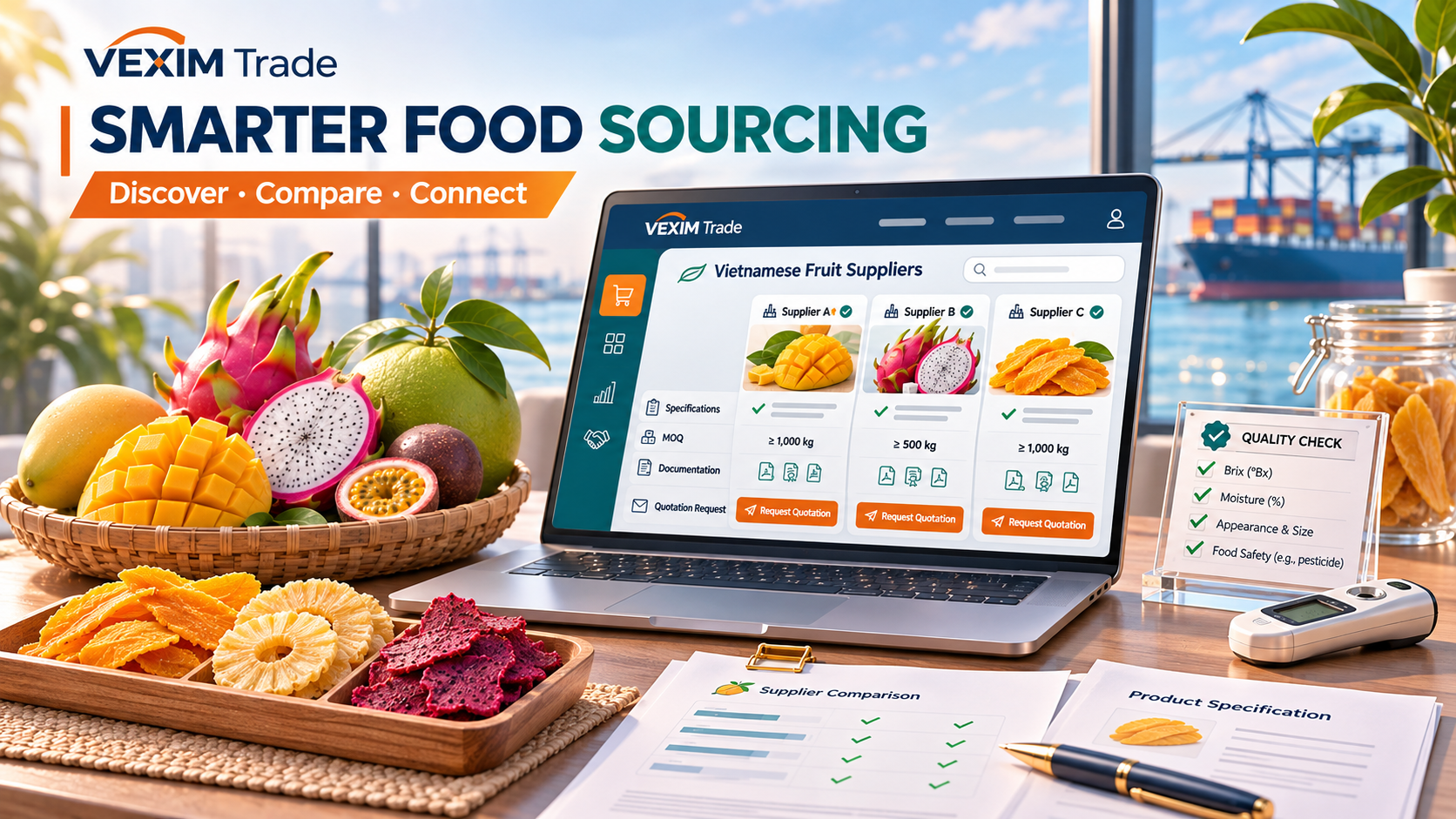
Buyers can begin by searching VEXIM Trade using the product name, category, grade, or supplier. Listings may display product specifications, reference prices, minimum order quantities, lead times, and verification records. The information helps users identify potentially suitable offers, but listing details must be confirmed with the supplier before a commercial agreement is finalized.
For example, VEXIM Trade currently has a category dedicated to Vietnamese dried fruits.
The category includes various processed fruit offers, with filters for purchasing requirements and supplier-related information.
Buyers can explore the available listings without assuming every supplier offers the same specifications or production capacity.
Explore: Vietnamese Dried Fruits on VEXIM Trade.
Step 2: Compare Product Specifications and Supplier Information
VEXIM Trade allows buyers to compare up to three selected products using available information such as specifications, minimum order quantities, export ports, certificates, and reference prices. This helps buyers evaluate differences between offers before contacting suppliers. However, reference prices are indicative and should not be treated as binding quotations for a specific volume or shipment schedule.
A practical comparison should consider more than the listed price.
Buyers should examine processing methods, packaging options, quality requirements, and delivery terms.
They should also review which supplier verification checks have been approved and whether relevant certificates belong to the supplier or a partner entity.
Compare: VEXIM Trade Product Comparison.
Step 3: Review Supplier Verification Evidence
Supplier verification records help buyers understand which company information has been examined by VEXIM Trade. The platform distinguishes business-document reviews, factory or partner-factory contract reviews, and delivery-history checks. These assessments are independent, meaning approval in one area does not establish that all other checks have been completed or that future transactions are guaranteed.
When reviewing a supplier, buyers should pay attention to the precise meaning of each approved badge.
A partner-factory contract does not necessarily establish direct factory ownership or an on-site inspection.
Similarly, reviewed shipment records do not guarantee future delivery performance.
These distinctions support transparent sourcing decisions.
Read: How VEXIM Trade Verifies Suppliers.
Step 4: Submit Product Requirements Through an RFQ
A Request for Quotation allows buyers to describe the product, quantity, specifications, destination, and delivery conditions they require. VEXIM Trade supports requests directed to a selected supplier and open requests for buyers seeking alternative sourcing options. Clear requirements help the platform and potential suppliers assess commercial suitability without implying that every requested product is available.
When a buyer selects a supplier, the request is sent to that supplier first.
If the supplier cannot meet the requirements, VEXIM Trade's buyer guide states that the platform asks permission before suggesting alternatives.
The platform also states that buyer contact information is not shared with suppliers through quotation requests until the buyer approves an introduction.
Buyers negotiate final terms and make payments directly to their chosen suppliers.
Get started: Submit a Sourcing Request.
Which Quality and Import Requirements Should Buyers Check?
Buyers importing Vietnamese fruits and vegetables should verify requirements for the specific commodity, processing format, origin, and destination market. Food safety regulations, labeling rules, permitted treatments, and plant-health restrictions can differ substantially between fresh and processed products. A supplier's export history or platform verification status does not automatically establish compliance for a new shipment.
Recommended Buyer Compliance Checklist
| Area | Questions to confirm |
|---|---|
| Product identity | Is the product description and intended use clear? |
| Specifications | Are the grade, ingredients and quality parameters defined? |
| Traceability | Can relevant batches and production sources be identified? |
| Food safety | Are suitable test results and compliance documents available? |
| Phytosanitary rules | Are special requirements applicable to fresh produce? |
| Storage | Are the temperature and handling conditions appropriate? |
| Packaging | Does packaging protect product integrity and meet buyer needs? |
| Destination regulations | Is the exact product eligible for import? |
| Commercial terms | Are pricing, shipment terms and responsibilities clear? |
For buyers importing into the United States, the U.S. Food and Drug Administration provides guidance on food imports, including applicable food safety, facility registration, prior notice, and Foreign Supplier Verification Program requirements.
For fresh agricultural commodities, USDA APHIS provides a separate database of commodity-specific plant import requirements.
Not all requirements apply identically to every product, so buyers should check the relevant rules before confirming shipment.
Official references:
- U.S. FDA – Importing Food Products into the United States
- USDA APHIS – How to Import Plants and Plant Products
What Information Should Buyers Include in a Fruit and Vegetable Sourcing Request?
A useful sourcing request should clearly describe the product format, quality specifications, quantity, destination, and shipment requirements. International buyers should also identify necessary certifications, preferred packaging, and delivery conditions. The more specific the request, the easier it becomes to determine whether a supplier's products and capabilities are suitable for the intended transaction.
Recommended RFQ Information
| Field | Example information |
|---|---|
| Product category | Fresh, dried, frozen or preserved |
| Specifications | Grade, size, formulation or processing method |
| Quantity | Required volume and unit |
| Packaging | Bulk, retail or industrial packaging |
| Destination | Country and receiving port |
| Shipping terms | Preferred Incoterms |
| Documentation | Required quality and import documents |
| Shipment window | Target dispatch or delivery period |
| Additional requirements | Samples, tests or inspections |
For processed products, buyers may need to provide ingredient restrictions, target shelf life, and labeling specifications.
For fresh products, harvest schedules, transit time, and temperature requirements may be especially relevant.
Accurate RFQs can make supplier comparisons more meaningful, although they do not guarantee product availability, certification acceptance, or final commercial terms.
Frequently Asked Questions About Vietnam Fruit and Vegetable Exports 2026
Vietnam Fruit and Vegetable Exports 2026 have attracted international attention because of growing export revenue and changing seasonal supply patterns. Buyers researching Vietnamese produce often want to know which markets are expanding, how product formats affect purchasing, and where to find supplier information. The following answers address common questions relevant to B2B food sourcing.
1. How Much Did Vietnam Export in Fruits and Vegetables in 2026?
Vietnam's fruit and vegetable exports exceeded an estimated $8.27 billion during January–October 2026, representing 17.2% year-on-year growth. These figures are preliminary and include multiple fresh and processed product categories. They should not be described as the final export value for the entire calendar year, since November and December trade activity has not yet been included.
2. Which Countries Are the Main Buyers of Vietnamese Fruits and Vegetables?
China is Vietnam's largest fruit and vegetable export market, followed by important destinations such as the United States, South Korea, Japan, and the Netherlands. China accounted for more than 64.8% of export value during the first nine months of 2026. Import opportunities in each market still depend on product-specific regulations and commercial demand.
3. Can Buyers Source Processed Fruits Through VEXIM Trade?
Yes. VEXIM Trade has an established dried-fruit category containing listings from Vietnamese suppliers. Buyers can examine available products, compare relevant details, and request quotations. Availability of a particular dried, frozen, canned, or fresh product must be checked individually. Buyers can submit an open sourcing request when their requirements do not match existing listings.
4. Does VEXIM Trade Guarantee Supplier Quality or Delivery?
No. VEXIM Trade's verification badges identify specific evidence reviews approved by its team. They do not guarantee quality, delivery, or commercial outcomes. Buyers should confirm product samples, certificates, batch inspection requirements, and payment conditions before ordering. The final commercial contract is established directly between the buyer and the chosen supplier.
5. Are All Vietnamese Fresh Fruits Allowed Into the United States?
No. Import eligibility varies by commodity and country of origin. Some fruits and vegetables require specific phytosanitary conditions, treatments, or other approvals. Buyers should check the USDA APHIS Agricultural Commodity Import Requirements database and applicable FDA requirements before arranging shipments. A product's availability for export from Vietnam does not automatically establish eligibility for U.S. import.
What Is the Outlook for Vietnam's Fruit and Vegetable Market in Late 2026?
Vietnam's fruit and vegetable sector entered the final months of 2026 with strong cumulative export growth, although monthly volumes remained subject to seasonal changes. Year-end demand and the availability of alternative fresh and processed products could support further export activity. Actual results will depend on market conditions, product quality, regulatory compliance, and supplier capacity.
For international buyers, the key opportunity is not simply purchasing from a rapidly growing export market.
It is identifying suitable products and suppliers through clear, comparable, and verifiable commercial information.
As Vietnam's food and agricultural trade continues to develop, digital sourcing platforms can help buyers research available offers and communicate purchasing requirements more efficiently.
Explore Vietnamese Food and Agricultural Suppliers on VEXIM Trade
VEXIM Trade connects international buyers with Vietnamese food and agricultural suppliers through searchable product listings, product comparisons, supplier verification information, and quotation requests. Buyers can explore available offers, assess the scope of completed supplier reviews, and submit product requirements while retaining responsibility for their own purchasing decisions and final supplier contracts.
Explore sourcing opportunities through VEXIM Trade:
Browse Vietnamese Food and Agricultural Products
Understand Supplier Verification
Submit a Request for Quotation
VEXIM Trade — Explore Products. Compare Suppliers. Source with Confidence.
References
- Nhan Dan, October 29, 2026 – Fruit and Vegetable Exports Exceed $8.27 Billion in First Ten Months
- VnEconomy, October 14, 2026 – Fruit and Vegetable Exports Top $7.35 Billion in Nine Months
- VEXIM Trade – Dried Fruits Marketplace
- VEXIM Trade – How Sourcing Works for Buyers
- VEXIM Trade – Supplier Verification
- U.S. FDA – Importing Food Products into the United States
- USDA APHIS – How to Import Plants and Plant Products
Editorial cutoff: November 3, 2026. The export estimates are the latest figures reviewed, originally reported on October 29. The article provides general market and sourcing information, not product-specific customs or legal advice.
Sourcing request
Have a product in mind? Send us your brief.
We match it to a Vietnamese producer that fits, and tell you plainly when none does. A written reply by the start of your next business day.
Request a quoteRelated news
October 28, 2026
Vietnam EFTA Free Trade Agreement 2026: New Opportunities for Global BuyersOctober 28, 2026
Vietnam Trade October 2026: $945 Billion and What Global Buyers Should KnowNovember 3, 2026
Verified Vietnamese Food Suppliers in 2026: A Buyer’s Guide After Vietnam’s $1 Trillion Trade Milestone