
CIIE 2026 Vietnamese Food Suppliers: 80 Exhibitors and a B2B Buyer Guide
CIIE 2026 brings 80 Vietnamese food and beverage businesses to Shanghai from November 5–10. Vietnam's largest commercial pavilion at the expo spotlights processed foods, agricultural ingredients, beverages and new cross-border promotion methods. This guide explains what international buyers should verify, how China's food-import registration requirements apply, and how VEXIM Trade supports supplier research, product comparisons and quotation requests beyond the exhibition.
By Dang Duc Dung·Published
In this article
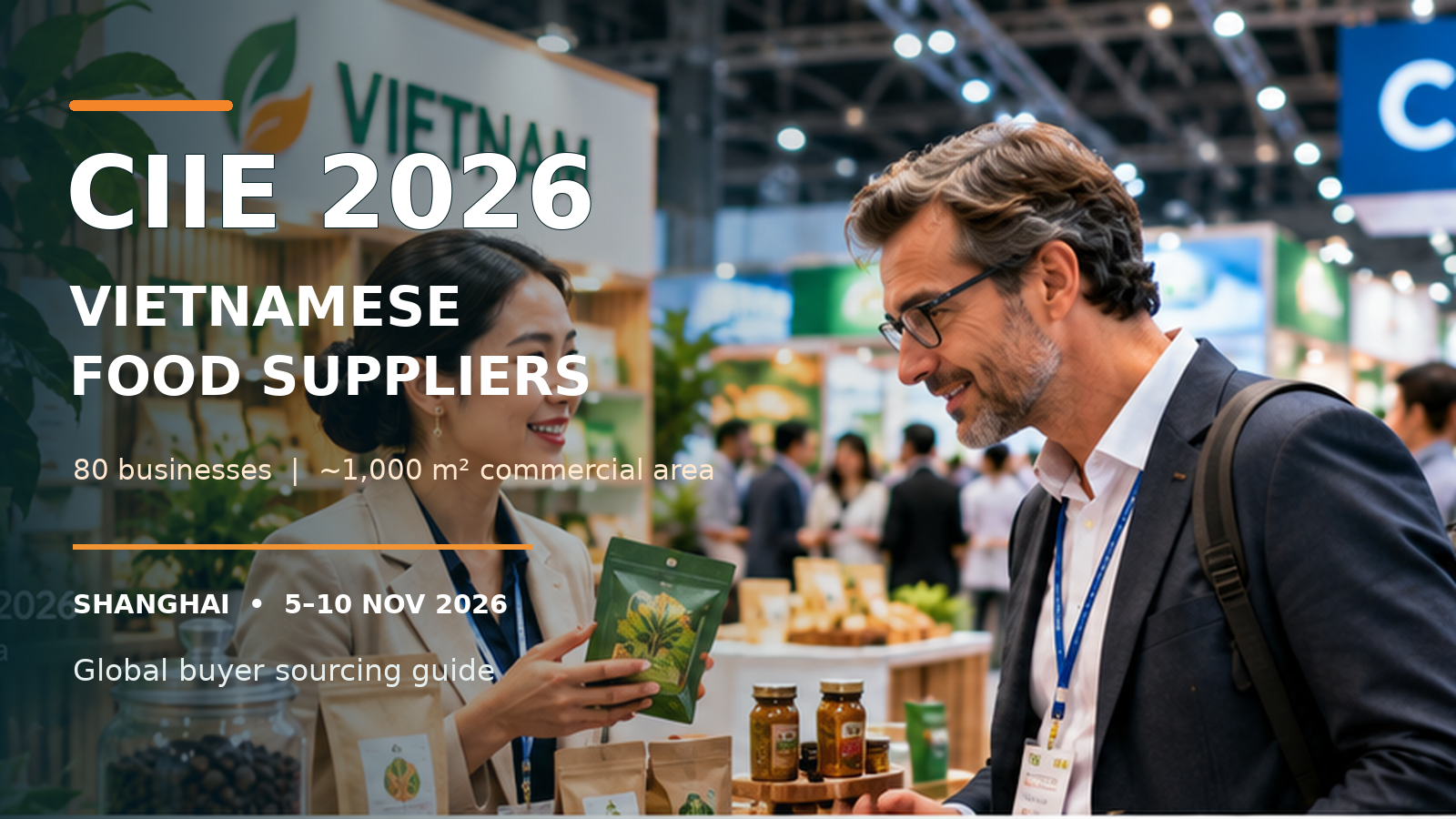
CIIE 2026 Vietnamese food suppliers are gaining international attention as 80 Vietnamese food and beverage businesses participate in the ninth China International Import Expo in Shanghai from November 5 to 10, 2026. According to Vietnam's Ministry of Industry and Trade, the country's commercial exhibition area spans approximately 1,000 square meters, its largest at the event to date.
The November 5 report also highlighted a new approach to promoting Vietnamese products: combining physical exhibition activities with cross-border e-commerce, including a Douyin Mega Livestream organized in cooperation with the Vietnam Trade Promotion Agency.
For international buyers, the exhibition provides an opportunity to explore Vietnamese food manufacturers and exporters. However, participation in CIIE does not automatically establish supplier reliability, product compliance, or eligibility for import into China.
This article examines Vietnam's presence at CIIE 2026, China's current food import requirements, and practical ways buyers can research, compare, and connect with Vietnamese suppliers through VEXIM Trade.
1. CIIE 2026 Vietnamese Food Suppliers: What Happened on November 5?
CIIE 2026 opened in Shanghai on November 5, bringing together international exhibitors and import-focused business activities. Vietnam's Ministry of Industry and Trade confirmed that 80 Vietnamese food and beverage businesses are participating in a commercial exhibition area of approximately 1,000 square meters. The Vietnamese presence includes a separate national pavilion, reflecting efforts to promote products and expand commercial cooperation with Chinese partners.
The ninth China International Import Expo runs from November 5 to 10 at the National Exhibition and Convention Center in Shanghai.
Vietnam's participation is organized through the 2026 National Trade Promotion Program, coordinated by the Vietnam Trade Promotion Agency under the Ministry of Industry and Trade.
The Vietnamese exhibition presence comprises two distinct areas: a national pavilion and a commercial exhibition area.
Key Facts About Vietnam's Participation at CIIE 2026
| Indicator | Confirmed information |
|---|---|
| Event | Ninth China International Import Expo |
| Dates | November 5–10, 2026 |
| Location | Shanghai, China |
| Venue | National Exhibition and Convention Center |
| Vietnamese food and beverage exhibitors | 80 businesses |
| Vietnam commercial exhibition area | Approximately 1,000 m² |
| Vietnam national pavilion | 132 m² |
| Main commercial sectors | Food, beverages and agricultural products |
| News publication date | November 5, 2026 |
Sources: Vietnam Ministry of Industry and Trade, November 5, 2026; Shanghai Municipal Government.
The Ministry described the 1,000-square-meter commercial area as Vietnam's largest participation of this type at CIIE.
The national pavilion, meanwhile, highlights Vietnam's economic development, trade opportunities, investment environment, and broader international cooperation.
Several Vietnamese businesses and regional trade promotion organizations are taking part in the exhibition.
According to the Ministry, the Vietnamese area attracted visitors interested in products and commercial discussions on its opening day.
These early activities demonstrate opportunities for direct engagement, but the final number of successful transactions or long-term supplier relationships cannot be established from the opening-day report alone.
Official source: Ministry of Industry and Trade – Vietnamese Businesses at the Ninth CIIE.
2. Which Vietnamese Food Products Are Being Showcased at CIIE 2026?
Vietnamese exhibitors at CIIE 2026 are showcasing processed fruits and vegetables, beverages, dairy products, spices, sauces, confectionery, coffee, tea, honey, rice-based products, canned foods, and other food categories. The Ministry of Industry and Trade emphasized processed and packaged products within the commercial exhibition. These categories provide buyers with multiple sourcing options, although the exact specifications and availability depend on individual participating companies.

The exhibition reflects the diversity of Vietnam's food manufacturing and agricultural processing industries.
For buyers, the value of this product range lies in the ability to examine different production formats and assess potential supplier capabilities.
However, a broad industry category does not guarantee that a particular product grade, certification, or packaging format is available from every exhibitor.
Vietnamese Product Categories at CIIE 2026
| Product category | Products featured or represented | Key buyer considerations |
|---|---|---|
| Processed fruits and vegetables | Processed agricultural products | Product format, ingredients, shelf life |
| Beverages | Packaged drinks | Formulation, packaging, labeling |
| Coffee and tea | Coffee and tea products | Grade, processing, origin |
| Spices and sauces | Seasonings and condiments | Ingredients, additives, quality |
| Confectionery | Packaged food products | Shelf life, allergens, labeling |
| Rice-based products | Processed rice products | Specifications, processing method |
| Dairy products | Milk and dairy products | Temperature requirements, regulatory eligibility |
| Honey and canned foods | Processed and packaged products | Traceability, safety documentation |
Product categories are based on the Ministry's November 5 report. Buyer considerations are editorial guidance.
What Should Buyers Examine Beyond the Product Display?
Buyers should evaluate the underlying product specifications and supplier capabilities rather than relying solely on attractive exhibition displays. A product sample may demonstrate appearance, packaging, or taste, but commercial suitability also depends on production consistency, available quantities, documentation, and destination-market requirements. These factors should be confirmed before selecting a supplier or requesting a formal quotation.
For processed food products, relevant information may include ingredient composition, production methods, shelf life, packaging, and applicable quality requirements.
For agricultural ingredients, buyers may need to review grades, moisture content, origin information, and storage conditions.
Buyers should also determine whether the exhibitor manufactures the goods directly or operates through a partner factory.
This distinction becomes important when reviewing certificates, manufacturing evidence, and export documentation.
3. Why Is Cross-Border E-Commerce an Important Development at CIIE 2026?
Cross-border e-commerce is playing a more visible role in Vietnam's CIIE 2026 trade promotion activities. According to the Ministry of Industry and Trade, the Vietnam Trade Promotion Agency is cooperating with Douyin E-commerce to organize a Mega Livestream featuring Vietnamese agricultural and food products. The initiative adds an online promotional channel to traditional exhibition activities, but it does not replace commercial import requirements.
The livestream initiative is intended to introduce Vietnamese products to Chinese consumers through a digital platform.
This development reflects the growing combination of physical product promotion and online commercial channels.
However, three activities must be distinguished clearly.
Traditional B2B sourcing involves identifying suppliers, evaluating commercial requirements, requesting quotations, and negotiating business contracts.
Consumer-facing e-commerce focuses on presenting products to consumers through online retail channels, with relevant platform and regulatory requirements.
Trade exhibitions support product discovery, brand exposure, direct meetings, and business networking.
These methods can complement one another, but they do not have identical operating rules or transaction structures.
Does a Livestream Mean a Product Can Automatically Be Imported Into China?
No. Product promotion through a livestream or participation in an international exhibition does not automatically establish eligibility for commercial import into China. Food products may still require compliant manufacturing registration, labeling, product-specific approvals, inspection, or other documentation. Buyers and suppliers must evaluate the applicable requirements for the actual product and trade model before arranging shipments.
A product showcased at CIIE may be intended for market research, promotion, or future commercial distribution.
The customs treatment of exhibition samples should not be assumed to be the same as the treatment of goods imported for normal commercial sale.
China has published customs facilitation measures for CIIE exhibits, but those event-specific procedures do not provide a blanket exemption for later commercial shipments.
For international buyers, the central lesson is to separate product visibility from confirmed import eligibility.
4. What Food Import Requirements Apply to Vietnamese Suppliers Entering China in 2026?
Vietnamese food suppliers entering China must assess the applicable requirements for overseas food manufacturer registration, product classification, food safety, labeling, and customs documentation. China's revised GACC Decree No. 280 took effect on June 1, 2026, replacing Decree No. 248. The new framework remains relevant to food businesses exploring opportunities during CIIE 2026, although specific registration procedures depend on the food category.
China's General Administration of Customs published the revised rules to manage the registration of overseas manufacturers exporting food to China.
The regulations apply to qualifying overseas facilities involved in food production, processing, and storage.
They establish a risk-based registration framework and distinguish categories requiring recommendations from competent authorities from those using other registration procedures.
What Changed Under China's GACC Decree No. 280?
GACC Decree No. 280 introduced revised registration arrangements for overseas food manufacturers, including risk-based management and changes to renewal procedures. The decree became effective on June 1, 2026, and replaced the previous Decree No. 248. Certain food categories require official recommendations from the competent authority of the exporting country, while other applications follow procedures specified by GACC.
The revised framework also includes automatic renewal provisions for eligible registrations.
According to Chinese government information, most registered overseas food enterprises are covered by automatic renewal arrangements, subject to applicable exclusions and compliance requirements.
Businesses should not assume their products qualify for a simplified procedure without checking the relevant category.
China Food Import Compliance Checklist
| Requirement | What buyers and suppliers should verify |
|---|---|
| Manufacturer registration | Whether the manufacturing facility has the required GACC registration |
| Food category | Applicable registration method and product classification |
| Competent authority recommendation | Whether the product category requires official recommendation |
| Product eligibility | Whether the exact food product is permitted for import |
| Food safety | Applicable Chinese standards and product requirements |
| Labeling | Required Chinese-language and other labeling information |
| Packaging | Compliance with packaging and relevant identification rules |
| Documentation | Commercial, origin, inspection and customs documents as applicable |
Sources: GACC Decree No. 280 and official implementation guidance.
An approved business registration document on a sourcing platform is not the same as a required GACC food manufacturer registration.
Similarly, a supplier's previous export experience does not automatically establish that every product it offers is eligible for import into China.
Official reference: China's Revised Regulations for Overseas Food Manufacturers – GACC Decree No. 280.
Will China's Updated Food Labeling Standards Affect Future Shipments?
Yes. China's updated prepackaged food labeling standards, including GB 7718-2025 and GB 28050-2025, are scheduled to enter into force on March 16, 2027. Importers preparing longer-term supply arrangements should review the transition requirements and determine whether future packaging will need adjustment. The announced 2027 implementation date should not be mistaken for a new labeling requirement taking effect at CIIE in November 2026.
The updated standards concern general food labeling and nutritional information for applicable prepackaged foods.
Buyers should review the product's ingredients, label content, country-of-origin information, and relevant registration identifiers against the rules applicable to the shipment.
Exporters planning production for delivery in 2027 may need to consider the transition period when discussing packaging specifications.
Reference: International Trade Administration – China's Food Labeling Requirements.
5. How Can International Buyers Compare Vietnamese Food Suppliers After CIIE 2026?
International buyers can compare Vietnamese food suppliers after CIIE 2026 by organizing information collected during meetings and evaluating companies against consistent purchasing criteria. Supplier identity, product specifications, manufacturing arrangements, relevant certificates, order quantities, and delivery conditions should all be reviewed. A structured comparison helps buyers identify suitable options without assuming that exhibition participation guarantees product quality or export readiness.
The first step is to distinguish what was observed at the exhibition from what has been independently documented.
An attractive product display may support initial interest, but technical and commercial information must still be confirmed.
Recommended Supplier Comparison Framework
| Evaluation criterion | Information required |
|---|---|
| Company identity | Registered business name and legal details |
| Supplier type | Manufacturer, cooperative or trading company |
| Product specification | Grade, ingredients, processing and packaging |
| Manufacturing source | Own factory or partner-factory arrangement |
| Quality documentation | Relevant certificates, holder and validity |
| Import readiness | Applicable China registration and product requirements |
| Minimum order quantity | Commercially available order volume |
| Lead time | Production and shipment preparation |
| Reference quotation | Price, currency, validity and Incoterms |
| Delivery evidence | Available shipment or export records |
Why Should Buyers Separate Supplier Verification From Import Compliance?
Supplier verification and import compliance serve different purposes. Supplier verification helps buyers understand business identity, production relationships, and available transaction evidence. Import compliance determines whether a specific product and shipment satisfy the destination country's legal requirements. A supplier can have legitimate company documents while still needing additional manufacturing registration, product testing, or labeling changes for a particular market.
This distinction is especially relevant to China, where GACC registration and product-specific requirements may apply to overseas food manufacturers.
A certificate displayed on a supplier profile should be examined according to its holder, scope, validity, and intended use.
Buyers should not treat a general business review as proof that every item offered by the supplier meets Chinese customs requirements.
6. How Can VEXIM Trade Support B2B Sourcing Beyond CIIE 2026?
VEXIM Trade supports international buyers by providing searchable Vietnamese food and agricultural product listings, supplier information, comparison tools, and quotation requests. These functions can complement supplier research conducted during or after CIIE 2026. The platform operates independently of the exhibition and does not claim that all Vietnamese CIIE exhibitors are listed, verified, or commercially available through its marketplace.
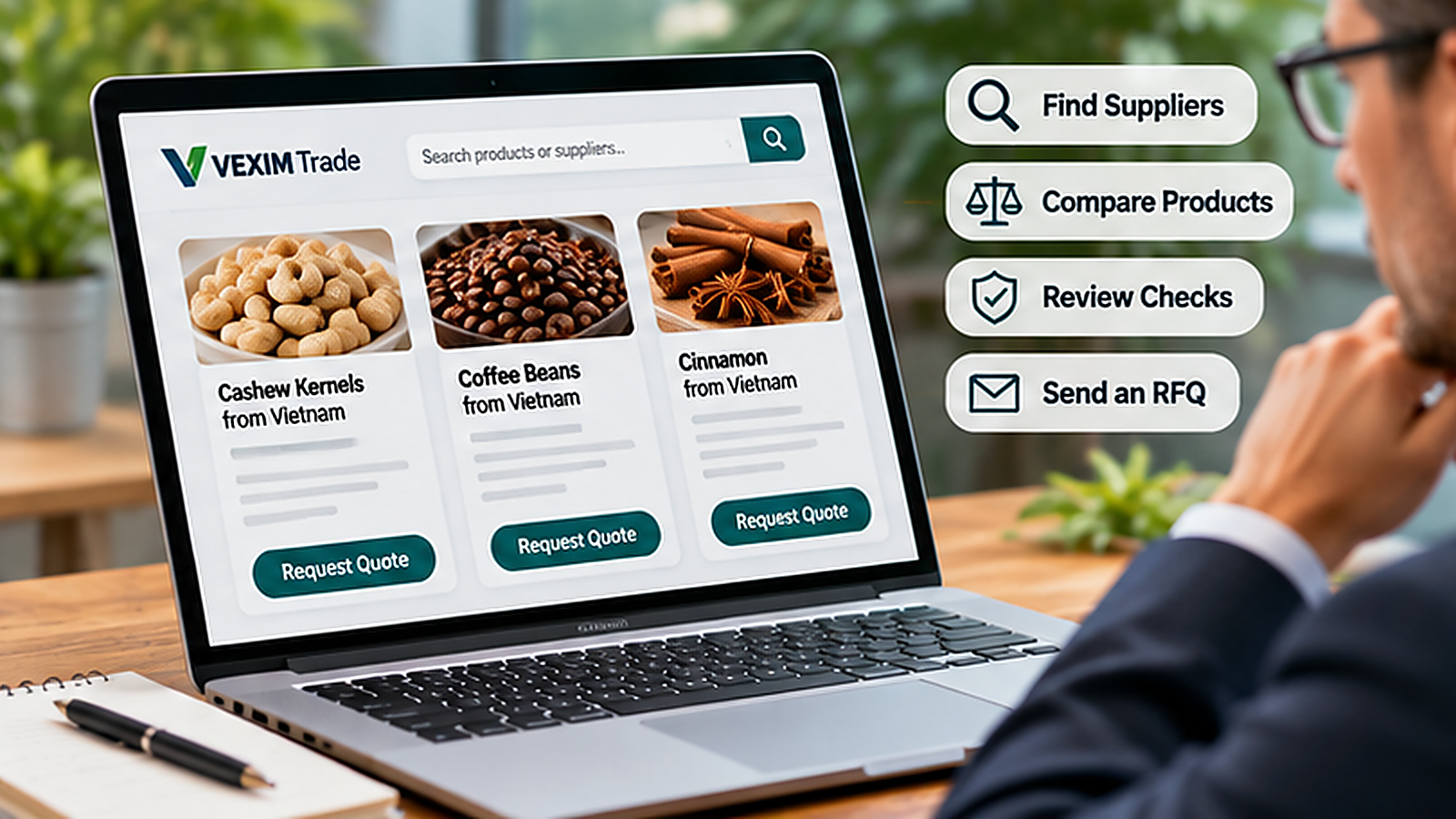
VEXIM Trade is designed to connect buyers with potential Vietnamese suppliers rather than acting as the seller of all listed products.
According to its published buyer guide, the sourcing process includes searching products, comparing information, reviewing available supplier checks, and requesting quotations.
Step 1. Find Relevant Products and Supplier Listings
Buyers can search VEXIM Trade by product name, grade, or category to identify available Vietnamese food and agricultural offers. Product listings provide information that may include specifications, minimum order quantities, lead times, and reference prices. The search process helps buyers narrow their options, but it does not guarantee that a particular CIIE exhibitor or product is available on the platform.
Current marketplace categories include food ingredients and processed agricultural products.
Buyers should begin with the exact product requirements rather than relying on broad category names.
If an appropriate listing is unavailable, they can use the platform's custom sourcing request process.
Explore: VEXIM Trade Marketplace.
Step 2. Compare Available Specifications and Commercial Terms
VEXIM Trade's buyer guide describes a product comparison feature that allows users to compare up to three selected products. Available fields include specifications, minimum order quantities, export ports, certificates, and reference prices. This supports initial research by making important differences visible, but buyers must confirm final product availability and commercial conditions directly with the relevant supplier.
Two products may appear similar while differing in packaging, processing methods, quality requirements, or delivery arrangements.
Reference prices should not be treated as final contractual quotations.
Buyers should also account for transport costs, customs obligations, and other expenses when evaluating the total landed cost.
Buyer guide: How Sourcing Works on VEXIM Trade.
Step 3. Review Supplier Checks and Supporting Information
Buyers can review VEXIM Trade supplier profiles to understand which independent checks have been approved. The platform distinguishes business documentation, factory evidence or partner-factory contracts, and relevant shipment history. Each check has a defined scope, and approval in one area does not automatically indicate approval in another or establish that a product satisfies import requirements.
VEXIM Trade's Three Supplier Checks
| Check | Information reviewed | Important limitation |
|---|---|---|
| Business documents | Company registration and submitted business information | Does not independently verify all tax or banking details |
| Production source | Factory evidence or partner-factory contract | A contract does not prove factory ownership or on-site inspection |
| Export history | Relevant shipment evidence | Does not guarantee future delivery or product quality |
Source: VEXIM Trade Platform Operating Rules, updated November 1, 2026.
Buyers should examine the individual status of each check rather than interpreting a badge as a universal guarantee.
Learn more: How VEXIM Trade Verifies Suppliers.
Step 4. Submit an RFQ and Confirm Supplier Suitability
A Request for Quotation allows buyers to specify product requirements, expected volume, packaging, destination, and preferred commercial conditions. VEXIM Trade supports enquiries directed to a selected supplier as well as open requests when a buyer has not identified a suitable company. Supplier availability, final quotations, and contractual terms remain subject to confirmation.
A clear sourcing request should include:
- Exact product name and technical specifications.
- Required quantity and minimum order considerations.
- Packaging and labeling requirements.
- Destination country and port.
- Preferred Incoterms and shipment window.
- Applicable certificates, testing, or registration requirements.
- Sample and inspection expectations.
VEXIM Trade states that an initial update is provided within one business day; this does not guarantee a completed supplier match or binding quotation within that period.
Buyers approve introductions before their email addresses and telephone numbers are shared with suppliers through quote requests.
Final contracts and payments are handled directly between buyers and their chosen suppliers.
7. What Should Vietnamese Food Suppliers Prepare After CIIE 2026?
Vietnamese food suppliers seeking to develop international relationships after CIIE 2026 should prepare accurate company information, detailed product specifications, relevant manufacturing documents, and realistic commercial terms. Exhibition participation may generate business enquiries, but buyers need reliable information to evaluate suppliers after initial meetings. Digital supplier profiles and clear RFQ responses can support this follow-up process.
Five Actions for Vietnamese Food Suppliers
| Step | Recommended action | Expected result |
|---|---|---|
| 1 | Update business registration and company information | Clear supplier identity |
| 2 | Describe actual production and partner-factory arrangements | Transparent manufacturing source |
| 3 | Standardize product specifications, MOQ and lead times | Easier comparison for buyers |
| 4 | Review certificates and China-market compliance where relevant | Better documentation readiness |
| 5 | Maintain current product listings and respond to enquiries | More effective buyer communication |
Suppliers should avoid claiming that participation at CIIE automatically means they are approved for commercial imports into China.
Manufacturers and trading companies should also distinguish clearly between their own production facilities and external manufacturing partners.
For suppliers interested in developing a presence on a B2B sourcing platform, accurate product and company information is more useful than unsupported promotional claims.
Supplier information: Join VEXIM Trade as a Vietnamese Supplier.
Account registration does not automatically mean the supplier has been published or fully verified.
8. Frequently Asked Questions About CIIE 2026 Vietnamese Food Suppliers
CIIE 2026 Vietnamese food suppliers have attracted attention through their participation in Shanghai's major import exhibition. International buyers may want to understand the number of participating businesses, featured products, China's import requirements, and how to find suitable suppliers after the event. These answers distinguish confirmed exhibition information from supplier-specific capabilities and commercial obligations.
1. How Many Vietnamese Food Suppliers Are Participating in CIIE 2026?
Vietnam's Ministry of Industry and Trade reported that 80 Vietnamese food and beverage businesses are participating in the country's commercial exhibition area at CIIE 2026. The area covers approximately 1,000 square meters and is Vietnam's largest commercial presence of this type at the event. These figures refer to the Vietnamese commercial exhibition, not the total number of CIIE exhibitors.
2. When and Where Is CIIE 2026 Taking Place?
The ninth China International Import Expo takes place from November 5 to 10, 2026, at the National Exhibition and Convention Center in Shanghai, China. The exhibition opened on November 5, and Vietnam's participation was reported by the Ministry of Industry and Trade that evening. Visitors should consult official event information for schedules and access arrangements.
3. Which Vietnamese Food Products Are Featured at CIIE 2026?
Vietnamese exhibitors are presenting processed fruits and vegetables, beverages, dairy products, spices, sauces, confectionery, coffee, tea, honey, rice-based products, and other packaged foods. The exact selection varies by exhibitor. Buyers should request product specifications and supporting documents from each company rather than assuming that all participating businesses manufacture or export the same product categories.
4. Do Vietnamese Food Suppliers Need GACC Registration to Export to China?
Overseas food manufacturers exporting products to China are subject to the relevant GACC registration framework. Decree No. 280 took effect on June 1, 2026, replacing Decree No. 248. Registration procedures depend on the product category and applicable requirements, including official recommendations for certain categories. Buyers should verify the manufacturing facility's status before arranging commercial imports.
5. Does Participation in CIIE 2026 Guarantee That a Supplier Is Reliable?
No. Participation in CIIE demonstrates involvement in a trade exhibition, not a guarantee of company legitimacy, product quality, regulatory compliance, or delivery performance. Buyers should review supporting business documents, manufacturing arrangements, certificates, and commercial terms. Where appropriate, independent inspections, product testing, and supplier due diligence remain necessary before confirming an order.
6. Can Buyers Find Vietnamese Food Suppliers Through VEXIM Trade After CIIE?
Yes. VEXIM Trade allows buyers to explore listed Vietnamese food and agricultural suppliers, compare available product information, review individual supplier checks, and submit quotation requests. However, the platform is independent of CIIE and does not guarantee that every exhibitor is listed. Buyers can submit requirements for potential sourcing options subject to supplier availability.
7. Can VEXIM Trade Verify Whether a Food Product Meets All Chinese Import Requirements?
No. VEXIM Trade's supplier checks relate to defined categories of business documents, production-source evidence, and shipment history. These checks do not replace GACC registration, applicable product approvals, import inspections, or destination-market compliance verification. Buyers and suppliers must confirm the legal requirements for each product and shipment with the appropriate authorities or qualified professionals.
9. Conclusion: What Does CIIE 2026 Mean for Vietnamese B2B Sourcing?
CIIE 2026 highlights Vietnam's continued efforts to connect its food and agricultural businesses with international buyers. The participation of 80 food and beverage companies, together with online promotional activities, demonstrates the growing combination of physical trade events and digital channels. However, successful commercial sourcing still depends on product suitability, supplier transparency, regulatory compliance, and verified transaction terms.
For international buyers, the exhibition provides an opportunity to discover products and initiate business relationships.
For Vietnamese suppliers, it creates an occasion to present capabilities and understand market expectations.
Beyond the exhibition, accurate supplier profiles, clear specifications, supporting documents, and structured quotation processes can help both sides evaluate potential cooperation.
VEXIM Trade supports this process as an independent B2B platform for Vietnamese food and agricultural sourcing.
10. Explore Vietnamese Food Suppliers Through VEXIM Trade
VEXIM Trade connects international buyers with potential Vietnamese food and agricultural suppliers through searchable listings, product information, supplier verification records, and quotation requests. Buyers can research available options and select businesses for further discussions, while suppliers can present their actual capabilities and supporting documentation. Final commercial agreements, product approvals, and payments remain the responsibility of the participating parties.
For international buyers: Explore listed products, compare specifications, review supplier records, and submit detailed sourcing requirements.
For Vietnamese suppliers: Prepare accurate company documents, maintain current product information, and apply for platform review.
Explore Vietnamese Food and Agricultural Suppliers
Understand Supplier Verification
Information for Vietnamese Suppliers
VEXIM Trade — Discover Products. Review Suppliers. Connect Directly.
Official References
- Vietnam Ministry of Industry and Trade – Vietnamese Businesses at the Ninth China International Import Expo, November 5, 2026
- Shanghai Municipal Government – Major Trade Exhibitions in November 2026
- General Administration of Customs of China – Decree No. 280, Effective June 1, 2026
- Chinese Government – Revised Overseas Food Manufacturer Registration Rules
- U.S. International Trade Administration – China Food Labeling and Marking Requirements
- VEXIM Trade – How Sourcing Works for Buyers
- VEXIM Trade – Supplier Verification Process
- VEXIM Trade – Platform Operating Rules, November 1, 2026
Editorial cutoff: November 6, 2026. Information about CIIE reflects the Ministry of Industry and Trade's November 5 report. The exhibition continues through November 10. Import requirements depend on the specific product and transaction. VEXIM Trade is not presented as an organizer, sponsor, or official partner of CIIE 2026.
Sourcing request
Have a product in mind? Send us your brief.
We match it to a Vietnamese producer that fits, and tell you plainly when none does. A written reply by the start of your next business day.
Request a quote